

This article first appeared in The Edge Malaysia Weekly on August 17, 2026 - August 23, 2026
ISLAMIC finance is entering a new phase in which the biggest opportunity for financial institutions may lie not simply in expanding the pool of shariah-compliant capital but in connecting regions that are becoming increasingly intertwined through trade, investment and financial flows.
This is a key emerging trend identified by Standard Chartered plc’s (StanChart) Islamic banking business as geopolitical tensions, tariff disputes, supply-chain and energy disruptions push countries and companies to diversify their economic relationships.
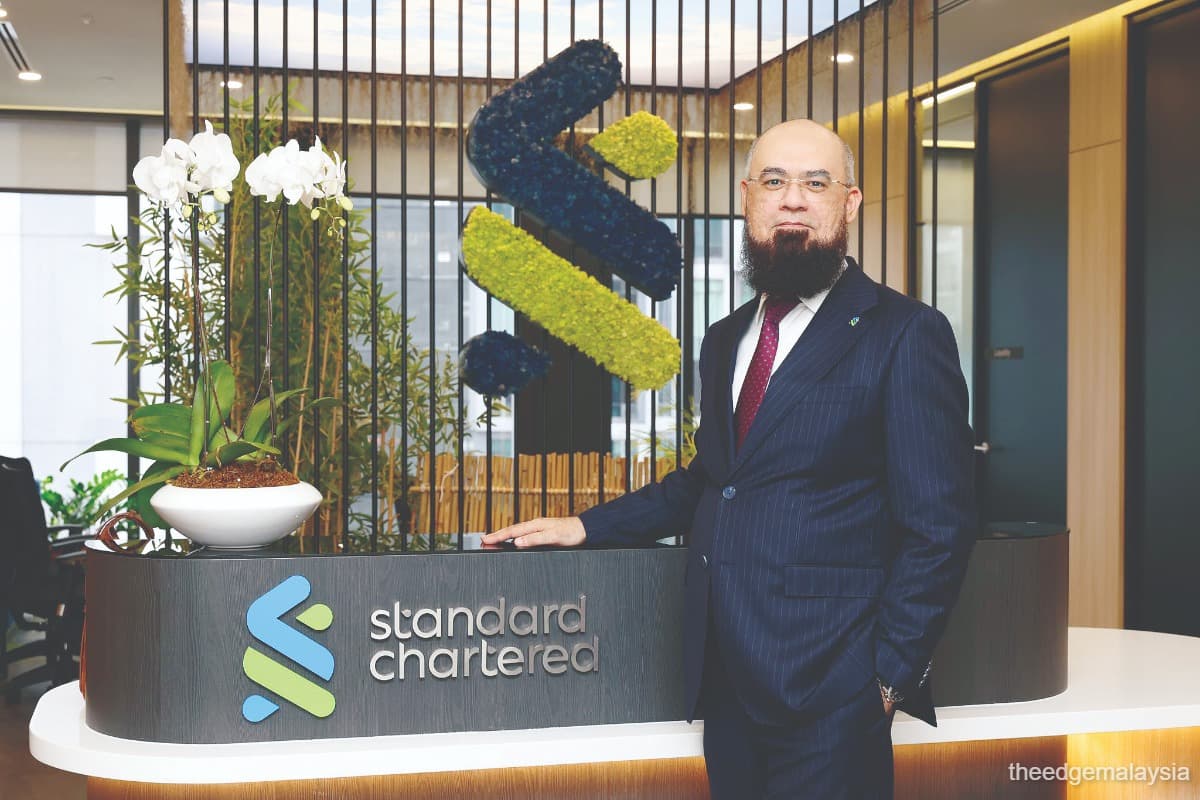
StanChart CEO of group Islamic banking Khurram Hilal says the industry is moving into what he describes as an “Islamic finance connector era”, with the Middle East, Asia, Africa and other emerging markets looking for more efficient ways to channel capital and liquidity across borders.
The global Islamic finance industry is already estimated at US$6 trillion (RM24.5 trillion) across banking, sukuk, asset management and other segments, with StanChart projecting it will reach US$9 trillion by 2030.
“The story in Islamic finance has been that of massive growth in terms of capital and liquidity so far,” Dubai-based Khurram tells The Edge in an interview in Kuala Lumpur, drawing on more than two decades’ experience in the sector.
“But what we see is a shift in the narrative, which is now more focused on how we can leverage Islamic finance as a tool to connect regions.”
The trend has become more pronounced as countries and companies reassess their dependence on individual trading partners, following tariff disputes and geopolitical tensions.
“The more diversified your supply chain and institutional linkages are, the more ready you are to manage these types of shocks, [and] the more resilient your financial system, your balance sheet is,” Khurram says.
He says Islamic finance could facilitate the movement of capital and liquidity between regions while providing a common financial framework for investors and borrowers.
The China opportunity
The opportunity is particularly significant between Asia and the Middle East, where trade and investment ties have deepened in recent years.
China, for example, is now Saudi Arabia’s largest trading partner, having overtaken the US, Khurram notes. As Chinese companies become more active in the Middle East, they will increasingly need to understand Islamic finance, given the size of shariah-compliant banking in the region.
According to Khurram, around 85% of Saudi Arabia’s banking sector is shariah-compliant, and Islamic banking accounts for 25% to 30% of the banking sector across the rest of the Gulf Cooperation Council. In Pakistan, efforts are underway to convert the entire financial sector to become shariah-compliant by January 2028.
“That’s why we are saying to Asia — to China and other Asian partners — that, as you become more active in the Islamic markets, you need to realise the rise of Islamic finance and the medium of exchange is Islamic finance. So, how can we help them build capacity and create the rails through which capital and liquidity can flow swiftly and efficiently? That’s another big area of focus for us,” he says.
StanChart has been engaging Chinese government institutions, banks and corporates on the role Islamic finance can play as China’s trade and investment links with Islamic markets grow. Khurram says the response has been “extremely positive”, including during meetings with several institutions in Beijing last month.
The development of such cross-border links is also relevant to African and South Asian markets, where access to Islamic capital remains relatively limited despite significant infrastructure and development needs.
Global sukuk outstanding crossed US$1 trillion last year, Khurram notes, but the market remains concentrated among select sovereigns, financial institutions and a limited number of geographies.
Only about 6% of sukuk capital reaches Africa and South Asia, according to a StanChart report titled “Islamic banking for financial institutions: The Islamic finance connector era”, released earlier this month. That creates a mismatch between where capital is available and where financing needs are greatest. Khurram was in Kuala Lumpur to launch the report at the bank’s Global Islamic Financial Institutions Forum.
“There are regions that are surplus in capital and liquidity, and there are regions that need that capital and liquidity,” Khurram says.
Islamic finance can help close that gap, but doing so requires more than simply introducing sukuk to a new market. Countries need the appropriate regulatory, legal and tax frameworks to accommodate shariah-compliant structures, which differ from conventional bonds because of their underlying asset-based structures, he points out.
Several African markets, including Egypt, Tanzania and Nigeria, have been working to develop this capability.
Khurram says StanChart has been involved in helping institutions and governments understand how they can access Islamic capital markets, while supporting the groundwork needed to make those markets viable. The potential is substantial because many of these economies require significant infrastructure and development capital.
“With our network spanning markets that are home to around 70% of the world’s Muslim population, we believe we are in the right position, at the right time, to provide that connectivity and coverage to our customers,” he says.
New growth avenues in Malaysia
Bilal Parvaiz, CEO of Standard Chartered Saadiq Bhd, StanChart’s Islamic banking entity in Malaysia, rejects the idea that growth in the country’s Islamic finance sector is stalling.
Bilal highlights that Islamic banking loan growth continues to outpace conventional banking, while the industry is expanding into products and markets that did not exist several years ago.
Citing the Islamic repo market as an example, Bilal says the market was virtually non-existent three years ago but has since developed significantly, with regulatory and industry efforts. StanChart Saadiq is now among the largest participants in the reverse repo market, with its exposure exceeding RM3 billion.
Bilal notes that the scale of transactions being financed through Islamic structures is also growing. He points to a RM15 billion-equivalent multicurrency green financing package secured by WG Data Hub Sdn Bhd last year to fund data centres in Johor, highlighting the depth of liquidity available in Malaysia’s Islamic banking market. The transaction was the largest syndicated Islamic facility of its kind in the country, with StanChart among the joint leads.
“I don’t see any stalling. I actually see a lot of value that the Islamic banking industry is bringing, not just by unlocking some of these large investments, but also in the area of sustainable finance,” Bilal remarks.
Meanwhile, an important aspect of the emerging connector trend is that Islamic finance is increasingly attracting “non-faith”-driven investors, notes Khurram. This is particularly evident in the development of new Islamic instruments and the growing participation of conventional investors.
Khurram points to Islamic certificates of deposit as an example. He says StanChart helped establish three certificate of deposit programmes for Islamic financial institutions in the Middle East in 2024. The number increased to eight in 2025, with US$18 billion raised through the programmes last year.
What was particularly notable, he says, was where much of the demand came from. “We had the largest share of channelling liquidity in those certificate of deposit programmes through our trading desk. And when we analysed that data, it was really amazing to see that the majority of that flow came from Asia, and these were Vietnamese money-market funds and Singaporean private banking funds. So, essentially, it was non-faith-driven capital looking at a good credit-quality asset to deploy in, to diversify their exposure into other regions,” he says.
That demonstrates how Islamic finance can function as a broader capital-market connector rather than simply serving investors and borrowers in Muslim-majority economies, he notes.
Impact from conflict contained
Meanwhile, despite geopolitical uncertainty, Khurram says, the impact of the Middle East conflict on Islamic capital markets has so far been contained. The Middle East accounts for about 6% of StanChart’s exposure.
Khurram points out that Middle Eastern markets entered the conflict from a position of relative strength, following record sukuk issuance in 2025 and robust demand in Islamic capital markets.
While markets initially adjusted to the conflict, he says, demand recovered strongly, with recent sukuk transactions attracting substantial investor interest. Khurram cites, for example, the Malaysian government sukuk issuance of US$1.5 billion last month that StanChart helped arrange. The dual-tranche offering was 4.7 times oversubscribed and achieved the tightest-ever spreads for Malaysia’s global sukuk issuances.
The broader message, he says, is that geopolitical shocks may disrupt markets temporarily, but they also reinforce the need for diversification and resilience — precisely the areas where Islamic finance can play a growing role.
Save by subscribing to us for your print and/or digital copy.
P/S: The Edge is also available on Apple's App Store and Android's Google Play.