

This article first appeared in The Edge Malaysia Weekly on August 24, 2026 - August 30, 2026

Malaysia has a growing pension sustainability problem. We have all read the headlines. Pension payments totalled RM38.6 billion, or 11.5% of total government revenue, in 2025. They are estimated to rise to RM42.8 billion (12.5% of revenue) this year, having grown at an annual compounded rate of 7.4% over the past decade, far outpacing the 4.4% growth in revenue. Per the government’s own account, based on the current trajectory, pension payments will balloon to RM120 billion by 2040. Including emoluments and retirement charges, payments for the active and retired civil workforce are budgeted to take up more than 44% of the entire government revenue for 2026.
Every ringgit spent on salaries and pensions is a ringgit that cannot go towards critical capital development. This includes spending on healthcare, education and infrastructure that expands the nation’s capacity for future economic growth.

Pension bill written decades ago
Realistically, there is very little that can be done (and that is politically palatable) to halt the runaway pension expense. This train left the station 25 years ago. Today’s pension bill is the delayed fiscal consequence of the hiring sprees decades earlier.
Malaysia’s civil workforce started expanding sharply in the aftermath of the Asian financial crisis (AFC), both in absolute numbers — from 676,000 in 2000 to 1.27 million in 2018 (excluding police and military) — and as a percentage of population (which should have accounted for the corresponding expansion in public services) (see Charts 1 and 2). Even though the civil workforce increase has moderated somewhat since then, the number of pensioners and the pension bill will continue to accelerate as that cohort gradually ages out of the workforce over the next 20 to 30 years.
Aside from the absolute number of civil servants, pension payments per retiree (calculated based on last drawn salary) are also rising, driven by the steady increase in salaries — emoluments have grown at a compounded annual rate of 3.8% in the last 10 years to 2025, and budgeted to rise a further 7.8% this year — and longer lifespan. In short, the growth in future pension liabilities has been baked in.


An easy and expeditious solution back then …
We can understand the rationale of increased public-sector hiring in the immediate aftermath of the AFC. The economy was in deep recession and confidence suffered severely with the implementation of capital controls. Domestic private and foreign investments shrank. The economy (private sector) was not creating sufficient jobs and absorbing new entrants to the workforce into public service kept the unemployment rate stable at around 3.5% to 3.6%.
But the hiring boom expanded well beyond the AFC years, after those immediate pressures had passed. This begs the question: Is the Malaysian economy not creating sufficient jobs for our expanding workforce? Or is the government incentivising people to join the civil service with overly generous remunerations plus benefits?
After all, civil servants have near lifetime job security, predictable annual increments, bonuses and promotions that are more often tied to seniority than merit (less competition), regular hours and so on. Allowances for civil servants are notably generous. For instance, fixed monthly allowances for housing, civil service and cost of living typically range between RM600 and RM900 depending on grade, occupation type, location and housing arrangements. And then there are other allowances such as for critical services, hazard, on-call and entertainment that could easily lift total monthly allowances well above RM1,000 for certain roles. And let’s not forget the lifelong pension — and then derived pension for the retirees’ surviving spouses and underage children.

All in all, new graduates entering the public sector can expect to earn RM3,000 to RM4,000 a month, higher than the average/median starting wage of around RM2,500 to RM3,000 in the private sector, on average.
For the government, an expanded civil service is a convenient tool for social distribution; for instance, redistribution towards less-developed states. More importantly, to keep the national unemployment rate low and stable.
Stable employment, steadily rising wages and upward mobility are essential for social cohesion and political stability, and reinforce public confidence in the economic system. Plus, of course, the civil workforce is historically seen as a huge and dependable voting bloc for the incumbent government, at least prior to 2018.
… with broad long-term negative consequences
As a result of this civil service expansion, there are nearly one million pension beneficiaries currently, up from less than 763,000 just 10 years ago — and rising. This includes some 250,000 derived beneficiaries. Malaysia now has 1.3 million active civil servants, the majority of whom will eventually become pension recipients. In a nutshell, the pension bill will continue to snowball for decades to come.
Total spending on emoluments and pension as a percentage of government revenue and percentage of gross domestic product (GDP) are already the highest among our neighbours (see Charts 4 and 5).


The situation will become increasingly untenable as Malaysia ages. By 2040, it is estimated that the number of working adults per retiree will shrink from approximately 8.8 to just 4.6. In other words, fewer working people paying taxes into the government coffers, which, in turn, pay for the ballooning pension payments. The government estimates pension payments will grow to RM120 billion by then.
Large and rising wage and pension bills must be paid for — primarily from a combination of higher revenue (taxes), increased borrowings and/or cutting back on development expenditures. Clearly, all these options are negative for the broader economy.
We have previously articulated why the government must focus on cutting expenses instead of raising taxes — for the very simple reason that higher taxes disincentivise work and investments. Higher income taxes reduce disposable incomes and consumption potential. Rising sales and service tax (SST) raises the cost of living for every Malaysian.
Increasing government borrowing crowds out the private sector and leads to higher interest payments, which are ultimately also not sustainable. Malaysia’s debt-to-GDP is high, at over 65%. Debt servicing is projected to cost RM58.3 billion in 2026, eating up 17% of total government revenue.
And as we have mentioned at the start of this article, allocating less and less money for development, infrastructure, research and development, and other productive investments will lead to even worse outcomes. It will stunt the nation’s productive capacity to generate economic growth and, in turn, future tax revenue, reinforcing the vicious cycle.
Impact beyond fiscal sustainability
Critically, the long-term consequences of a large civil workforce extend beyond fiscal sustainability. Aside from competing for funding, overly attractive civil service benefits divert labour and talent from the private sector.
It also risks reducing economic dynamism. For most people, joining the civil service means lifetime employment and, thereafter, lifelong pension. That perceived security significantly reduces the motivation to change jobs — labour mobility is one of the primary mechanisms for diffusing accumulated experience and skills to other parts of the economy — learn new skills or innovate, and weakens productivity growth as well as discourages entrepreneurship because leaving becomes costly.
There is a danger in institutional accumulation, as the government expands the civil workforce. It is easy to create new positions and agencies to absorb new recruits but thereafter, near impossible to abolish or merge existing ones. As more agencies and layers of management are created, they overlap in terms of responsibilities and approvals. Regulations and compliance requirements rise to justify the expansion. Bureaucracy increases, coordination becomes more difficult and decision-making slows.
The expectation of lifetime employment reduces the incentive to continuously improve performance, to reorganise, adopt new technologies and processes as the environment changes. Outdated positions continue to be filled. Public sector effectiveness and efficiency decline. Productivity deteriorates. Accountability falls when responsibility lines blur. Rent-seeking opportunities grow.
Excessive bureaucracy becomes a burden to firms, adding to the cost of doing business particularly for micro, small and medium enterprises (MSMEs). All of which makes investing less attractive and Malaysian businesses less competitive globally.

The road to reducing pension bill will be long
Malaysia is not alone in facing a growing and unsustainable pension bill. Expanding the civil service and giving away benefits are easy but shrinking headcount and/or reducing said benefits are near impossible.
Case in point: France has tried pension reform almost continuously since the 1990s, including raising the retirement age, increasing contribution years, reducing special schemes and changing indexation. Almost every type of reform triggered nationwide strikes, transport shutdowns, demonstrations and political instability — that ends with watered-down reforms.
We recently highlighted the authoritarian government of Vietnam’s success in slimming down its civil workforce, which included big cuts in the number of ministries and agencies, merging of 63 provinces into 34 and abolishing the entire district-level tier of government and 705 administrative units — collapsing its four-tier system of governance into three.
The takeaway: Pension reform (and reforms in general) is difficult to implement because it is an extremely politically sensitive issue. But the task becomes significantly more challenging for democratically elected governments that need to win elections through the popular vote.
That said, there are nations that have reformed their pension systems with relative success. For instance, Hong Kong inherited a pension system from the British that was remarkably similar to Malaysia’s. In June 2000, its government shifted all new hires to a defined contribution model — replacing lifetime pension with employer-employee contributions and accumulated investment returns.
This is similar to the Employees Provident Fund (EPF). All benefits for existing civil servants were retained. Over time, pension liabilities are gradually reduced as employees (hired pre-2000) retire and pass away.
Singapore recognised very early on that a pension system would eventually be unsustainably expensive. Hence, beginning in 1986, new civil recruits were placed under the Central Provident Fund retirement scheme. Today, the majority of its civil workforce are under CPF with only the old-timers still on the pension scheme. As such, the city state does not have to deal with enormous pension bills coming due.
In both the Hong Kong and Singapore cases, the investment and longevity risks of unfunded pension — paid for from an annual government budget — was shifted away from taxpayers. Yes, the results require decades to fully manifest, but the impact is gradual and manageable. Importantly, the government retains control over the transition.
Contrast this with Greece. The nation was forced into abrupt reforms only after the sovereign debt crisis hit, the result of persistent budget deficits and deteriorating fiscal position. Its pension crisis is one of the clearest examples of what can happen when a generous pension system collides with ageing demographics, a large public sector, weak tax collection and years of fiscal mismanagement. The Greek government had to make multiple and drastic cuts to pension benefits and raise the retirement age — at enormous economic and social cost. The nation fell into a deep recession. Unemployment exceeded 27% at its worst. Many retirees suffered in poverty as their pension incomes were slashed. There were mass demonstrations and protests, at times violent, and political instability.
The lesson: Successive Greek governments recognised the fiscal unsustainability and need for reforms. Yet, they waited until the country lost market confidence. And ultimately, Greece lost the ability to institute reforms on its own terms and pace (as in the case of Hong Kong and Singapore). Its pension reforms were harsh, dictated as conditions under multiple bailout programmes (from the International Monetary Fund, European Central Bank and European Union). In short, delaying politically unpopular reforms until too late will eventually be extremely painful for the people. Surely a cautionary example if there ever was one.
The longer the delay, the higher the eventual cost
Malaysia is not Greece. But danger signs are clear. We are already late in the game, having procrastinated over pension reform for years without action. It was only in February 2024 that new employees were recruited under temporary, non-pensionable three-year contracts pending finalisation of a new contribution-based retirement scheme. As of today, the government is still fine-tuning this scheme.
Malaysia already has an established defined contribution model for all private sector employees in the EPF. Therefore, unlike some nations, it does not have to “reinvent the wheel”. That makes reform easier and more acceptable since the scheme is well understood.
To be sure, pension reform will raise expenses because the government must finance two systems — paying pension while also contributing to EPF for new recruits — simultaneously during the transition. But delaying reform will lead to much higher cost in the future.
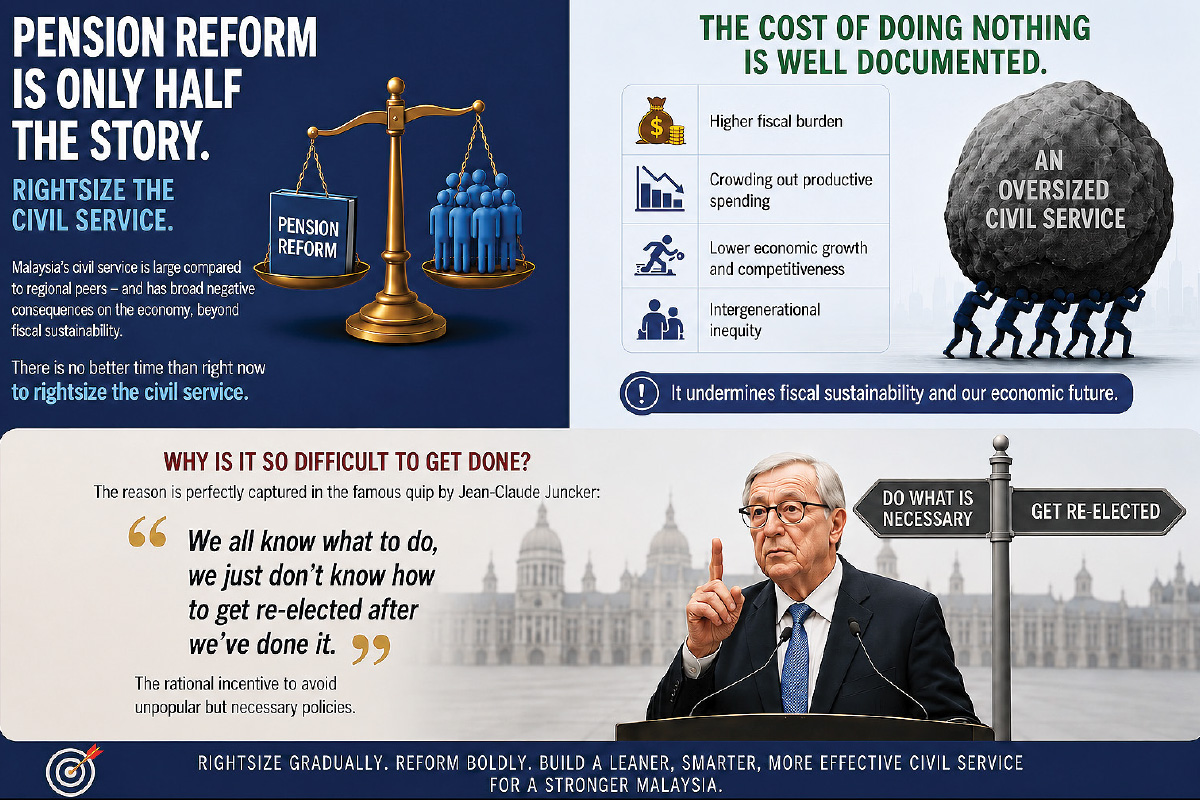
Pension reform is only half the story. As we have articulated above, Malaysia’s civil service is large compared to that of regional peers — and has broad negative consequences on the economy, beyond fiscal sustainability. There is no better time than right now to rightsize the civil service.
We are not suggesting massive retrenchment. But surely, every digitised government service and increasing proliferation of artificial intelligence tools will enable more to be done with less. Integrate government databases, remove duplicative application and approval processes. Some administrative work can be automated to improve productivity. These are low-hanging fruits.
Shrink the civil service gradually through natural attrition. For instance, Italy, post-eurozone sovereign debt crisis, imposed a strict hiring cap, starting with only one new hire for every five retirees (measured by personnel cost), before gradually relaxing this requirement as public finances improved.
The cost of doing nothing is well documented and fairly well understood, we think. The reason why it is difficult to get done is perfectly captured in the famous quip by Jean-Claude Juncker, “We all know what to do, we just don’t know how to get re-elected after we’ve done it.” The rational incentive to avoid unpopular but necessary policies.

Portfolio commentary
The Malaysian Portfolio fell 0.8% for the week ended Aug 19. The two gaining stocks were Hong Leong Industries (+1.8%) and Malayan Banking (+0.4%), while the big losers include United Plantations (-4.8%), Kim Loong Resources (-1.8%) and LPI Capital (-1.2%). Total portfolio returns declined to 220.2% since inception. Nevertheless, this portfolio continues to outperform the benchmark FBM KLCI, which is down 5.4% over the same period.
The Absolute Returns Portfolio was similarly down 0.8% last week. Total portfolio returns now stand at 33.9% since inception. The top gainers were Singapore Technologies Engineering Ltd (+7.1%), Sun Hung Kai Properties (+2.3%) and Thermo Fisher Scientific (+1.7%), while the biggest losers were Talen Energy Corp (-11.7%), Schneider Electric (-4.3%) and Nvidia Corp (-2.9%).
Elsewhere, the AI Portfolio also closed in the red, falling 2.6% and paring total portfolio returns to 28.7% since inception. The top gainers were Marvell Technology, Inc (+9.3%), Unusual Machines (+4.7%) and Alibaba (+1.4%), while the top losers were Broadcom Inc (-12.9%), Hewlett Packard Enterprise (-9.6%) and Akamai Technologies, Inc (-8.1%).
Disclaimer: This is a personal portfolio for information purposes only and does not constitute a recommendation or solicitation or expression of views to influence readers to buy/sell stocks. Our shareholders, directors and employees may have positions in or may be materially interested in any of the stocks. We may also have or have had dealings with or may provide or have provided content services to the companies mentioned in the reports.
Save by subscribing to us for your print and/or digital copy.
P/S: The Edge is also available on Apple's App Store and Android's Google Play.