

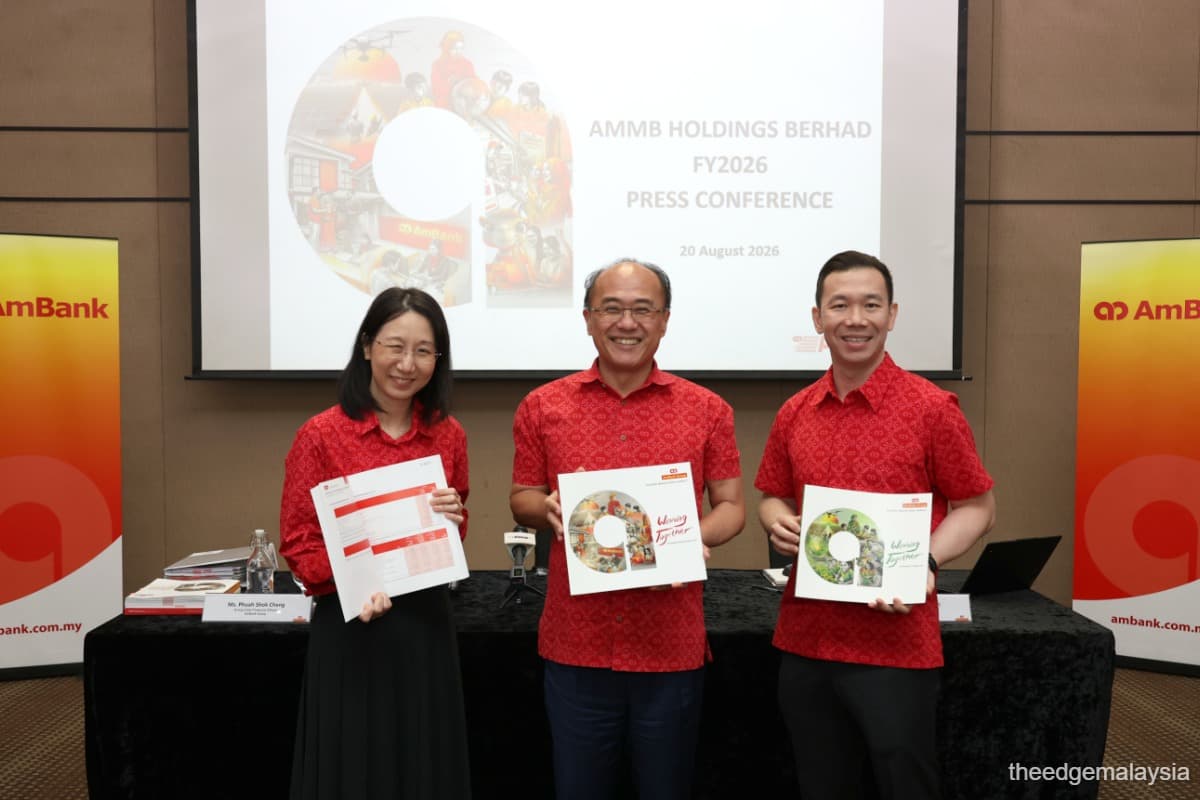
KUALA LUMPUR (Aug 20): AMMB Holdings Bhd (KL:AMBANK) expects asset quality to remain stable in the current financial year ending March 31, 2027 (FY2027) despite the prolonged West Asia crisis, but warned that a sustained conflict could put further pressure on borrowers, particularly small and medium enterprises (SMEs).
Elevated oil prices could fuel cost-push inflation and tighten working capital conditions, with SMEs likely to be particularly vulnerable as they bear the brunt of higher input costs, group chief executive officer Jamie Ling said at a press conference after the group’s annual general meeting on Thursday.
SMEs accounted for 21% of the loan portfolio at the country's sixth largest banking group by assets.
“When we look at our risk portfolios, the SMEs are currently a little more uncertain because they will be the first to bear the brunt of all the price increases. We have therefore increased our buffers for them by RM52.5 million in the (first) quarter," he said.
The RM52.5 million in overlays is primarily for manufacturing and distribution companies, particularly those that sell to or source from the Middle East, amid the ongoing conflict.
“We monitor the risk and where we think we need more support in terms of our prudential buffers. We also conduct stress tests under different scenarios and make decisions accordingly. All of that is essentially dynamic risk management for us to manage through this period,” Ling added.
AMMB’s gross impaired loan ratio edged up to 1.62% as at June 30, 2026, from 1.59% at end-March 2026, while its loan loss coverage ratio, including regulatory reserves, improved to 102.5% from 100.9% previously.
NIM, loan growth seen improving
AMMB group chief financial officer Phuah Shok Cheng said the bank expects its net interest margin (NIM) to improve towards 1.97% to 1.98%, while maintaining loan growth at about 7% for FY2027, subject to market conditions.
In the first quarter ended June 30, 2026, NIM moderated to 1.93% from 2.01% a year earlier, mainly due to lower asset yields following the overnight policy rate cut last year. Total gross loans, advances and financing grew 7% year-on-year, driven by growth in wholesale, business and retail banking.
Phuah said stiff competition in the deposit market has pushed deposit rates higher, but the bank is continuing to optimise its funding mix while building up its portfolio of financial assets.
“Competition out in the market is quite stiff, especially for the deposit rate. It has gone up significantly as well. So, one key item is that while we continue to try to get better liability management. We have also bought quite a lot of financial assets.
“This is part and parcel of the strategy to expand together with our loans as well. And we have not seen the full contribution of the interest income coming from these financial assets.
“So, by virtue of that, we do think that it will be stable, but we will try very, very hard to obviously improve upon it as we go through this journey itself,” she said.
Special dividend from excess capital
CEO Ling reiterated that surplus capital would be returned to shareholders through special dividends, following the potential release of about RM2 billion in excess capital after the implementation of the Basel III reforms in January 2028.
AMMB is also considering raising its dividend payout ratio from 55% in FY2026, said Ling.
Under its Winning Together 2029 (WT2029) strategy, AMMB is targeting a 45 sen dividend per share by FY2029. It declared 35 sen per share last year. The targeted dividend payout ratio under WT2029 is 60%.
“By second quarter we will see whether we want to raise the dividend payout. We have to sort of work on that for the next three years to look at where that 35 sen per share is getting to. Obviously, the first pass is to get to 40 sen first before you get to 45 and we're quite confident that we can do that,” he added.
The bank also intends to maintain the group’s CET1 (Common Equity Tier 1) capital ratio at between 13.5% and 14.2%, even after the excess capital is returned to shareholders. AMMB's CET1 ratio stood at 14.82% as at end-June this year.
AMMB's share price closed unchanged at RM7.10 on Thursday, valuing the company at RM23.5 billion. Year to date, the counter has risen over 9%.