

This article first appeared in The Edge Malaysia Weekly on August 17, 2026 - August 23, 2026
ACE Market-listed geotechnical engineering and erosion control specialist Fibromat (M) Bhd (KL:FIBRO) is entering a new phase of growth with an order book of nearly RM500 million and a growing presence in infrastructure projects across Peninsular Malaysia, Sabah and Sarawak.
Managing director and CEO Danny Ng Kian Boon is not simply betting, however, on the country’s infrastructure spending cycle alone. He believes Fibromat’s longer-term advantage lies in its ability to provide integrated geotechnical and erosion solutions that go beyond the manufacturing, sales and trading of geosynthetics and erosion control products alone.
From river and coastal protection, slope stabilisation and erosion control to ground improvement, the company has built capabilities spanning product manufacturing, providing technical advisory services to project implementation over the past 27 years.
“We are neither a geosynthetic products manufacturer alone nor are we an infrastructure contractor per se. Instead, we are an integrated solutions provider,” Ng tells The Edge.
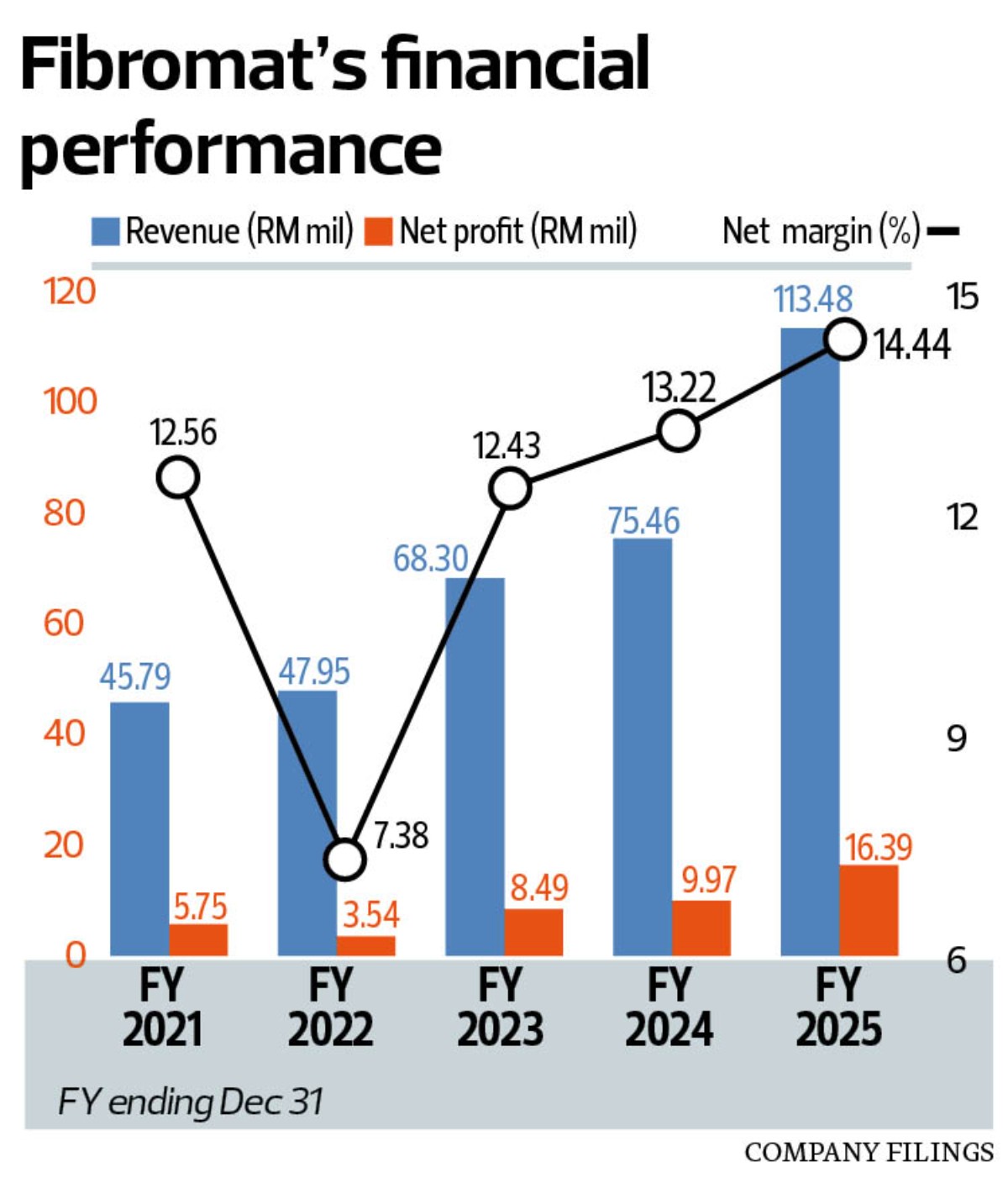
That integrated business model has helped Fibromat grow from a business generating about RM41 million in revenue for the financial year ended Dec 31, 2019 (FY2019), to RM113.48 million in FY2025, with its current order book of RM499.2 million as at mid-July 2026 providing revenue visibility up to 2029.
The order book was replenished last month when the company secured a RM140 million subcontract to undertake the construction of the Limpaku Pinang access road in Sarawak’s Limbang Division. The award strengthens Fibromat’s foothold in Sarawak, where it sees significant opportunities from the state’s ongoing infrastructure development.
Its current order book comprises RM242.3 million from the Central Spine Road (CSR), or 48.5% of the total; RM148.2 million from Sarawak projects (29.7%); RM73 million from ground improvement works (14.6%); and RM34.2 million from the Sabah Pan Borneo Highway job (6.9%).
Beyond its existing order book, Fibromat is currently negotiating about RM2 billion worth of projects through selective tenders while pursuing smaller value-engineering jobs.
For Ng, the order book forms only part of Fibromat’s growth story. The bigger opportunity is to leverage the company’s technical expertise and integrated business model to capture greater value from each infrastructure project undertaken.
There are only two or three full-fledged geotechnical solutions players in the local market that can manufacture products, design and build, and provide technical support and installation services as a single entity at the same time, according to Ng. Among local companies, Fibromat believes it is the only one with the complete solution and product offerings.
That gives the company some protection and insulation from the intense price competition faced by conventional geotechnical engineering and erosion control solutions providers.
“With our 27 years’ experience, we have that competitive edge,” says Ng. “Our clients know that this integration has already been done, and we are able to deliver comprehensive solutions.”
The advantage is particularly important as access to geosynthetic products becomes easier, with Chinese suppliers in Malaysia and online platforms making it simpler for customers to source an alternative themselves, which puts pressure on product pricing.
But geosynthetic products are different from ordinary construction materials. Before they can be specified for domestic infrastructure projects, they must meet stringent technical and certification requirements set by local authorities, creating an entry barrier to new entrants.
Fibromat has invested heavily to build that competitive edge, including an ISO 17025-accredited laboratory located at its factory in Rasa, Selangor. The years spent developing its technical credentials have since become part of its moat, making it harder for new competitors to replicate its offerings.
From materials supplier to complete solutions provider
Perhaps the clearest example of Fibromat’s strategy is its expansion into providing prefabricated vertical drain (PVD) installation services.
Previously, the company supplied materials for PVD projects while third parties handled the installation. After taking over the machinery and operations of another PVD business, Ng says, Fibromat has expanded from 25 PVD rigs previously to 33 today, making it the largest PVD operator in Malaysia.
The move was strategic to build its moat and strengthen its leading position domestically.
A PVD project typically requires several geosynthetic products. Non-woven geotextile is required before the PVD installation, while high-strength woven geotextile is used subsequently. By providing the installation services, Fibromat can potentially supply all three components as a complete solutions provider. The difference can be substantial to fence off competition from any smaller partial PVD services players.
Ng cites a Sarawak project currently under negotiation where the PVD portion is worth about RM7 million, but the combined package involving PVD installation plus the supply of non-woven and woven geotextiles would bring the contract value to about RM20 million.
This strategic move allows Fibromat to capture more revenue from the same project while reducing its dependence on third-party installers. The company says its PVD operation has the capacity to execute on average RM31 million worth of jobs a year.
With about 80% of its business coming from government projects, Fibromat is deliberately focusing on public infrastructure works. The preference is partly driven by the certainty of payment. Government projects could come with shock-protection mechanisms, such as variation-of-price (VOP) clauses that help contractors manage significant changes in input costs during unanticipated and drastic changes in market conditions.
The sharp increase in diesel price, for instance, has increased Fibromat’s operating costs. But because much of its work is tied to government projects, the company is entitled to VOP adjustments for eligible contracts, subject to approval from the project owners.
Prior to the Strait of Hormuz crisis, Fibromat already held about RM22 million of inventories, enough to last roughly a year of material sales requirement. Its products have an indefinite shelf life. Furthermore, Fibromat has strong relationships with its suppliers, which provide relatively long credit terms, giving the company a buffer against higher raw material costs.
“The increase in the selling price of geosynthetic products actually benefited us because we can sell at higher prices, or if we maintain the same selling price, we can capture a larger market share. Either way, we still gain,” Ng explains.
Looking ahead, East Malaysia is becoming an increasingly important market. Fibromat has already won projects there and is moving its machinery into Sarawak to support a new road job awarded recently.
The state’s difficult terrain presents greater opportunities for the company because large areas of peat soil require ground treatment before roads and other infrastructure can be built safely.
“We follow the money trail,” says Ng.
While both Peninsular Malaysia and East Malaysia offer opportunities, he sees particularly strong potential in the latter as both the federal and state governments continue to channel significant infrastructure spending into it.
Growth comes with a capital cost
Fibromat’s rapid expansion has also increased its capital requirements. From about RM40 million in revenue recognised when it was listed, the company now needs higher working capital. The larger capital expenditure required to execute multiple projects simultaneously is expected to be a temporary pressure point on its operating cash flow before progress payments are collected in accordance with the work schedule.
The company recently undertook a private placement to raise RM17.38 million for machinery purchases and working capital, particularly to support its expansion in Sabah and Sarawak. The exercise involves the issuance of up to 24.83 million new ordinary shares at an indicative placement price of 70 sen each.
Of the proceeds, RM9.24 million, or 53.2%, will go towards acquiring 26 units of new machinery, including excavators, tipper trucks, bulldozers and compactors, to expand its capacity for larger-scale geotechnical projects. Another RM7.63 million, or 43.9%, will be used as project working capital, including purchases of sand aggregates, precast concrete drains and bitumen, as well as payments to subcontractors.
An active tender book of RM649.8 million as at July 10 means the additional capacity could position Fibromat to take on more projects if they materialise.
Bank financing can act as another source of funding to support a larger scale of operation, as the company’s gearing ratio remains relatively manageable at 0.41 times as at Dec 31, 2025. The ratio will fall to 0.35 times upon completion of the proposed new share issuance, which is partly aimed at balancing debt and equity as both increase simultaneously.
The focus on growth also means shareholders should not expect an aggressive dividend payout for now. “We will try to pay cash dividend again once our cash flow is okay,” says Ng.
For now, Fibromat is prioritising capital deployment to support expansion, with shareholder dividend returns taking a back seat to growth. Ng says existing shareholders understand the need for equity fundraising and the dilution that comes with it, given that the company remains in a growth phase.
In terms of financial performance, Fibromat’s net profit has grown for four consecutive years, rising from RM3.54 million in FY2022 to RM16.39 million in FY2025. Revenue has also more than doubled over the same period, from RM47.95 million to RM113.48 million.
Ng remains the largest shareholder in Fibromat, with a 61.94% stake. Other notable institutional shareholders include the Employees Provident Fund, with a 1.37% stake; Pelaburan Mara Bhd, with 0.81%; and Pheim Asset Management, with 0.30%.
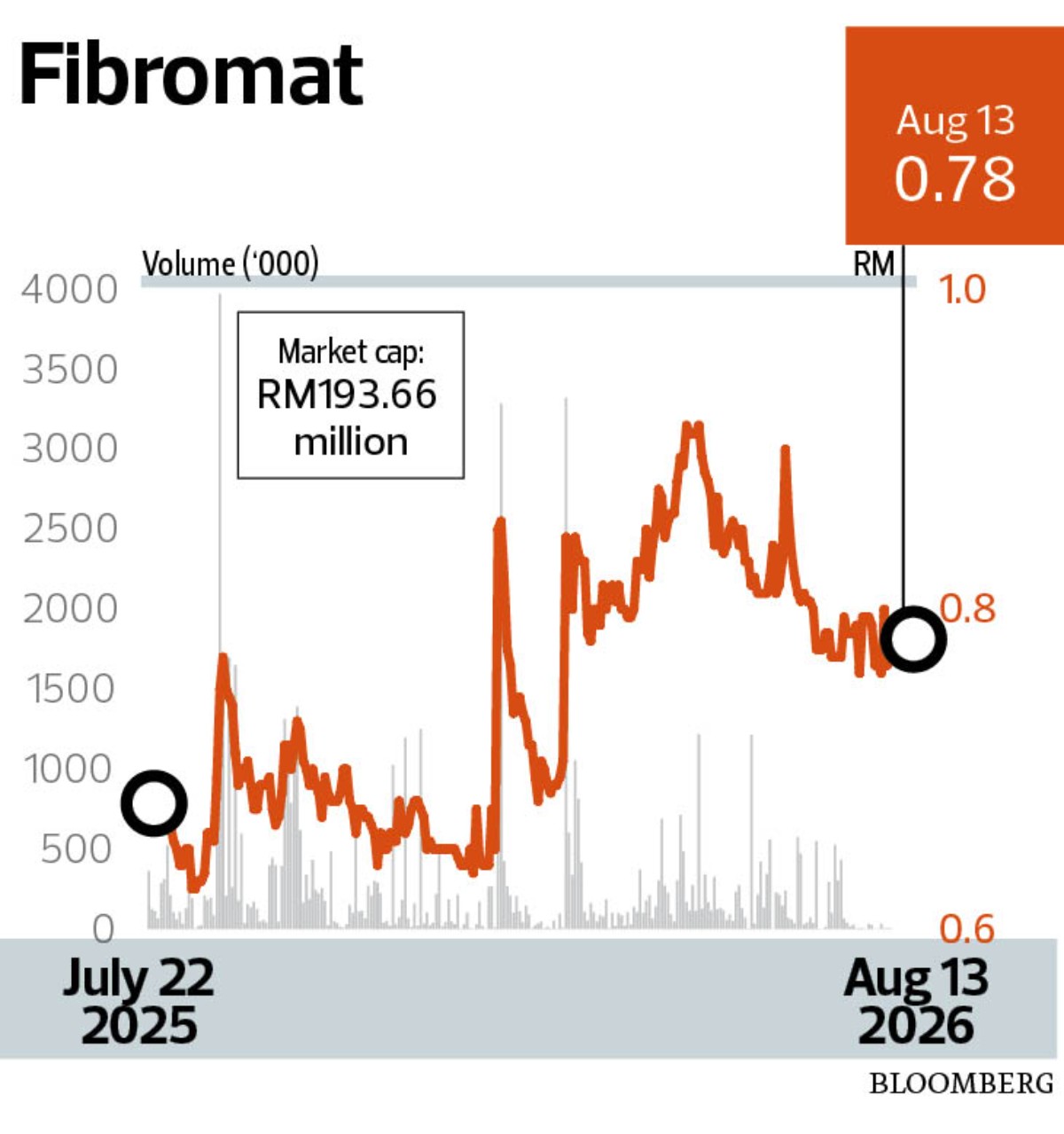
Over the past year, Fibromat’s shares have risen about 24%. At its closing price of 78 sen last Thursday, the company had a market capitalisation of RM194 million and traded at a trailing price-earnings ratio of 10.6 times.
Save by subscribing to us for your print and/or digital copy.
P/S: The Edge is also available on Apple's App Store and Android's Google Play.