

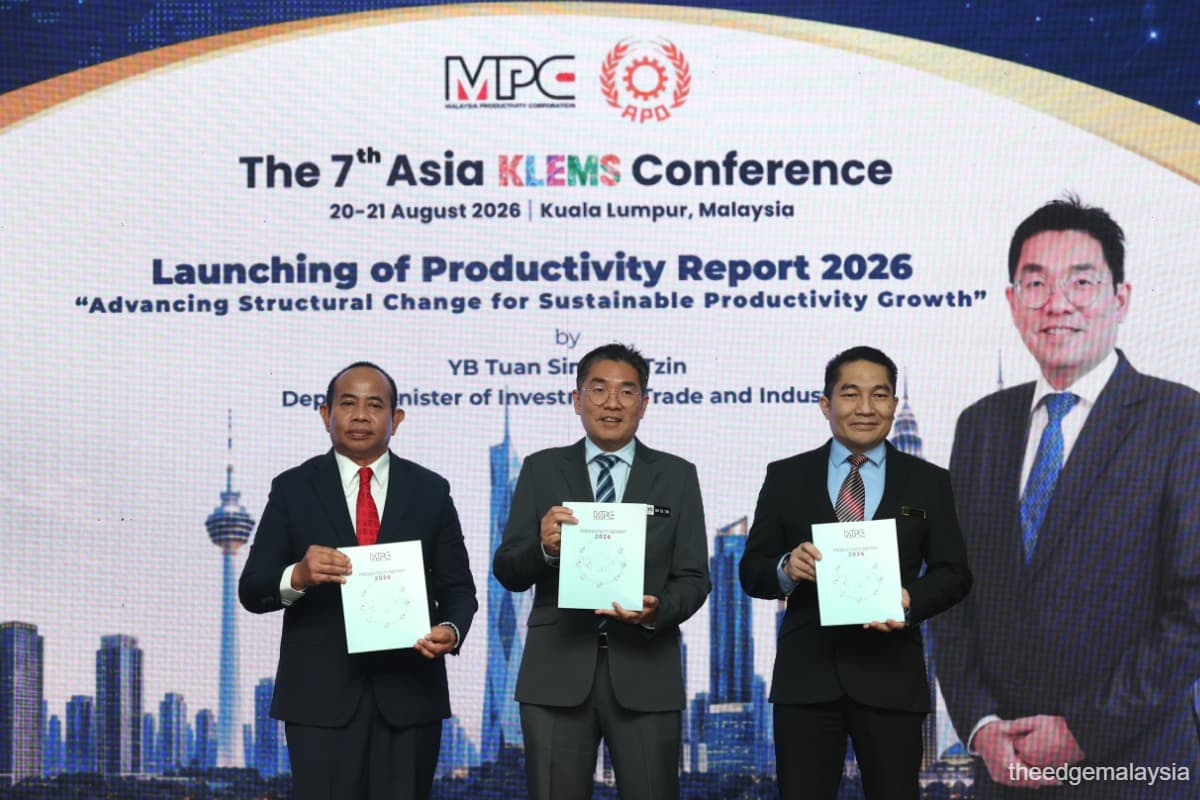
KUALA LUMPUR (Aug 20): Malaysia aims to reduce foreign workers to 10% of the workforce by 2030, as the government pushes businesses to invest in automation and technology instead of relying on cheaper foreign labour, Deputy Investment, Trade and Industry Minister Sim Tze Tzin said.
The government has lowered the foreign worker ceiling to 13% this year from 15% previously under the 13th Malaysia Plan (13MP), with a further reduction planned over the next four years, he told reporters after launching the 7th Asia KLEMS Conference 2026 and Productivity Report 2026 on Thursday.
Sim said businesses should begin preparing for a tighter labour market by automating operations and improving efficiency.
“But once you rely on cheaper foreign labour, then you are not investing into technology, you are not investing into process, you are not saving, you are not making important decisions to move up the value chain,” he said.
The government, meanwhile, is providing various incentives, including automation grants, to help companies improve their processes and productivity as they reduce their reliance on foreign workers.
The move forms part of a broader push to lift Malaysia’s productivity and transition towards higher-value economic activities.
Sim also urged multinational companies (MNCs), particularly those benefiting from strong demand for electrical and electronics products and artificial intelligence-related exports, to share their gains with Malaysian workers through higher wages and bonuses.
“It is time for them to reward our workers,” he said, noting that MNCs had also benefited from Malaysia’s pro-business policies and tax incentives.
He said their success was also supported by their Malaysian employees, adding that it was fair for workers to benefit from the gains.
Under the 13MP, Malaysia is targeting average annual labour productivity growth of 3.6% from 2026 to 2030, which is expected to lift productivity per employee to RM122,745 by 2030 from RM104,556 in 2025, Sim said.
“Lasting gains will not come from working harder alone. They will come from moving resources towards more productive firms and activities, deepening technology and building capabilities that allow the economy to generate higher value,” he said.
Malaysia's labour productivity per employee grew 4.3% year-on-year to RM26,171 in the first quarter of 2026, while productivity per hour worked rose 4.8% to RM45.50. Despite the improvement, Sim said Malaysia remains a mid-tier regional performer.
He said industrial and productivity transformation need to progress together, with investment directed towards talent, digitalisation, research and innovation as well as more efficient work processes.
“Moving forward, we must pursue targeted sectoral strategies that advance sophisticated manufacturing, modernise services and strengthen the productive linkages between them,” he said.