

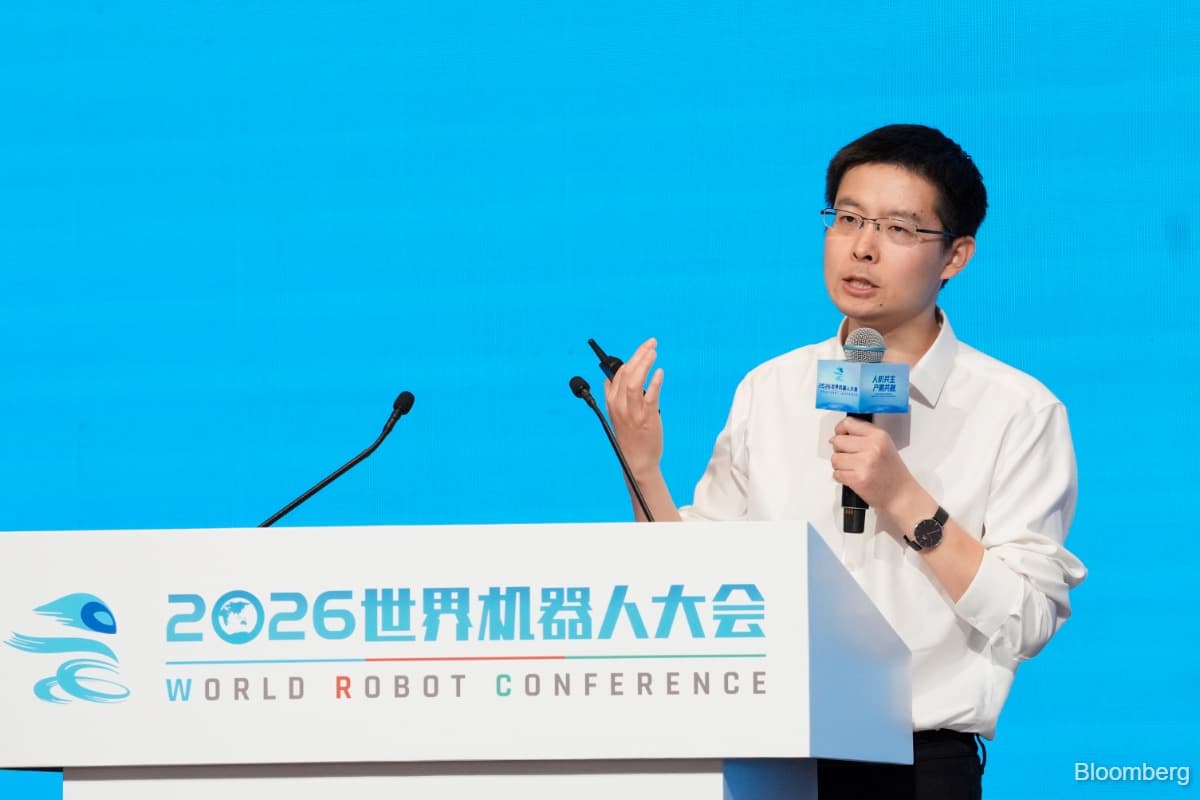
(Aug 20): Humanoid robots will reach “mass market” popularity within a decade, after manufacturers solve problems that hold back their current usefulness, the founder of China’s Unitree Robotics said.
The market will take off once robots can handle 80% of tasks given to them via voice instructions in unfamiliar surroundings, Wang Xingxing said in a speech at the World Robot Conference in Beijing on Thursday. That will take two to 10 years, he said.
Robots already perform well in test conditions, but their execution collapses once objects or surroundings shift even slightly, Wang said. That means robots still lag behind human workers and suffer from weak versatility in terms of the tasks they can handle, he said.
The key to closing the gap lies in developing the humanoid brain, which Wang said is now Unitree’s main focus. That reflects a pivotal shift by a company that has won its global recognition largely for the physical dexterity of its robots. Unitree plans to spend nearly half of the proceeds from its recent initial public offering (IPO) to develop the humanoid brain, also known as embodied artificial intelligence (AI), according to its IPO prospectus.

That underscores a broader trend in China’s robot industry, with billions of dollars of venture capital flowing to companies working on AI models designed to let humanoids carry tasks on their own. The improving capabilities of the humanoid brain will also unlock more industrial demand, bolstering the case for robots to replace human workers across factories to address labor shortages and reduce costs.
Wang said Unitree is drawing on progress in frontier AI models to enhance robotic brain training. “AI models are underused in the development of robots despite their wide adoption in other things, such as programming,” he said.
Shares of Unitree soared this week in their Shanghai trading debut, which made the firm the first listed humanoid robot maker in mainland China. Embodied AI is emerging as one of the most closely watched frontiers in the global AI race as Beijing steps up support for strategic technologies ranging from semiconductors to humanoid robots.
JPMorgan forecasts global humanoid robot shipments will rise to 60,000 this year and 1.75 million units by 2030, compared with 18,000 units in 2025. The bank sees China accounting for more than half of global demand.
Unitree is among the companies that are expected to benefit if such growth materialises. The company shipped more than 5,500 humanoid robots last year, ranking first globally, according to its prospectus.
Uploaded by Felyx Teoh