


(Aug19): The UK Treasury would be as much as £32 billion (RM176.06 billion) better off each year if Britain’s government-run health service had kept pace with its pre-pandemic productivity gains, according to analysis of official figures.
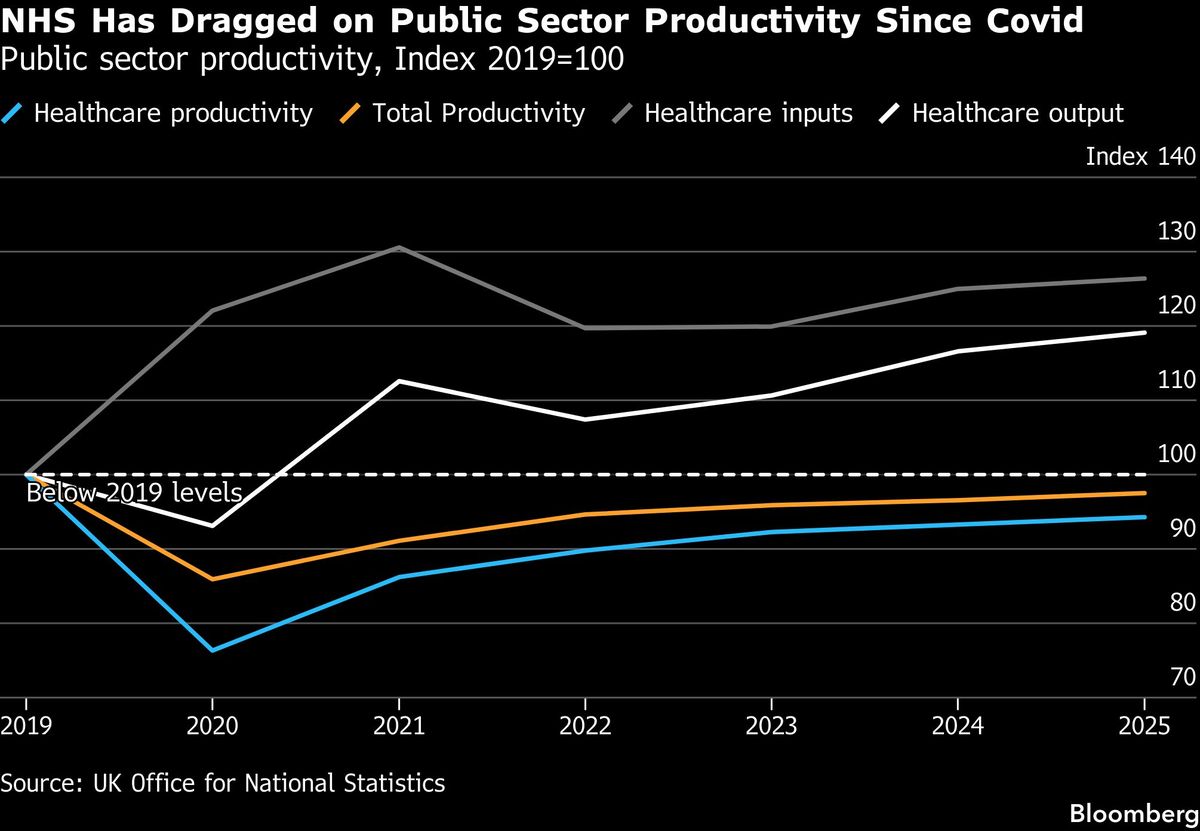
The data shows a 26% surge in resources used by the National Health Service from 2019 to 2025 as successive governments tried to turn around ailing frontline services. However, NHS output was up just 19% over the same period.
It leaves productivity lagging well behind pre-Covid-19 levels despite some improvement in recent quarters. If productivity had continued to grow at the pace seen during the 2010s, the government could be spending £31.5 billion less each year on health while achieving the same level of service that it currently provides. Alternatively, the UK could be spending that money to improve the NHS or other public services.
When looking at a wider timescale, the Treasury would be saving over £26 billion a year if NHS productivity had continued at levels seen between 1997 and 2019.
The NHS has long been a hot political issue in Britain. Providing health treatment free at the point of use, it is extremely popular with the public despite discontent around the level of service. The Labour government has been trying to slash backlogs that built up during the pandemic under the previous Conservative administration. However, waiting lists still number more than seven million patients, well above pre-Covid-19 levels.
Left-wing Members of Parliament would like to increase health funding even further, yet new Chancellor of the Exchequer John Healey has little wriggle room ahead of his first budget in the autumn.
Healey needs to find more money for Britain’s military and some of UK Prime Minister Andy Burnham’s other ambitions for a more active state.
“We could spend the same amount but spend it more efficiently and effectively,” said Tera Allas, co-chair of the Health Foundation’s NHS Productivity Commission, who analysed the numbers. “I can’t help but look around and see that there’s a ton of ways in which that could be done. Those tons of ways don’t easily match up with the reality of political economy.”
She said under-investment in the NHS’s capital resources is the main reason behind the productivity slowdown as workers lose valuable time dealing with inadequate equipment, waiting for access to machinery or dealing with deteriorating facilities. Allas highlighted a lack of managers who can allocate resources, improve processes, reduce waste and train workers.
The NHS could also cut regulations and prioritise a modern patient-records system to turn things around more quickly. But fundamental changes take time, Allas said, like sustained investment in infrastructure, tech and staff training. “You need to start investing in them now.”
NHS productivity tanked in 2020, after improving for decades, and has still not returned to its pre-Covid-19 path. Capital per worker in the NHS fell 36% between 2010 and 2019 while a £14 billion maintenance backlog makes operations less efficient. During that decade, the UK would have needed to invest £32.9 billion more to keep up with comparable European peers such as France, Austria, Denmark or Greece.
“Not investing in your capital budget in the 2010s doesn’t really look bad in the short term,” said Stuart Hoddinott, associate director at the Institute for Government. “But over the long term, that really builds up into a very bad backlog of problems in your estate and in your capital stock, which makes your staff less productive. That’s the state we’re in now.”
Hoddinott said there may also be a productivity impact from losing experienced staff around the pandemic as well as the prioritisation of frontline hospital resources over other parts of the system, such as social care, mental health services and community care.
Uploaded by Arion Yeow