

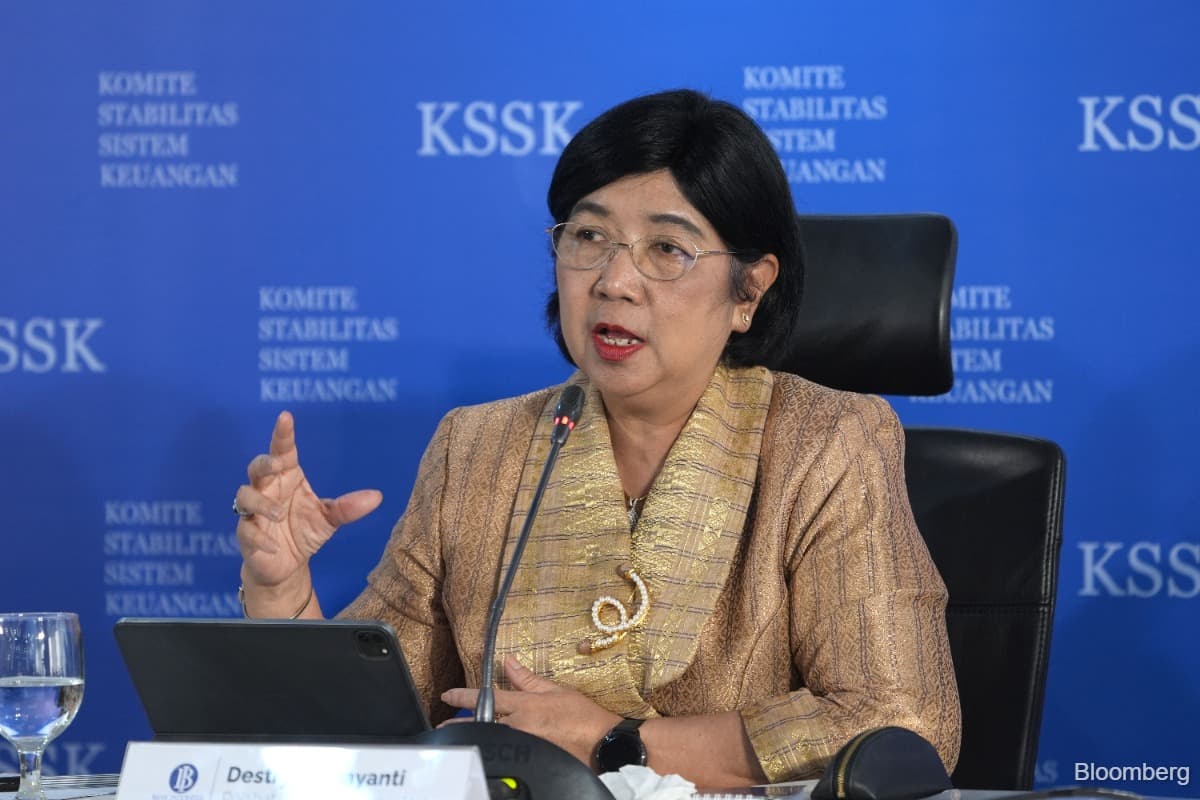
(Aug 19): Indonesia’s central bank held its policy rate steady in the first monetary decision under acting governor Destry Damayanti, who stuck close to past guidance and vowed to uphold the stability of the rupiah.
Bank Indonesia (BI) left its benchmark BI-Rate at 5.75% for a second straight month, as expected by all but one of 35 economists surveyed by Bloomberg. The central bank has already hiked rates by 100 basis points this year to shore up the currency and investor confidence.
Destry, the sole nominee to head BI after the abrupt resignation of former governor Perry Warjiyo, reiterated on Wednesday that monetary policy would continue focusing on the currency, and expanded a hedging incentive scheme to lure more inflows.
The first meeting under Destry is being closely scrutinised by investors after Warjiyo’s departure fuelled concerns about BI’s autonomy. The prospect of a smooth transition to an experienced leader and an easing of external risks have helped revive capital inflows and strengthen the rupiah, which has gained nearly 1% so far this month.
“This decision remains consistent with efforts to strengthen the rupiah’s stability against the impact of heightened global volatility caused by the war in the Middle East, maintain the inflation target of 1.5-3.5% for 2026 and 2027, and support sustainable economic growth,” Destry said in an online briefing.

The rupiah should continue to strengthen as BI wields all monetary instruments incentives to attract foreign inflows, she said, adding that the central bank will keep intervening in onshore and offshore markets and offer incentives for foreign inflows.
Meanwhile, it will use macroprudential measures to ensure ample liquidity keeps flowing to banks to enable more lending. Credit growth expanded 13.58% in July, the fastest pace since at least the pandemic.
The rupiah held an earlier gain and ended Wednesday trading 0.1% higher versus the dollar while stocks closed 0.9% lower. The 10-year government bond yield extended a decline of five basis points to 7.11%, the lowest in almost two months.
“Monetary policy continuity has broadly been reaffirmed through this decision,” said Lavanya Venkateswaran, economist at Oversea-Chinese Banking Corp.
Like her predecessor, Destry spoke at length about the global environment and local economy before announcing the actual rate decision.
Destry is expected to be permanently named governor after parliamentary hearings in the coming weeks, and the rate pause shows the leadership change has not prompted an abrupt shift in BI’s policy path. Still, investors will parse Destry’s comments for clues as to how she will address the need to support President Prabowo Subianto’s push for faster economic growth.
The rupiah’s recent rally gives Bank Indonesia “temporary breathing room”, said Eugenia Fabon Victorino, head of Asia strategy at Skandinaviska Enskilda Banken AB in Singapore.
“While BI continues to champion currency stability in its messaging, the true test will come if the greenback rebounds. Markets remain uncertain whether policymakers will maintain their resolve or relent under government pressure,” she said.
Destry herself signalled that currency pressures may be up ahead. BI sees global price pressures building and a possible rate hike from the US Federal Reserve in the fourth quarter. That could keep the dollar strong and US Treasury yields rising, she said.
The acting governor could opt to use her other policy tools before resorting to raising borrowing costs. While gross domestic product growth decelerated to 5.29% last quarter, BI kept its full-year forecast at 4.9% to 5.7%, with Destry noting that it will keep coordinating with the government to support the economy.
On Wednesday, BI expanded its hedging incentive scheme. The change, which will take effect in the second week of September, is “particularly important” as it broadens channels through which foreign currency can enter more easily, said Irman Faiz, chief economist at PT Bank Danamon in Jakarta.
“This gives BI more room to defend the rupiah without immediately imposing additional tightening on domestic financial conditions,” he said.
Destry said BI is leaning more on incentives to attract foreign inflows rather than pushing up yields on its high-yielding SRBI securities, a brainchild of Warjiyo. She noted that inflows have continued even as SRBI rates declined.

“We’ve rolled out several incentives specifically designed to support capital inflows entering Indonesia, because, of course, we do not want our SRBI rate to rise,” she said. “So, if we look at the past two weeks, the SRBI rate has continued to decline. Nevertheless, inflows have continued to come in.”
While SRBI have been able to lure in sizable foreign inflows, they have also been scrutinised by the government for crowding out its own bonds, and for encouraging banks to park their funds there instead of lending.
The 12-month SRBI average yield fell by 22 basis points on Aug 14, following BI’s decision to reduce the amount of outstanding securities, Barclays plc’s Brian Tan pointed out in a note after the decision.
“We would expect SRBI yields and amounts outstanding to remain under pressure unless the rupiah again comes under significant depreciation pressure,” he said.
Uploaded by Chng Shear Lane