


This article first appeared in City & Country, The Edge Malaysia Weekly on August 17, 2026 - August 23, 2026

Living in a vertical community or a strata development has become commonplace in Malaysia. At the same time, strata mixed-use developments with various components such as residential, retail and commercial are becoming prevalent. To ensure that these types of developments are well maintained in the long run, the Strata Management Act 2013 (SMA) contains regulations to guide owners, management committees and property managers on their upkeep.
In collaboration with Henry Butcher Malaysia (Mont Kiara) Sdn Bhd (HBMK), City & Country will feature a six-part series of articles that lay the groundwork for a deeper understanding of what it takes to maintain mixed-use developments. In this first part, we look at share units and why they are important, their function and how they affect owners’ rights.
What is a share unit?
When it comes to calculating the maintenance charges and sinking fund, the familiar route for many is to use the psf method. For example, if the unit size is 1,000 sq ft and the charge is 20 sen psf, then you would need to pay RM200 per month. However, this does not take into account accessory parcels such as parking bay, private lobby and storage space outside your unit.
A more standardised way to calculate the amount of service charge payable is through share units. According to HBMK managing director Low Hon Keong, it “is a fair calculation of [the owner’s] shared percentage in the entire strata development”.
In a nutshell, a share unit is a numerical value assigned to an individual parcel that determines the owner’s maintenance fee, sinking fund contributions and voting rights.
To obtain the share unit figure, potential owners need to review the Schedule of Parcels document. Under the SMA, it is a legal document that acts as a “floor plan” indicating the overview and floor measurements of the parcels in a development. The Schedule of Parcels also shows the proposed share units of each parcel or proposed parcel, and the total share units of all the parcels. This document can be requested from the developer.
This is particularly important for a mixed-use development as some components may have more share units than others, like, say, the retail or commercial space due to the parcel size. As such, purchasers would have to pay a higher service charge compared to a small residential unit.
Low highlights that the calculation of one’s share unit, which is stipulated in the First Schedule of the SMA, is done in square metres and not square feet — an important distinction, so that there is no confusion regarding the calculations.
Moreover, the calculation of the allocated share unit is done by the Land Office, and under the First Schedule there is a standard formula used to calculate the allocated share units of a stratified parcel that include weightage factors for parcels, including accessory parcels.
The share unit figure is shown in the strata title document, which owners should obtain by paying for the Memorandum of Transfer to have the name on the title changed from that of the developer or the previous owner to the current owner’s name. This is important, especially when it comes to voting rights at important meetings such as the annual general meeting (AGM) or extraordinary general meeting (EGM). If your name is not on the title, you are not eligible to vote.

Voting rights
Low explains that in a mixed-use development, owners of retail or commercial units with a much larger parcel size and number of accessories will have more share units and thus more voting rights compared to owners of smaller residential parcels.
Some quarters may claim that owners with more share units will use their position to only vote for the items they want to go through and potentially reject all other suggestions or ideas.
Low disagrees with this viewpoint and says, “For example, in any company, if my shareholding is larger, automatically I will have more voting rights, but at the same time, I will also have more concerns about the company.
“The owner with larger share units is more concerned about the property because they have to pay more, so they are more concerned about their investment — [they want to ensure] the maintenance fee that they have paid is fully utilised and the common areas are well maintained — compared to a minority shareholder [who] will not have to fork out as much.”
Owners with smaller share units do not lose out as the decision made will benefit the entire mixed-use development and not just one section or component, he continues.
Under the SMA, voting can be done via two methods — a show of hands and a poll vote. The show of hands method means that each eligible person would raise one hand to represent their parcel. So, a retail owner with a much larger unit and a residential owner with a much smaller unit would both have one vote each.
The show of hands method is normally used for standard mundane matters. For instance, during an AGM/EGM, an interim chairperson has to be elected to chair the meeting. Low says this method is suitable because it simply allows the meeting to start and to move on efficiently.
A poll vote can be demanded by an owner or their proxy. Under this method, the votes are counted based on the number of share units an owner has. This means a retail owner of a larger unit would have more voting rights than a residential owner with a smaller unit. Moreover, the poll vote is conducted through secret ballots.
This method is particularly useful for sensitive issues such as the raising of maintenance charges or voting for committee members.
“To vote by a show of hands is very sensitive because it is very visible and people may start causing problems if they see who is voting for or against the motion. To resolve this, voting by poll is a secret ballot and is done by paper, but we are moving to electronic voting,” says Low.
He adds that a poll vote is also suitable when there are too many nominees for the management committee, which he has experienced before. According to the SMA, the management committee needs a minimum of three members to a maximum of 14 members. Using the poll vote maintains harmony within the strata community and does not fuel discontent between neighbours.
Low further emphasises voter eligibility, stating that only owners whose names appear on the strata title are entitled to vote on major issues.
To help owners with smaller share units understand that the owners with larger share units would not outmanoeuvre them and claim all the gains for themselves, Low’s strategy is to be open and transparent on financial and crucial matters to ensure that scepticism and ill-will do not grow and cause disharmony within the community. Thus, having a competent property manager as a bridge between all the mixed-use development components is essential.

Important documents
Besides the strata title document, owners need to be in possession of other documents in order to make informed decisions on what is best for their development.
The first two, Low says, are basic documents that all owners should look through, so that they have a baseline understanding of how the development is managed. These are the income and expenditure statement and the AGM minutes. The former lets you know how much is being spent and collected while the latter, which is produced once a year, provides an overview of what has happened in the development.
To go one level up, Low suggests reading the minutes of the management committee meetings. They provide further details of what was discussed so owners gain a deeper understanding of the decisions made in managing the development.
The SMA states that the management committee must display signed copies of management committee meeting minutes on the property’s designated noticeboard within 21 days after the meeting is held.
In addition to these documents, Low also advises owners to visit the management office. “Some people have not even stepped into the office. Talk to the staff, find out the answers to any questions you may have. What you want to know or if you need something clarified, do ask them. Interact with the people there.”
One main misconception about property management is that people think they only do one thing: maintenance.
“In fact, this is wrong because maintenance matters only account for 20% of the work of the management. There are also accounts, financial, administrative [and] keeping records. So, communicate with management office personnel. Don’t judge things from the surface,” he explains.
Management committee matters
Whether they have a smaller or larger share unit within a mixed-use development, every owner has the right to sit on the management committee. However, Low says getting owners to be part of the management committee can be difficult. At times, residential component owners are reluctant to step up and volunteer their time for the development.
Low believes that strata property owners need a change in mindset because when they are in the management committee, they will better understand the challenges and the requirements to maintain a mixed-use development for the benefit of the whole development and community.
He cites a personal example of being in the Parent-Teacher Association (PIBG). Prior to joining the committee, Low had always wondered what the headmaster did all day since he did not have to teach classes. However, once he became part of the PIBG, Low saw that the headmaster had to deal with numerous issues — ranging from unreasonable parents complaining about their children not being selected to answer questions even when they had raised their hand to how a teacher spoke — as well as field calls from the Ministry of Education.
Similarly, management committees of mixed-use developments have to deal with many administrative matters, on top of complaints and fielding calls from the commissioner of buildings (COB), if any.
“Challenge yourself and volunteer to be a management committee member. Don’t be shy … just volunteer your time. Understand the job of a committee member, what they face, what is the behaviour of the residents that the management office has to deal with. There are people who may behave very nicely to you as a neighbour, but act differently when dealing with the management office personnel,” says Low.

For committee members who are worried that they will be left to flounder on their own, Low provides some assurance that they will not be going it alone. “As a property manager, all the administrative work is done by us. You, as a committee member, are like a board of directors. We are the executor of your decisions; we will be the one advising on what can or cannot be done, the compliance aspects and so on.
“All you have to do is attend committee meetings, sign the minutes and make decisions. We, as the property manager, will give you various options. Just choose. If you don’t like the options, let the property manager know and they will look for more options based on your requirements or requests.
“We can assist and advise on what it is you wish to do. We will work together with you as a team. We are not your staff, we are your partners,” says Low.
Formula for the computation of allocated share units as per First Schedule of Strata Management Act
1. The allocated share units of a parcel shall be calculated as follows:
Allocated share units of a parcel = (area of parcel x WF1 x WF2) + (Area of accessory parcel x WF3)
a Areas are expressed in square metres;
b WF1 is the weightage factor for the type of parcel specified in Table 1;
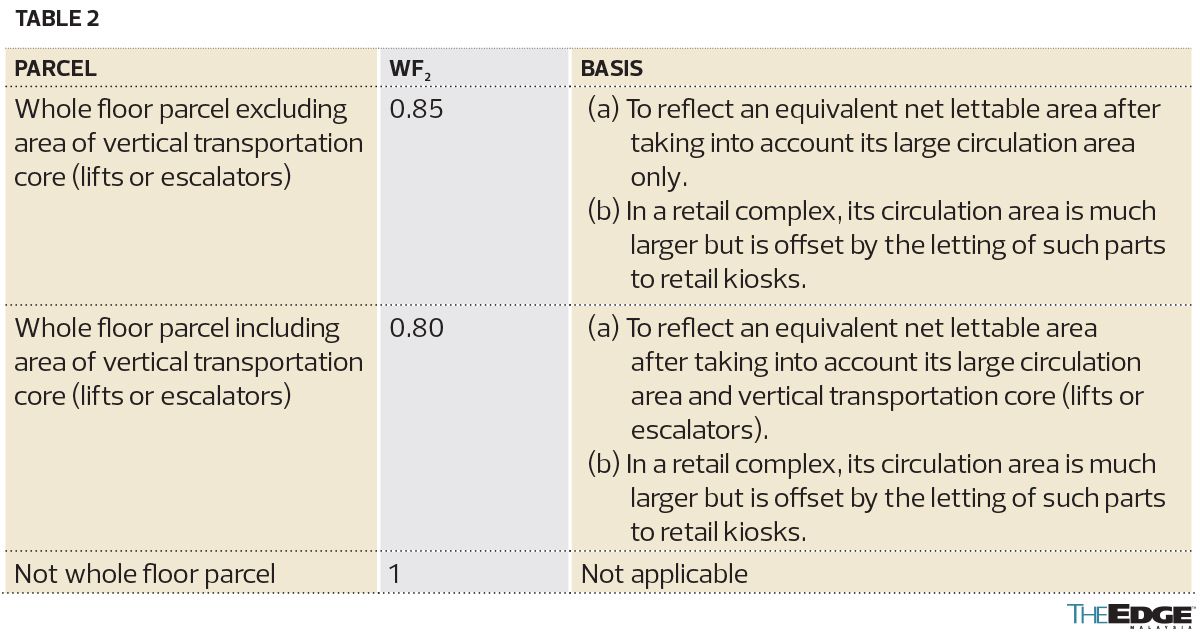
c WF2 is the weightage factor for whole floor parcel as specified in Table 2;
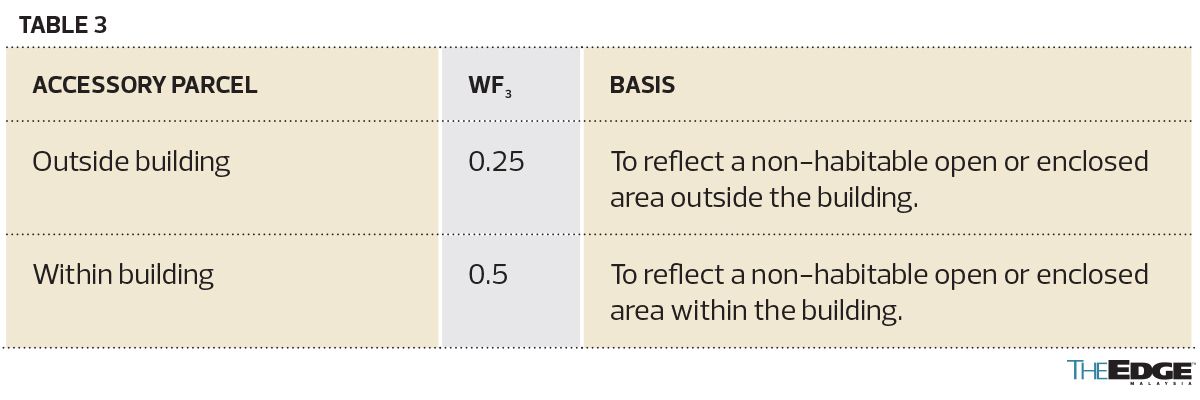
d WF3 is the weightage factor for accessory parcel as specified in Table 3;
e If there is more than one accessory parcel, the component formula for the accessory parcel (area of accessory parcel x WF3) shall be applied to each accessory parcel and then shall be added to the formula; and
f Share units shall be expressed as a whole number and any fraction or decimal shall be rounded to the nearest whole number.
2. Weightage factor (WF1) for types of parcel
a. Table 1 shows the weightage factors (WF1) for the types of parcels reflecting the frequency of usage and general maintenance of the common property which are as follows:
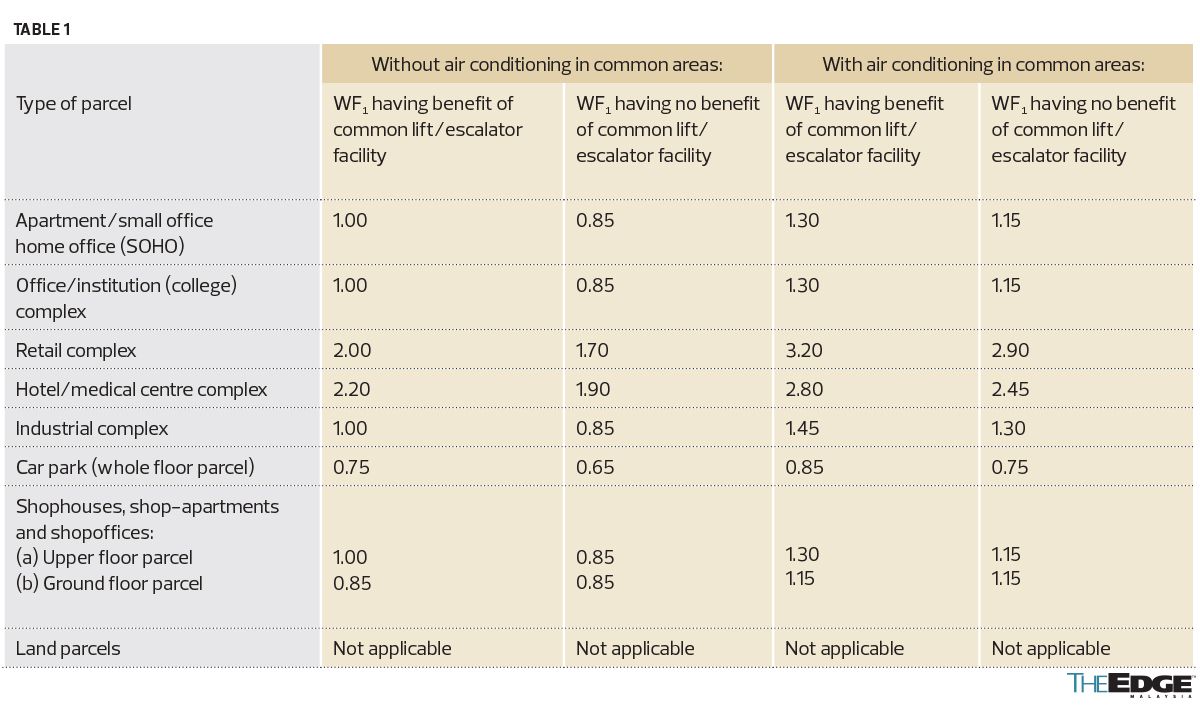
3. Weightage factor (WF2) for types of parcel
a Table 2 shows the weightage factors (WF2) for the whole floor parcel which are as follows:
b The examples of whole floor parcels are, but not limited to, the following:
i. A whole floor or a block of contiguous whole floors in an apartment complex;
ii. A whole floor or a block of contiguous whole floors in an office complex;
iii. A whole floor or a block of contiguous whole floors in a retail complex; and
iv A whole floor or a block of contiguous whole floors of car parks in a complex.
c In order to be equitable to other parcels which form the majority and comprise only net lettable areas, a whole floor parcel must be adjusted to its equivalent net lettable area by taking into account its large circulation area or vertical transportation core (lifts or escalators) in the whole floor parcel.
d Table 2 shall not apply to simple types of shophouses, shop-apartments, shopoffices and duplexes (each parcel is located on two floors).
4. Weightage factor (WF3) for accessory parcel
a Table 3 shows the weightage factors (WF3) for an accessory parcel which are as follow:
b An accessory parcel is an open or enclosed part of the development area that has been made appurtenant to a parcel and cannot be disposed of independently of the parcel.
c The examples of accessory parcels are, but not limited to, car bays, garden areas, roof areas and storerooms located away from the parcels.
d In order to be equitable before incorporating into the allocated share units of a parcel, the area of an accessory parcel must be adjusted to reflect that it is non-habitable and generally of lower construction cost.
e For the purpose of ascertaining the weightage factor in accessory parcels, the following interpretations shall apply:
i. “outside building”, in relation to an accessory parcel, means that the accessory parcel is located on a part of the development area which is outside a building and is neither part nor deemed to be part of a building; and
ii. “within building”, in relation to an accessory parcel, means that the accessory parcel is located on a part of the development area which is within a building and forms part or deemed to form part of the building.
Save by subscribing to us for your print and/or digital copy.
P/S: The Edge is also available on Apple's App Store and Android's Google Play.