

This article first appeared in The Edge Malaysia Weekly on August 17, 2026 - August 23, 2026
Cetaceans such as whales, dolphins and porpoises face the risk of displacement, decline and extinction, in Southeast Asia, in part due to unregulated tourism activities and unethical boating practices, according to Dr Louisa Ponnampalam, co-founder and executive director of the MareCet Research Organization. But this situation can be reversed with better and more responsible tourism practices, she says.
MareCet is a non-profit non-governmental organisation (NGO) established in 2012 to research and conserve marine mammals and their habitats in Malaysia. The Subang Jaya-based NGO conducts research all over the country, with key project sites in Kedah, Perak, Johor, Perlis and Penang.
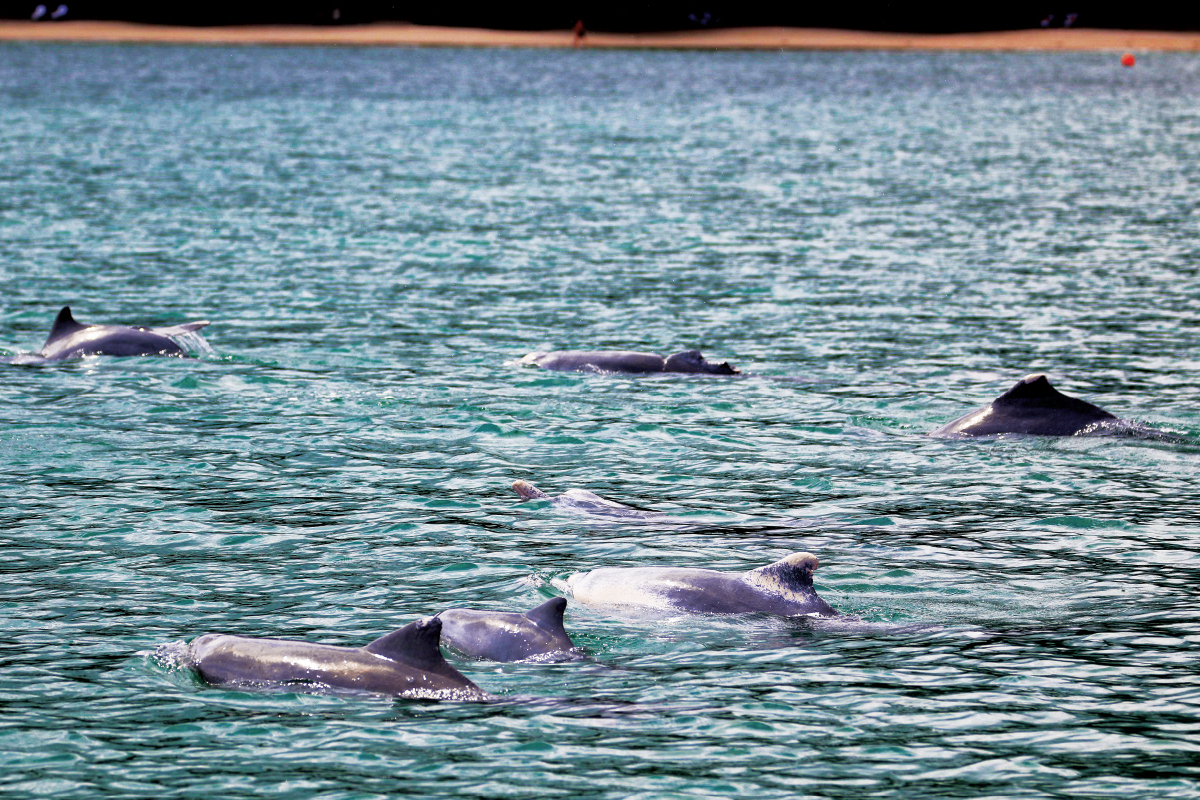
The three endangered cetacean species that commonly inhabit Malaysian coastal waters are the Indo-Pacific finless porpoise, Indo-Pacific humpback dolphin and Irrawaddy dolphin. The Indo-Pacific finless porpoise and Indo-Pacific humpback dolphin are classified as Vulnerable on the International Union for Conservation of Nature (IUCN), while the Irrawaddy dolphin is classified as Endangered.
The main threats faced by these species are intensive fishing activities, degradation from coastal development, accidental entanglement in fishing nets, pollution and increasing vessel traffic. The situation is exacerbated by unregulated tourism activities and unethical boating practices, such as speeding, in Malaysia. For instance, finless porpoises have been recorded as having one of the highest number of strandings due to entanglement in fishing nets and collisions with speeding boats.
“The finless porpoise is especially vulnerable to fishing nets because of its small size and how it uses echolocation to navigate,” says Louisa.
“They communicate with each other and detect their surroundings using clicks in ultrasonic frequencies that humans cannot hear. The low-frequency noise produced by boats often does not overlap with the porpoise’s hearing range, making it difficult for them to detect approaching vessels early enough.”
Consequently, the porpoises only realise the boats are near when they are extremely close, increasing the risk of collisions or injury. “That’s one of the reasons why, through our research programmes, we have tried to put more emphasis on finless porpoises,” she adds.
The Indo-Pacific finless porpoise and Indo-Pacific humpback dolphin are commonly sighted around Kilim Karst Geoforest Park in Langkawi. To protect the species, MareCet engages in scientific research and conservation efforts with the Langkawi Development Authority. The government agency is responsible for managing, conserving and promoting the Langkawi Unesco Global Geopark, which Kilim Karst Geoforest Park is part of.
“Langkawi is especially significant because it has been internationally recognised by the IUCN as an Important Marine Mammal Area (IMMA) since 2019. Over 440 dolphins have been catalogued in the Kilim Karst Geoforest Park to date, with the cataloguing or more dolphins still ongoing. Malaysia has five designated IMMAs, and this is the country’s only transboundary site,” says Louisa.
According to Unesco, a transboundary site is a heritage or conservation area whose natural or cultural features span the borders of two or more countries. In the context of marine conservation, the term is used more broadly to describe ecosystems and species that move across national boundaries.
For instance, in Unesco’s transboundary marine biosphere reserve in the Tropical Eastern Pacific, Colombia, Costa Rica, Ecuador and Panama collaborate to manage shared marine ecosystems and migratory species across international waters.
Langkawi is considered part of a transboundary marine ecosystem as marine mammals in the area are known to move between Malaysian and Thai waters.
The Langkawi Dolphin Research Project was developed by Fairul Izmal Jamal Hisne and Louisa in 2010, before the official establishment of MareCet in 2012. The NGO focuses on investigating the distribution, ranging patterns, social structure, behaviour, acoustic ecology and overlaps in human-dolphin interactions of the Indo-Pacific finless porpoises, Indo-Pacific humpback dolphins and Irrawaddy dolphins in the waters across the Langkawi archipelago, Kedah and Perlis.

Addressing threats
Marine mammals in Malaysia are protected under several pieces of legislation, including the Fisheries Act 1985. However, the governance of boats comes under the purview of Malaysia’s Marine Department and the Department of Fisheries Malaysia (DoF). According to a DoF source, there are currently no regulations governing the speed of tourism boats.
Louisa says MareCet has participated in stakeholder discussions to establish a boating code of conduct aimed at protecting Malaysia’s marine mammals, although no formal framework has been introduced so far.
According to MareCet’s website, recommendations for speed limit zones for public ferries were submitted under the Langkawi Plan 2015-2030, drafted by Kedah’s Department of Town and Country Planning.
“There’s currently no legal framework. There is no Act that specifically says boats must slow down for marine wildlife. We need to create that clause,” she says.
“We want dolphins and porpoises to be safe. Without speed limits, boats can move as fast as they want. We do not want these animals to be injured or killed by boat strikes. At the same time, we are trying to raise the standard of tourism in Langkawi.”
Since there are currently no speed limits or regulations in place, the NGO has produced informational posters as a temporary awareness measure for tourists. It is also seeking approval from the Langkawi Development Authority to display these posters at major jetties.
“Our hope is that tourists who see irresponsible boating behaviour around wildlife may encourage boat operators to slow down. We have also actively contributed to roundtable discussions and management planning efforts related to marine habitats in Langkawi and across Malaysia,” says Louisa.

The role of sustainable tourism in conservation
Other than having regulations for boats, long-term protection of marine mammals also depends on promoting more sustainable tourism practices in destinations such as Langkawi, says The Habitat Foundation’s senior programme manager Mariam Ghani.
Rather than solely focusing on attracting more visitors, sustainable tourism emphasises the responsible management of natural resources, protection of ecosystems and wildlife, and the well-being of local communities.
“In the context of sustainable tourism, the idea is really to show our countrymen what we have in the country. Our principles for sustainable tourism lie along three pillars — improving local livelihoods, connecting people with the planet and protecting the local heritage, culture and landscapes,” she adds.
The Habitat Foundation is a charitable trust that focuses on biodiversity conservation, environmental education and supporting grassroots conservation initiatives across Malaysia. It provides funding in the form of small grants to changemaking conservation and research projects.
The Habitat Foundation and the Ministry of Finance, through Sustainable Tourism Malaysia, are supporting MareCet’s marine mammal conservation programme.
“Why would anyone want to go somewhere where there are unethical practices? It might not be immediate to tour operators, but in the long run, good tourism practices will benefit tour operators, especially if people start being more aware of ethical and sustainable tourism,” says Louisa.
Sustainable tourism involves regulating tourism activities in ecologically sensitive areas, minimising pollution and ensuring that economic benefits are shared with the local communities, says Mariam.
“With MareCet, what they do is very much what we believe sustainable tourism to be. They bring people out to different places in Langkawi and show them the local heritage, landscapes and culture alongside the conservation of marine mammals,” she adds.
“We have supported their Sea Science and Schools programme through the STM grant. The idea around that programme is to work with the local children in Langkawi to show them why it is important to protect the sea and the life within it. That is something we felt would really impact the tourism industry in the long run, because the future is really the children, who will be the stewards of this land.”
Save by subscribing to us for your print and/or digital copy.
P/S: The Edge is also available on Apple's App Store and Android's Google Play.