

This article first appeared in The Edge Malaysia Weekly on August 17, 2026 - August 23, 2026
The Ministry of Housing and Local Government (KPKT) has identified 18 locations for solid waste-to-energy (WTE) plants to be built. But the plants may not be able to operate effectively because Malaysia lacks proper waste separation at source, according to industry players.
More energy would be needed to burn mixed waste that includes organic waste. Additionally, without proper waste separation, valuable materials that can still be recycled would be lost in the mix.
This points to the need for proper implementation or enforcement of waste separation at source for WTE plants to be a truly effective waste management strategy in Malaysia.
“If we have separation at source, all the usable resources can be segregated first and then collected accordingly. The waste can then be channelled to the respective treatment facilities for further processing,” says Low King Hserng, technical committee member and chair of the Advanced Waste Technology Working Group at the Waste Management Association of Malaysia.
Much of the country’s domestic waste comprises wet organic or food waste (44.5%), based on figures in KPKT’s 2025 to 2035 Circular Economy Blueprint for Solid Waste in Malaysia.
WTE plants work by incinerating waste to produce electricity. Organic waste is wet and, when burnt, has a lower calorific value compared to inorganic waste because more energy is needed to evaporate water during combustion. The WTE plants in the country are adopting various strategies to address this challenge.
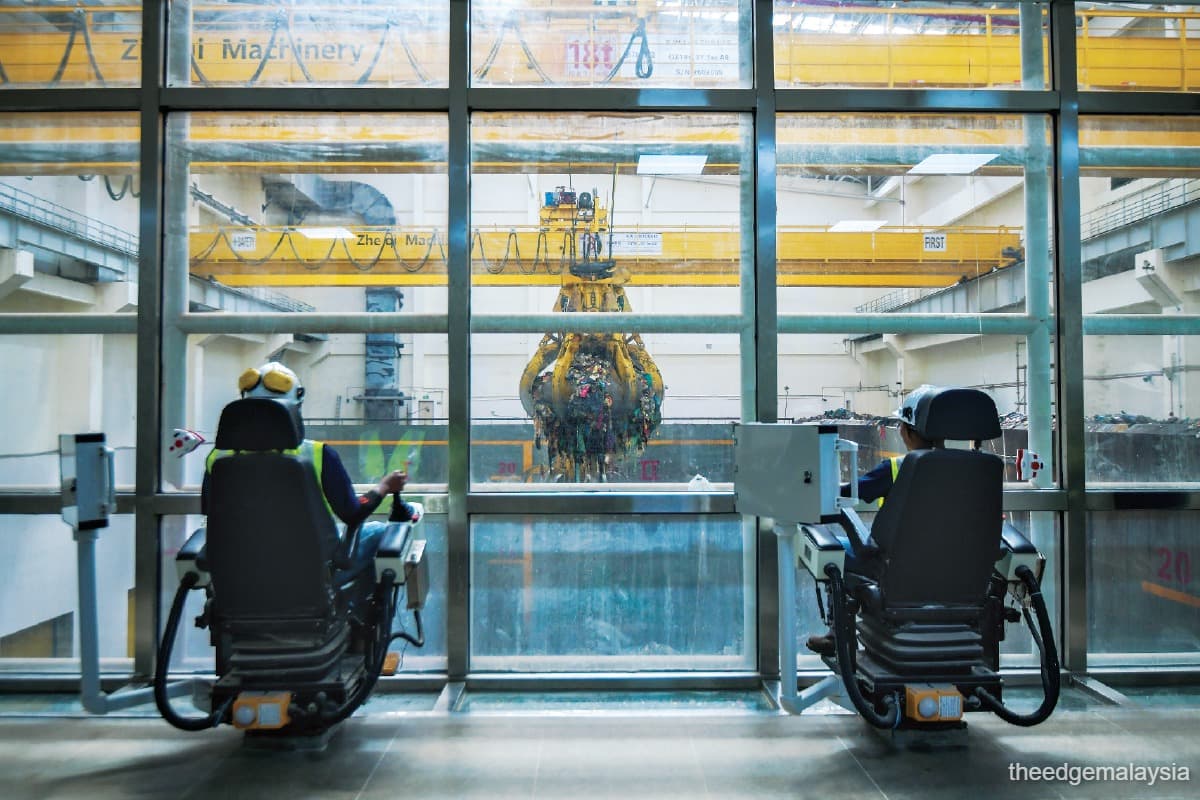
There are currently only two main commercial WTE plants operating in Malaysia: Cypark Resources Bhd’s (KL:CYPARK) Smart WTE Plant in Ladang Tanah Merah, Port Dickson, and Worldwide Holdings Bhd’s Worldwide Jeram WTE in Jeram, Selangor, which was launched on June 12.
Another WTE plant, the construction of which began in April, is being developed by Malakoff Corp Bhd (KL:MALAKOF). The Batu Arang WTE incinerator in Rawang had its environmental impact assessment recently approved.
Cypark has developed its own waste sorting facility on-site, while Worldwide Holdings and Malakoff are engaging with third-party separators to sort their waste. All have adjusted their technologies to take in mixed waste with high organic content.

Waste separation solutions deployed by WTE plants
Cypark’s WTE plant began operation in 2019. The company chose to develop a proprietary Waste Segregation Facility (WSF) so that it can separate waste in-house. The WSF segregates incoming waste into three categories: organic waste, inorganic combustible waste and recyclables.
The inorganic combustible waste is directed to the WTE plant, where it is shredded to the required size and stored in the bunker to be homogenised before being fed into the combustion chamber.
“This pre-treatment process is what allows the plant to maintain consistent combustion and energy generation. Seasonal variations in waste composition add another layer of complexity, requiring our operations team to continuously adapt daily planning,” explains Mohamed Belqaizi Mohamed Taufik, chief investment officer at Cypark.
However, because municipal solid waste arrives at the WSF unsegregated, the plant must run its mechanical separation of waste constantly and adjust for seasonal shifts in moisture levels.
This illustrates one of Cypark’s main challenges, which is customising the WTE plant to process Malaysia’s unique waste profile. Belqaizi says domestic municipal solid waste typically contains more than 50% moisture content, which is significantly wetter than the waste streams many of the conventional and international WTE technologies are designed to handle. This condition makes processing high-moisture waste result in poor combustion efficiency and reduced energy output.
On the other hand, Worldwide Holdings’ Jeram WTE plant works with third-party waste management organisations.
Danial Liew, chief operating officer and general manager of the environment division at Worldwide Holdings, says the company works with licensed recyclers, material recovery facilities (MRFs) and other parties in the waste management value chain to carry out waste segregation and recycling before it reaches the WTE facility.
“The facility incorporates a waste bunker, waste mixing mechanism and advanced combustion controls that achieve high flexibility in treating a wide range of waste. This enables stable and efficient combustion while ensuring emissions remain within stringent environmental standards,” says Liew.
Waste separation at source would make the plant more efficient, he adds. The company has plans to install a recycling facility at the plant in the future.
“The role of the Jeram WTE plant is to treat residual waste that remains after the recyclable materials have been recovered, thereby reducing reliance on landfill disposal while generating renewable energy from waste,” he says.
The Malakoff WTE plant in Melaka also works with third-party operators.
“Whatever that is delivered to our plant, we have to process, except for the waste that is non-combustible — for example, construction waste and hazardous waste. Because the waste arrives mixed, as long as it is combustible, we have to accept it,” says Hedzuan Azlee Hashim, a project manager at Malakoff.
Like Cypark, the company has to adjust its equipment to local conditions.
“We lower the calorific value in our design based on the mixed waste [profile in Malaysia]. If we design our plant at a higher calorific value, should organic waste begin arriving at our plant, we would not be able to process it,” he explains.
Additionally, Malakoff is working with its technology partner Kanadevia Corp to deploy grate-based incinerators, which is a type of industrial combustion system used to handle varying waste compositions, including those with high moisture content, and fluctuation of calorific values.

Encouraging waste separation at source
Despite the current designs of WTE plants, Cypark, Worldwide Holdings and Malakoff agree that the separation of waste before it reaches the WTE plant will result in a more efficient process.
“If the waste were segregated, we would have a better calorific value for the waste and the incineration process would be more efficient. At the same time, if we can have waste management regulated, we can think of what else can be done with the organic waste,” says Hedzuan.
Belqaizi concurs, saying that separating waste before it reaches the WTE plant improves the consistency and quality of the waste that arrives at the WSF and supports higher energy recovery rates.
In 2015, the Malaysian government tried to mandate states, under the Solid Waste and Public Cleansing Management Act 2007 (Act 672), to separate waste at source but major barriers prevented its enforcement owing to weak infrastructure, insufficient manpower and a lack of awareness, according to reports. Additionally, only six states and two federal territories had adopted the legislation.
The objective of Act 672 is to regulate solid waste and public cleansing management to maintain proper sanitation in the country. It was designed to govern the collection, management and disposal of solid waste across the participating states by enforcing separation at source, regulating public cleansing services, mandating licensing for waste handling and imposing penalties for non-compliance.
The government must provide the proper infrastructure to ensure that waste can be channelled and sorted to reach the right facilities, say the interviewees. Issues such as separated waste that is still dumped into the same bin, must be addressed.
“Separating bottles and cans is already a good start. Once we are able to establish different kinds of facilities and plants available based on the suitable technology that can be implemented for Malaysia, then I believe our society has matured [for recycling],” says Low.
He also mentions extended producer responsibility as a mechanism to push the responsibility of recycling back to the manufacturer by charging the companies for waste or encouraging producers to establish buyback centres.
Anaerobic digestion plants
Once waste is separated, organic waste, which roughly accounts for 30% to 40% of the waste stream, should be sent for anaerobic digestion to extract its full value, suggests Low.
Anaerobic digestion is a process where microorganisms break down organic matter without the presence of oxygen to produce biogas, which is then converted into renewable energy.
There are pilot anaerobic digestion plants and initiatives underway, with a large-scale plant currently being constructed in Manjung, Perak, and will be commissioned by Forward Energy Sdn Bhd.
“When we have anaerobic digestion plants ready, which is another form of treatment, that will help to divert waste out of our landfill. If we are able to take food waste out of the waste stream in a very clean manner, then we will be able to treat it at anaerobic digestion plants,” says Low.
Proper waste separation can create a system where combustible inorganic waste is incinerated, while wet organic waste is diverted to anaerobic digestion plants or for composting.
“The food waste must be cleaned, churned up, broken down and made into a stabilised slurry form. Because it will be a chemical and biological chemical process, they need to make sure that the slurry is more homogeneous. Otherwise, when you put everything in, the bacteria can be in shock,” Low explains.
Save by subscribing to us for your print and/or digital copy.
P/S: The Edge is also available on Apple's App Store and Android's Google Play.