

This article first appeared in The Edge Malaysia Weekly on August 17, 2026 - August 23, 2026

Is rising leverage in the US equity market combined with elevated valuations a warning sign for investors? Per FINRA (Financial Industry Regulatory Authority), total US investor margin debt just reached an all-time high of US$1.5 trillion in June, up by nearly 50% from this time last year and more than double from the start of 2024.
The steep increase in borrowing to buy stocks has coincided with — and likely added fuel to — the strengthening market rally. The Dow Jones Industrial Average, S&P 500 Index and Nasdaq Composite all hit fresh record highs over this period (see Chart 1).
Optimism for stocks, in turn, is underpinned by both strong earnings growth and high expectations for the unfolding artificial intelligence (AI) boom, and that is being reflected in higher-than-historical-average valuations. The trailing price-earnings ratio (PER) for the S&P 500 Index is now hovering at around 30 times, the highest level outside of crisis times (the 2020 Covid-19 pandemic, Global Financial Crisis in 2008-2009 and dotcom bubble in the early 2000s) (see Chart 2). The same goes for margin debt as a percentage of total liquid money supply, M2 (see Chart 3).


Are the dramatic near-collapse of AI-focused hedge fund Situational Awareness and the July meltdown in the South Korean equity market canaries in the coal mine?
Leverage must necessarily increase the risks and quite possibly, volatility, particularly for certain stocks and sectors, and warrants caution. But we don’t think it is a signal of the imminent danger of a broader market collapse. And it most certainly does not suggest that investors should stay on the sidelines.
The pitfalls of excessive leverage and concentrated risks
It would be wrong to extrapolate what happened in South Korea and the implosion of Situational Awareness to the broader US equity market, even though leverage (and speculation) also featured in both events.

Excessive leverage in the South Korean market (see Chart 4) was narrowly focused on single-stock leveraged exchange-traded funds (ETFs) for SK Hynix and Samsung Electronics, the two biggest listed companies on the exchange (which account for about half the total market cap of the bellwether Kospi). After the products’ launch in late-May, the leveraged ETFs became extremely popular with retail investors — because they amplify rising price gains for the two underlying stocks, which were riding high on soaring AI demand for memory chips. Worse, retail investors were chasing the stocks by using margin debt — the balance outstanding surged to a record high in late-June, up nearly 42% from end-2025 — including to buy the leveraged ETFs, adding a second layer of leverage.
Basically, to maintain their target 2x leverage, the ETFs buy more shares when prices rise and sell when prices fall. In effect, this daily rebalancing mechanism amplifies gains on the way up but also magnifies losses on the way down. The latter happened when the chip rally reversed in July — when over-optimistic expectations got a reality check. Reports estimated that retail investors lost some US$39 billion in the ensuing rapid deleveraging.
US-based hedge fund Situational Awareness’ spectacular unravelling in the same month was similarly triggered by price declines for the same group of stocks. The hedge fund reportedly used as much as four times leverage, borrowing heavily to make aggressive AI bets. When prices for the chip sector started falling, it led to outsized declines in the fund’s value, resulting in margin calls from lenders. But as Situational Awareness sold down its holdings to meet the margin calls, it further depressed prices, leading to even more margin calls. The fund was in effect driving its own portfolio value down. Once its financial troubles were known, few investors would step in to catch the falling knife. Ultimately, Situational Awareness sold its public-listed portfolio that was financed with borrowed money to its rival, Citadel, at a discount, rather than perpetuating the vicious cycle. Some reports suggest the fund had by then lost two-thirds of its estimated US$45 billion value.
The fault line in both the South Korean market and Situational Awareness crises is obvious — excessive leverage and concentrated risks. Borrowing to buy stocks is already a risky proposition. Concentration on a handful of stocks made it worse. Stock prices don’t only go up, they go down too. Margin calls will force you to liquidate at depressed prices, if you cannot come up with the additional cash.
Demand vs supply
While the absolute US$1.5 trillion in US margin debt may sound alarming, one must also recognise that the US equity market has been growing rapidly and is enormously larger, with unrivalled depth and breadth compared with the rest of the world. Case in point, margin debt as a percentage of total market capitalisation (leverage relative to equity collateral) remains well within the historical range of the past three decades (see Chart 5).
The equity market, like all markets, is driven by demand and supply. And demand for US stocks remains robust.


US stocks are drawing increasing capital from global investors. The rise of platforms like Interactive Brokers (IBKR) and Moomoo have made it remarkably easy to trade US stocks, near-frictionless accessibility at very cheap or zero commission (see Chart 6).
Another major source of demand is domestic retail investors. Retail participation surged during the pandemic, fuelled by lockdowns (more free time) and the democratisation of investing through social media platforms such as Reddit (the sharing of investment ideas) and zero-commission trading apps like Robinhood.

Margin debt is rising and, yes, so is the increasing popularity of leveraged/inverse ETFs. There is no question, leverage adds risks and volatility. But the risks are more diversified, in terms of underlying stocks, sectors, indices and products. For instance, while leveraged ETFs can account for up to 40% of total ETF trading volume, they make up little over 1% of the total US$15.6 trillion invested in US ETFs. Chart 7 shows how US market volatility (the CBOE Volatility Index, VIX) remained relatively stable during the recent chip-stock rout.
High valuations not necessarily irrational
We think that most investors, like us, are clear-eyed about investing in this AI boom. We know that not every AI stock can be a winner. In fact, many more will probably fail. But we also believe the AI transformation is real. It will change our way of work and life, and significantly raise productivity across the entire economy.
What we are less certain about is the exact timetable and even less sure who the eventual winners will be. But the winners, we think, would win so big that their gains will more than offset the losses from those that fail. It is ultimately a question of expected returns and the asymmetry of the payoff.
Few investors can afford to sit on the sidelines and miss out on the potentially huge returns.
Uncertain ROI: AI infrastructure capex is now larger than the telecom boom
Having said that, we are also realistic about return expectations in the short to mid term.
For starters, in the last few years, S&P 500 returns were driven largely by the mega-cap tech stocks, the so-called Magnificent Seven. And part of this is attributed to share buybacks. These companies historically run asset-light platforms with fat margins and generate massive cash flows. Apple, Alphabet, Meta and Microsoft have undertaken the largest share buybacks among listed peers, returning excess cash to shareholders.
Share buybacks affect both demand and supply in the market. Companies buying back shares tend to be less sensitive to short-term market sentiment, providing a steady source of demand and stabilising effect during market weakness. Buybacks also reduce supply, by removing shares from the market. A smaller share base equals higher earnings per share. Higher demand + smaller supply = positive driver for share prices. That’s changed.
Massive capex for AI infrastructure is rapidly shrinking their huge positive free cash flows. Instead of spending massive amounts on buying back shares, they are raising money from the capital markets, including issuing new shares, for capex. Case in point, Alphabet just reported its first-ever negative free cash flow since listing and is set to raise up to US$85 billion (US$45 billion completed) in equity this year. Just this month, it issued another US$25 billion in bonds. Meta has paused its share buyback since 4Q2025, issued US$55 billion in bonds over the past year and is reportedly weighing raising tens of billions in equity. Its 2Q2026 free cash flow fell to just US$784 million from US$8.55 billion a year earlier.
Additionally, mega initial public offerings (IPOs) such as that of SpaceX and secondary listings like SK Hynix are adding to the supply side of the market equation. Year to date, US IPOs have raised more than US$142 billion, almost five times the amount raised in 2024. There is a finite global savings and pool of investable capital at any one point — and there is much more competition for investor dollars today. This could be one reason why the market is seeing more rotation between themes-sectors, such as from Big Tech to chip stocks and back, rather than a stronger, broader-based rally. There have also been big outflows from emerging markets into US AI stocks.

Plus, the AI capex is huge by any yardstick. Just four companies — Alphabet, Meta, Microsoft and Amazon — are allocating US$700 billion to US$800 billion this year (see Chart 8). That is roughly 2.5% of US gross domestic product and could reach as high as 4% of GDP in 2028 — well above the 1990s telecom boom (roughly 1.5% of GDP at peak investment intensity).
It is making investors jittery — whether the huge investments can generate the required rate of return. As we wrote before, railroad, electricity and fibre cables were all transformative technologies. Yet, the biggest returns did not accrue to the companies that built those infrastructure. Indeed, some of those early builders failed.
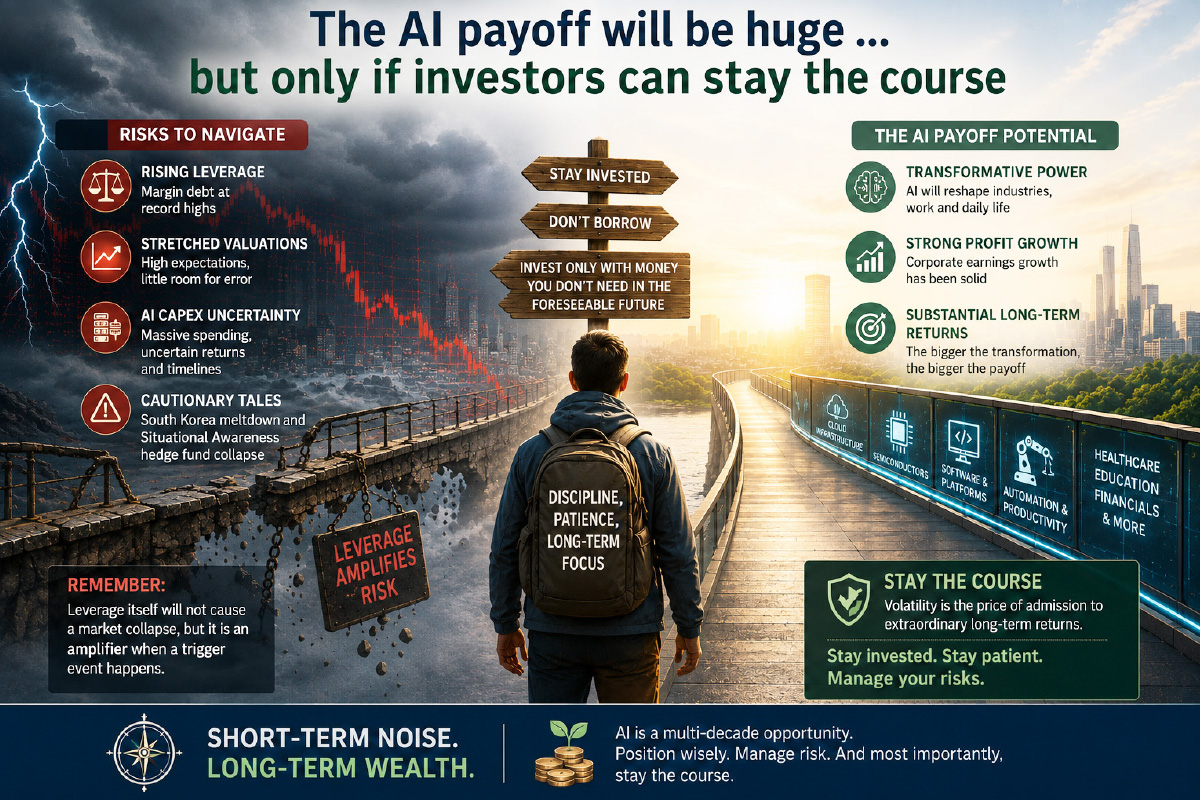
The AI payoff will be huge … but only if investors can stay the course
The combination of rising leverage, stretched equity valuations and uncertainties on massive AI capex and returns raises the risks. Although leverage in the US is more dispersed and its equity market depth and breadth is significantly larger, what happened in South Korea and at Situational Awareness should still be cautionary tales.
That said, given the probability of a huge AI payoff, current high valuations are not necessarily irrational, especially since corporate profit growth, thus far, has been strong. But high expectations also mean room for disappointment, if and when reality falls short. Remember, leverage itself will not cause a market collapse but it is an amplifier when a trigger event happens.
The transformative power of AI is real and we believe there are substantial returns to be made over the long term. But you must be able to stay invested long enough to see those returns materialise. That means not borrowing, and investing only with money you do not need to draw on in the foreseeable future.

Portfolio commentary
The Malaysian Portfolio fell 0.9% for the week ended Aug 12. The only winner was Kim Loong Resources Bhd, whose shares gained 0.7%, while the biggest losers were United Plantations (-2.3%), Hong Leong Industries (-2.1%) and Malayan Banking (-2.0%). Total portfolio returns now stand at 222.7% since inception. This portfolio is far outperforming the benchmark FBM KLCI, which is down 4.8% over the same period.
The Absolute Returns Portfolio, on the other hand, was up 0.7% last week. The gain lifted total portfolio returns to 35.0% since inception. The top gainers were Talen Energy Corp (+10.7%), Thermo Fisher Scientific (+4.4%) and Schneider Electric (+3.4%). Alphabet Inc - CL C (-4.9%), Alibaba Group Holding (-4.3%) and Sun Hung Kai Properties (-3.4%) were the notable losers.
The AI Portfolio was down 1.0% over the same period, paring total portfolio returns to 32.2% since inception. The top gainers were Hewlett Packard Enterprise (+10.5%), Unusual Machines (+5.1%) and Naura Technology (+3.6%) while the biggest losers included Datadog (-14.9%), Alibaba (-4.3%) and Cadence Design Systems (-4.1%).
Disclaimer: This is a personal portfolio for information purposes only and does not constitute a recommendation or solicitation or expression of views to influence readers to buy/sell stocks. Our shareholders, directors and employees may have positions in or may be materially interested in any of the stocks. We may also have or have had dealings with or may provide or have provided content services to the companies mentioned in the reports.
Save by subscribing to us for your print and/or digital copy.
P/S: The Edge is also available on Apple's App Store and Android's Google Play.