

This article first appeared in The Edge Malaysia Weekly on August 17, 2026 - August 23, 2026
Malaysia’s rubber industry is at a crossroads. The rubber cultivation area in the country, once the world’s largest producer, has declined over the years.
Of the approximately one million hectares still under rubber cultivation, around 400,000ha lie untapped. Ageing smallholders, depressed prices and a younger generation reluctant to endure the pre-dawn labour of rubber tapping have further weighed on production, relegating Malaysia to ninth place globally.
In 2025, Malaysia’s natural rubber production fell 12.9% (49,836 tonnes) to 336,676 tonnes, according to the Malaysia Rubber Board (MRB).
Rubber manufacturers, grappling with declining domestic natural rubber output, are increasingly relying on imported raw materials and greater use of synthetic rubber. Synthetic rubber, which is derived from petrochemicals, is widely used in technical and engineering products, and in some glove and tyre applications where cost stability and material consistency are priorities.
But synthetic rubber has its limits. Natural rubber’s high elasticity, durability and heat resistance cannot be fully replicated synthetically, which is why manufacturers of larger tyres for trucks and buses still require it.
As such, manufacturers are increasingly looking beyond Malaysia’s borders — sourcing natural rubber from Thailand, now the world’s largest producer, and emerging suppliers such as Ivory Coast.
That said, industry stakeholders argue that the global shift toward traceable and sustainably sourced rubber could allow Malaysia to stake a claim in supplying rubber to the international markets.
Global buyers and regulations like the European Union Deforestation Regulation (EUDR) now require proof that rubber is deforestation-free, legally compliant and traceable from plantation to exporter.
Even though implementation of the regulation has been delayed to December this year, preparations across the industry have continued as companies build traceability systems and compliance frameworks ahead of enforcement.
For instance, tyre manufacturer Continental requires suppliers across its natural rubber supply chain to demonstrate compliance with responsible sourcing standards, including legal compliance, environmental safeguards and supply chain traceability, says Michael Radke, its head of sustainability in purchasing.
Similarly, Cyrille Roget, scientific and innovation communication director of Michelin Group, adds that the firm is actively onboarding and supporting suppliers, including those in Malaysia, to meet sustainability requirements.

“Expectations are clear: suppliers that cannot demonstrate traceability and compliance will be unable to supply Michelin. Our supplier communication sets out the technical standards and data needs; timelines are tied to the regulation’s application and our internal global roll-out, which is already in effect,” says Roget.
Continental and Michelin are among the world’s biggest tyre manufacturers, and Malaysia is part of both companies’ sourcing base.
Malaysia’s largest international buyers of natural rubber are global tyre manufacturers and automotive companies — particularly in Europe, North America and Asia — that source significant volumes for tyres, industrial rubber goods and automotive components.
Similar expectations are present in the glove sector. Sustainability considerations are becoming more prominent in procurement and supply chain management as global customers increasingly prioritise responsible sourcing and transparency in natural rubber supply, says a spokesperson from Top Glove Corporation Bhd (KLSE:TOPGLOV).
The spokesperson says the company prioritises suppliers that demonstrate strong ESG practices, including transparent supply chain traceability, responsible land and resource management, and respect for labour standards.
“The tyre sector is highly focused on traceability and deforestation compliance. The glove sector faces strong expectations around environmental management, water usage, waste treatment, packaging reduction and social compliance standards,” says Muhammad Eizaaz Muhammad Redzuan, CEO of the Malaysian Rubber Council, an agency under the Ministry of Plantation and Commodities (KPK) responsible for promoting Malaysian rubber products.
“Natural rubber is included in the EUDR list of seven commodities, and all industries that are exporting to the EU are demanding sustainable rubber. Sustainability is increasingly becoming a prerequisite for market access rather than a differentiator,” says Muhammad Eizaaz.
In this environment, Malaysia’s ability to demonstrate traceability and regulatory oversight could become increasingly important.
The country might no longer compete on scale with larger producers, but stronger governance, traceability systems and sustainability compliance could allow Malaysia to carve out a role in supplying verified rubber to global markets.
“With the current demand, quality alone is not enough. You have to incorporate sustainability, and we see this as our next area of competitive advantage. Eventually, we will not be able to compete with other countries on general rubber products. Malaysia will differentiate itself, going only for niche, premium and sustainable. We don’t have the raw material to compete with them, as they have four to five times more area than us,” says Datuk Dr Zairossani Mohd Nor, director-general of MRB, which is the custodian of the rubber industry in Malaysia under KPK.

Traceability is in demand
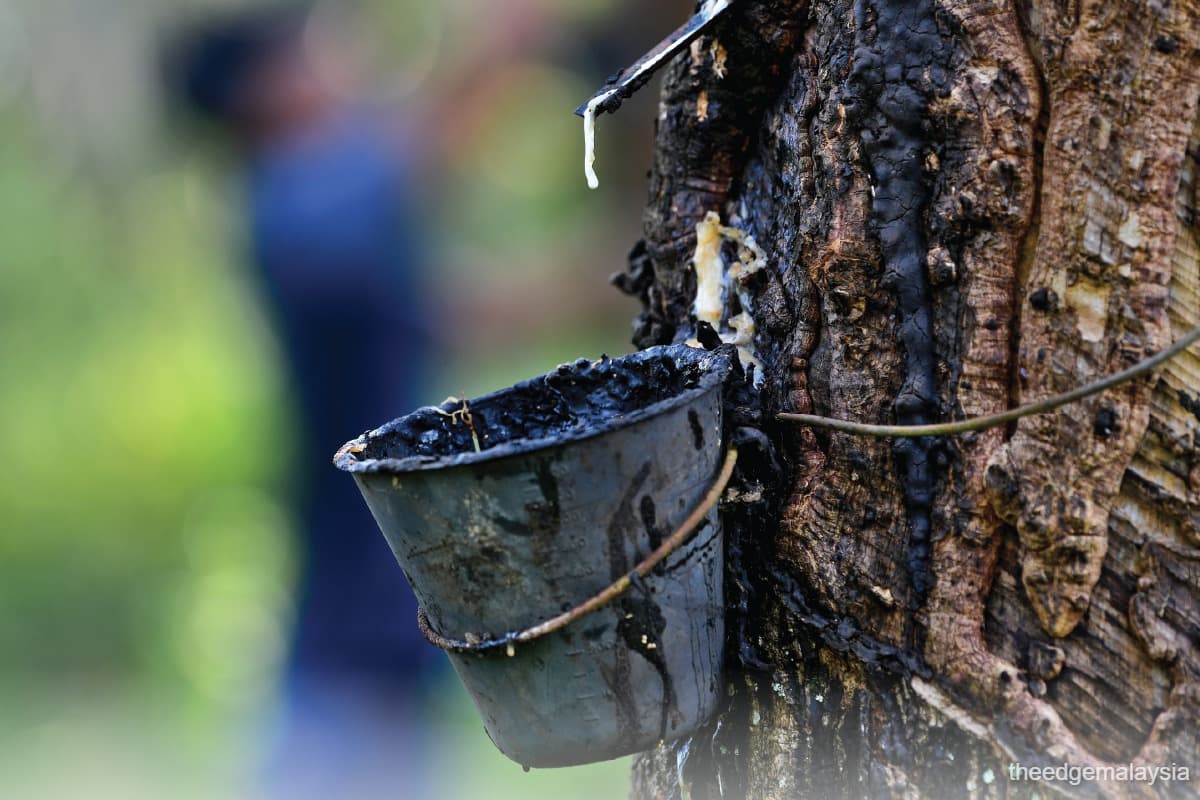
A rubber tree generates value through two main streams over its lifetime. For about 20 to 25 years, latex is tapped from the bark and processed into concentrated latex or rubber sheets, which are then used in products such as surgical gloves, mattresses, tyres and industrial components.
The cup lump becomes block rubber for heavy-duty applications such as conveyor belts and automotive parts. Once the tree can no longer produce latex economically, the timber is harvested and turned into products such as furniture, plywood and flooring.
Global buyers are seeking full traceability, which is the ability to track rubber from plantation to final product, as part of broader sustainability and due diligence requirements.
This is especially important as the EUDR kicks in, even if the rubber is not sold directly to Europe. The main export destinations for Malaysia’s natural rubber in 2024 were China (64%), the EU (11%) and the UAE (6%).
Even if the natural rubber is exported to China, the country’s downstream rubber manufacturing sector is still subject to regulatory pressures, as Chinese tyre and rubber goods exported to the EU must comply with EUDR traceability requirements, including proof that raw materials are deforestation-free and legally sourced, according Fern and BellaTerra Consulting’s 2026 report “Insights on EUDR requirements for trade flows linked to China”.
Malaysia’s main hurdle to achieving full traceability in rubber production is its fragmented base: about 90% of cultivation is carried out by smallholders operating small plots scattered across rural areas.
A smallholder is defined as a landowner with a plantation area not exceeding 40ha, according to the Rubber Industry Smallholders Development Authority (Risda).
To address this challenge, MRB introduced the Malaysian Sustainable Natural Rubber (MSNR) standard, which is a national system to ensure that rubber produced in the country meets global sustainability and traceability expectations.
MSNR was designed to align with EUDR requirements, says Zairossani. In December 2024, Malaysia exported its first 200 tonnes of MSNR-compliant rubber to the EU — 100 tonnes by Lee Rubber Group Sdn Bhd to Slovakia and another 100 tonnes by Seng Hin Rubber (M) Sdn Bhd to the Netherlands.
MRB has also engaged with international bodies including the European Forest Institute, Deutsche Gesellschaft für Internationale Zusammenarbeit, the Team Europe Initiative as well as EU operators to ensure that MSNR meets the requirements of the EUDR.
MSNR is embedded within Malaysia’s regulatory and licensing framework rather than operating as a certification scheme. Its legal authority comes from Parliamentary Act 551, known as the Rubber Act, which empowers MRB to develop and enforce regulations across the industry.
In this regard, smallholders must obtain a Permit Autoriti Transaksi Getah (PAT-G) — a digital permit containing land ownership, geolocation and tree profile data —to sell their rubber. When transactions occur, dealers input the permit information into the system, ensuring each batch remains traceable as it moves through the supply chain. Because MSNR forms part of the regulatory structure, enforcement and penalties can be imposed for non-compliance.
Zairossani says this regulatory approach was a deliberate choice shaped by the structure of Malaysia’s rubber sector. In palm oil, about 60% of land is owned by commercial estates that can absorb certification costs. But with more than 90% of rubber held by smallholders, the country opted to embed sustainability into existing licensing requirements rather than impose separate certification fees.
MSNR plays a key role in enabling end-to-end tracking of natural rubber from plantation to finished product, including through MSNR Trace, a mandatory digital system for rubber processors and traders to declare transactions related to purchasing, processing, sales and inventory.
Licence and permit holders under MRB who seek MSNR recognition are required to record their transactions within MSNR Trace as a condition of that recognition. Non-compliance carries fines of up to RM50,000, imprisonment of up to two years, or both.
It also allows exporters to generate a due diligence report, which serves as an official document of MSNR compliance that can be submitted to buyers as proof of compliance and to enable premium payments for rubber that meet sustainability standards.
Since enforcement began in January 2025, MRB has carried out field inspections and compliance checks across the industry, including geolocation mapping of plantations and verification of licence holders.
MSNR is built around five core principles: no deforestation for new rubber plantations, compliance with national land laws, environmental sustainability, social and labour standards, and full supply chain traceability. In 2026, the implementation of MSNR will be expanded to Sabah and Sarawak.
FSC moving into sustainable rubber certification in Malaysia
On the other hand, the global voluntary certification scheme from the Forest Stewardship Council (FSC), known for certifying responsible forest management, has moved into natural rubber certification in Malaysia, extending its timber and forest products framework to plantation crops.
FSC Malaysia launched its rubber initiative through a pilot project in Sabah in 2023, initially certifying 56 smallholders managing 183ha. The programme has since expanded to more than 1,300 smallholders covering about 7,300ha across Sabah and parts of Peninsular Malaysia including Melaka, Perak and Selangor.
The programme in Sabah began with latex and cup lump, and is now extending into rubberwood. Peninsular Malaysia is taking the reverse approach, starting with rubberwood to generate early revenue before gradually expanding to latex and cup lump.

Strong demand for FSC-certified rubberwood allows certificate holders to generate income early and finance the development of the wider supply chain without depending on external funding, says Charmaine Chee, country director of FSC Malaysia.
FSC certification requires compliance with standards covering environmental protection, biodiversity conservation, labour rights, community relations and responsible forest management, and verified through independent audits by accredited certification bodies. Certificates are valid for five years and subject to annual surveillance.
FSC certification does not automatically equal EUDR compliance. However, it provides many of the building blocks needed for compliance, such as verified forest management practices, traceability through chain-of-custody systems, independent third-party auditing and risk assessment mechanisms, says Chee.
For products to carry the FSC label, every stage of the supply chain — from plantation to processor to final manufacturer — must hold FSC chain-of-custody certification. A single uncertified link breaks the chain, and the label cannot be applied.
FSC-certified rubber is already used internationally in tyres, footwear, sports equipment and medical goods, with brands including Pirelli, Birkenstock and Lululemon among those incorporating certified rubber into selected products.
“If the chain is broken, you can’t put the label on it, because how are you, as a consumer, assured that it hasn’t been mixed with non-FSC certified materials? That’s why it needs to be certified all the way,” says Chee.
“If you’re FSC certified and you sell to me as a midstream processor, I have to be certified too, because I want my claims to be FSC certified. You pass on the FSC claim to me, and I pass it on further down the chain. Only the end manufacturer, the one who puts out the final product, can carry the label. And only if they’re certified. That’s how consumers get the assurance.”
In Malaysia, demand for certified rubber is still largely driven by overseas buyers rather than domestic. While the number of chain-of-custody certificate holders in the country is growing, producers remain cautious about investing in certification without stronger and more consistent demand signals from downstream buyers, observes Chee.
Boosting supply to meet demand
Malaysia requires an estimated 300,000 to 400,000 tonnes of latex annually, yet domestic production stands at around 40,000 tonnes. Roughly 90% of what the glove industry needs is imported, primarily from Thailand and Vietnam, according to MRB’s Zairossani.
However, MSNR can only trace domestically produced rubber. As a result, only about 10% of glove production in Malaysia can presently comply with MSNR standards, since only 10% of the latex used is locally sourced.
The goal, says Zairossani, is to eventually use all domestic raw rubber for local manufacturing and export only higher-value finished products. To achieve this, the industry must revive smallholder production and bring idle plantations back into use.
He says Malaysia has the capacity to produce around 1.5 million tonnes of total rubber output annually, yet actual output sits at roughly 500,000 tonnes. Around 400,000ha of rubber plantations — nearly half of the country’s one million hectares — is untapped.
Smallholders have largely stopped tapping because returns are too low relative to other crops and the work is physically demanding, often beginning in the early hours of the morning.
Based on Risda census data for 2023, there were a total of 508,850 rubber smallholders, including both mature and non-yielding plantations. According to MRB, 311,878 smallholders held a PAT-G.
If sustainability premiums and stronger market demand materialise, stakeholders believe smallholders could be incentivised to reactivate idle plantations or increase tapping, helping raise domestic rubber supply over time.
FSC’s Chee says sustainable natural rubber and rubberwood connect Malaysian smallholders to global markets that increasingly require traceability and verified sustainability. So far, the rubberwood sold with FSC-certification has been able to command a premium.
FSC Malaysia works with CMO International to onboard and train smallholders. CMO’s role covers sustainability education, FSC compliance guidance and digital recordkeeping, which maps each smallholder’s landholding and supports traceability for both FSC and EUDR purposes.
Under MSNR Trace, the system identifies exactly which smallholder supplied which material, making it possible to channel sustainability premiums to the source rather than having them absorbed elsewhere in the supply chain, adds Zairossani.
In international business-to-business markets, Technically Specified Rubber (TSR) meeting EUDR requirements is currently attracting a premium of US$150 to US$350 per metric tonne. TSR refers to processed natural rubber that has been graded according to standardised technical specifications.
Save by subscribing to us for your print and/or digital copy.
P/S: The Edge is also available on Apple's App Store and Android's Google Play.