

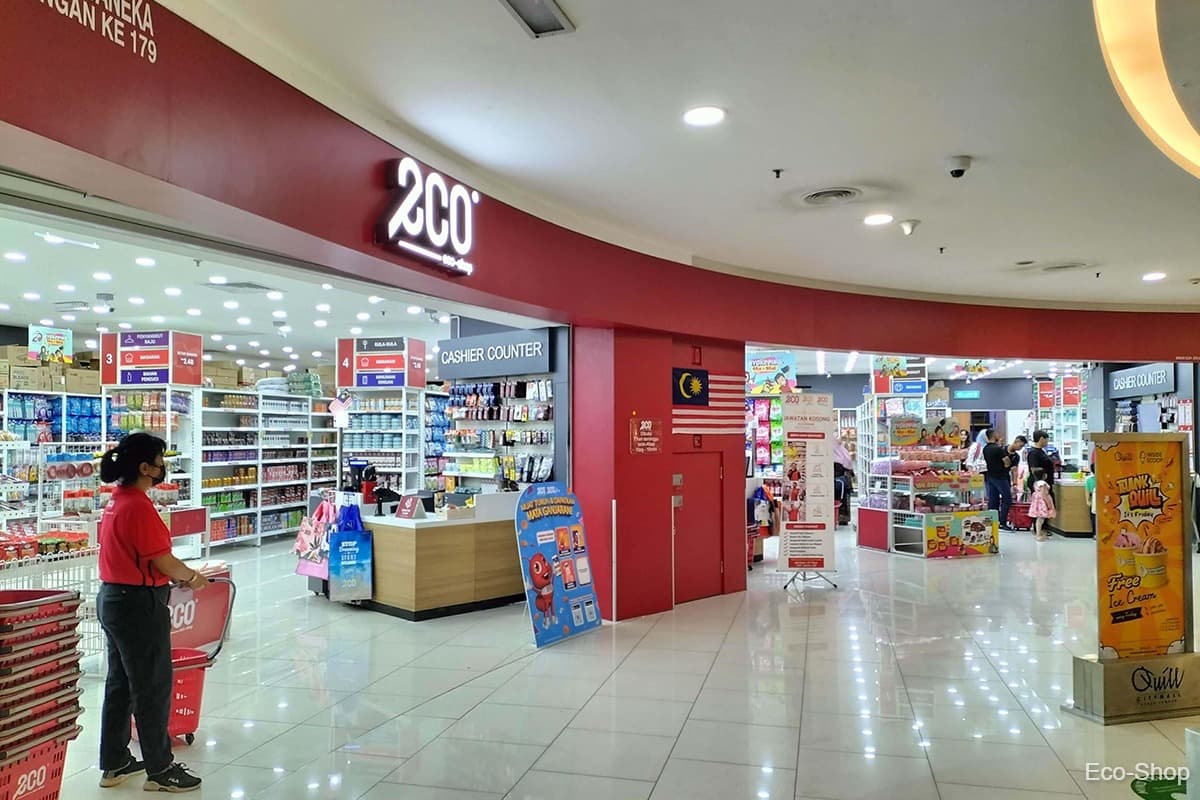
KUALA LUMPUR (Aug 14): CIMB Securities has initiated coverage of Eco-Shop Marketing Bhd (KL:ECOSHOP), Malaysia's largest fixed-price retailer, likening its growth profile to Mr DIY Group (M) Bhd (KL:MRDIY) but noting it lacks the latter's strong dividend track record.
"We initiate coverage of Eco-Shop, Malaysia's largest fixed-price retailer with 462 outlets, underpinned by a compelling value proposition and tailwinds from consumer downtrading activities amid current inflationary pressures," the house said in a note on Friday, assigning a 'hold' call to Eco-Shop, with a target price of RM1.50.
"This valuation reflects Eco-Shop’s stronger growth profile versus Mr DIY, but accounts for its lack of Mr DIY's strong dividend track record.
"While both Eco-Shop and Mr DIY have benefitted from consumer downtrading, Eco-Shop remains the absolute beneficiary owing to its fixed-price retailing positioning to price-sensitive consumers," it said.
The retailer, which operates under a headline RM2.60 fixed-price model, recently reported a record gross-profit margin (GPM) of 33.3% in the financial year ended May 31, 2026 (FY2026), up sharply from 19.6% in FY2022.
This milestone is consistent with their stable margin uptick over the last few years and reflects a solid growth strategy within the company, as it becomes more profitable despite low-price propositions.
Moving forward, CIMB Securities forecasts a 16.2% three-year (FY2026-FY2029) core net profit growth and a top-line growth of 14.8%.
Analysts suggest that the group’s main growth avenue is its net store expansions.
Eco-Shop currently operates 462 stores nationwide, and management plans to add a further 255 new stores within the next three years.
The expansion is expected to help the group capture continued demand for affordable, low-priced items as Malaysians engage in downtrading — a practice where consumers opt for lower-priced alternatives amid economic volatility and tighter household budgets.
At the same time, the retailer’s improving margins are supported by lower procurement costs and a growing range of house brand products, driving prices even lower than competitors.
“Higher-margin house brands drove 60% of sales in FY2026, supporting continued gross profit margin expansion,” said CIMB as the group aims to sustain this margin trajectory by shifting its sales and inventory mix towards higher-margin products.
Moreover, Eco-Shop’s focus on essential high-turnover goods such as cleaning supplies and personal care items also provides sales resilience as consumers continue to purchase everyday necessities even when budgets tighten.
This gives the group a relatively steady source of demand, rather than depending on market trends and changing consumer preferences.
However, CIMB noted that Eco-Shop’s strength — its price point of RM2.60 in West Malaysia and RM2.80 in East Malaysia, could also become its weakness.
Customers often associate the brand with affordability rather than product quality or assortment, which can be difficult to sustain and provides limited customer stickiness.
As such, it becomes difficult to raise prices, as any price hike would directly affect customer loyalty and can hardly pass unnoticed as general inflationary costs.
Analysts also warned of other key risks such as underperforming sales, a reversal in gross profit margin due to cost pressures, and currency depreciation, as over 65% of Eco-Shop's products are sourced from China.