

This article first appeared in The Edge Malaysia Weekly on August 17, 2026 - August 23, 2026
TEO SENG CAPITAL
Over the three financial years ended Dec 31, 2025, Teo Seng Capital Bhd (KL:TEOSENG) generated an aggregate net profit of RM481.27 million, while delivering average annual shareholder returns of 15.24%, as the group’s share price nearly tripled over the three-year period to an adjusted 89 sen as at March 2026, from 33.8 sen.
For a company operating in an industry vulnerable to cyclical commodity shifts and raw material cost spikes, those are remarkable numbers, reflecting a business that has mastered capital efficiency and tight operational execution.
Its overall stellar track record — as highlighted by its adjusted three-year earnings compound annual growth rate (CAGR) of 69.8% and a weighted return on equity (ROE) of 28.3% — earned Teo Seng the grand prize of Centurion of the Year at The Edge Malaysia Centurion Club Corporate Awards 2026, which honours standout performers among Bursa Malaysia-listed companies with a market capitalisation of under RM1 billion.
The 56%-owned subsidiary of Leong Hup International Bhd (KL:LHI) also clinched its third consecutive Highest Growth in Profit After Tax Over Three Years award in the consumer products and services category. Over the evaluation period, net profit surged from its FY2022 base of RM21.6 million to RM155.8 million in FY2023, to peak at a record high of RM183.4 million in FY2024, before easing to RM142.1 million in FY2025. It also consistently distributed dividends throughout the three-year period, paying out a total of RM87.1 million, representing 18.1% of its total aggregate net profit.
While earnings dropped in FY2025, net profit remained solidly above the RM100 million mark, as top line stayed comfortably above the RM700 million mark for the third straight year, at RM735.9 million. Though down from RM753.77 million in FY2024 and RM760.98 million in FY2023, this remains significantly higher than its FY2022 baseline of RM651.97 million.
The moderation of both earnings and revenue was primarily driven by lower average selling prices, as Malaysia’s table egg industry underwent a structural transition, with the phasing out of subsidies and price controls from mid-2025. While lower average selling prices weighed on revenue, the group managed to deliver higher sales volume, reflecting resilient demand and improved operational efficiency.

The transition meant that egg prices are now entirely dictated by market forces, and poultry producers can no longer rely on pricing floors or subsidies to support their profitability or buffer them against operational headwinds. But Teo Seng wasn’t caught unawares by this.
In anticipation of the phaseout, it had been busy improving productivity and expanding capacity through disciplined capital allocation. This is reflected in its strong double-digit return on equity (ROE), which came in at 33.48% in FY2023, peaked at 38.39% in FY2024, before settling at 21.1% in FY2025. Even as net profit normalised from record highs and its equity base expanded through reinvestment, Teo Seng still delivered formidable capital returns.
Scale was central to its strategic response because it allows fixed costs to be spread across higher production volumes while improving procurement efficiency for feed — the industry’s largest cost component. The group knows that as market pricing becomes increasingly competitive, cost leadership will become a more important differentiator.
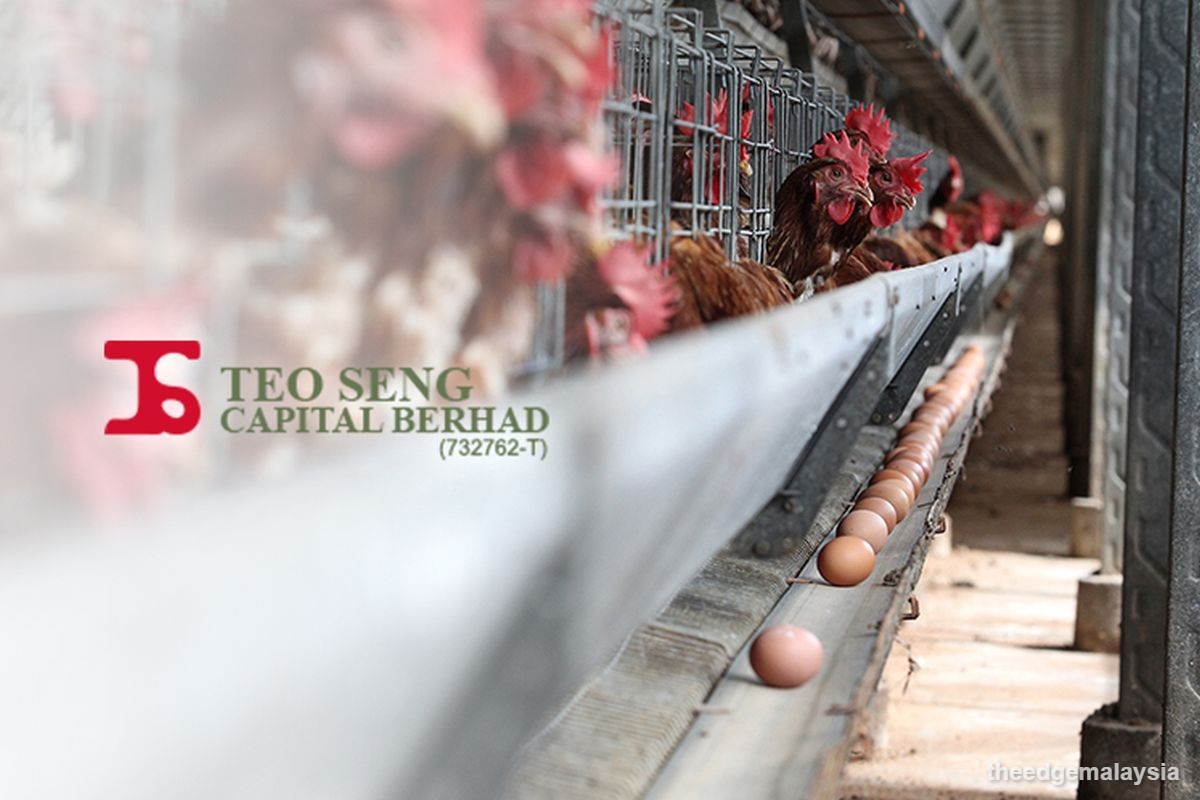
During FY2025, the group completed a new automated layer farm in Yong Peng, Johor, adding capacity for about 270,000 birds and increasing its network to 25 farms. This expansion supports Teo Seng’s target of producing five million eggs daily, compared with around four million eggs two years ago. Modern closed-house farming systems, automated egg collection and robotic flock monitoring are expected to improve productivity while enhancing biosecurity and reducing labour dependence.
“It signifies a major milestone in our strategic commitment to continually refine and elevate our existing operations,” Teo Seng said in its Annual Report 2025.


Producing more eggs is only one aspect of its strategy. Historically known as a producer of shell eggs, Teo Seng is increasingly focused on extracting greater value from every egg it produces through downstream food processing.
Its boiled egg business has already established a foothold domestically and recently secured approval to export to Singapore, opening a higher-value regional market. Building on that, the group rolled out egg mayonnaise for business-to-business customers and is preparing to expand production once operations stabilise.
Several additional downstream initiatives are also taking shape to capture untapped market segments, including a liquid egg production line that is being developed to supply bakeries, confectionery manufacturers and biscuit producers requiring pasteurised egg products with a longer shelf life.
Another is the group’s new old-hen processing plant, which is nearing commercial operation after completing equipment installation and entering the commissioning phase.
“Once in full swing, this facility will enable us to capture greater economic value from old hens by optimising depopulation schedules, improving storage capacity and unlocking new opportunities in downstream processing,” Teo Seng said.
These initiatives are designed to reduce earnings volatility by increasing exposure to value-added food products, where margins tend to be more resilient than commodity shell eggs.
Underpinning its financial performance is the group’s deeply integrated operating model. Unlike many regional poultry producers that outsource key functions, Teo Seng manufactures its own chicken feed and paper egg trays, operates in-house waste management facilities and distributes animal health products alongside its core layer farming business.
“Our integrated poultry model allows us to have feed, egg trays, waste management, downstream processing and animal health product divisions that complement each other seamlessly, driving a powerful synergy contribution that enhances overall efficiency and growth,” the group explained.
As the group entered FY2026 — its first financial year post-subsidies — early results showed a normalisation of earnings that was in line with expectations. Unaudited net profit came in at RM14.75 million for the first quarter ended March 31, 2026, compared with RM41.12 million in the corresponding quarter in FY2025. Revenue grew 9.5% to RM184.56 million from RM168.58 million, driven by higher volumes of eggs sold and stronger contributions from its animal health products division, proving that demand remains robust.
As Malaysia’s egg industry enters a new era of open-market competition, it will be interesting to see how Teo Seng navigates the journey ahead with its expanded scale, continuous downstream value creation and integrated cost leadership. The group also recently welcomed a new managing director, Nam Ya Jun, who succeeds his uncle Nam Hiok Joo, who held the post for about eight years.
“Honestly, we tried our best and we’ve been improving our quality. We’ve got premium eggs now too. We let our birds listen to music — happy birds, happy eggs. We are very honoured [by the awards]. Thank you for this recognition. It’s all possible with teamwork,” Teo Seng’s executive chairman Lau Jui Peng said after receiving the awards for the team. “Now, with our young team, young and aggressive with our new managing director, we hope we can continue [to outperform]. The pressure’s on them now,” he quipped.
Save by subscribing to us for your print and/or digital copy.
P/S: The Edge is also available on Apple's App Store and Android's Google Play.