

_0.jpg&w=1920&q=75)
(Aug 13): Prime Minister Sanae Takaichi’s government is supportive of a near-term rate hike by the Bank of Japan (BOJ), with the next move likely either in September or October, according to people familiar with the matter.
The central bank’s fears over yen weakness driving up prices and the government’s desire to strengthen the impact of the recent US-Japan currency intervention are aligning them on the need for a near-term raise, the people added.
While Japan’s central bank has legal independence over monetary policy, it is also required to maintain close contact with the government on economic policy goals. Takaichi’s Cabinet can’t force the BOJ to set specific interest rates, but can send signals that might influence its decisions.
The prime minister’s office said in an emailed statement that “we believe specific monetary policy measures, including interest rate hikes, should be left to the Bank of Japan”. The central bank should work closely with the government to achieve the 2% inflation target in a “stable manner,” it added. The BOJ declined to comment.
The yen strengthened to 159.18 against the dollar following the news from around 159.46, while yields on benchmark 10-year government bonds edged up.
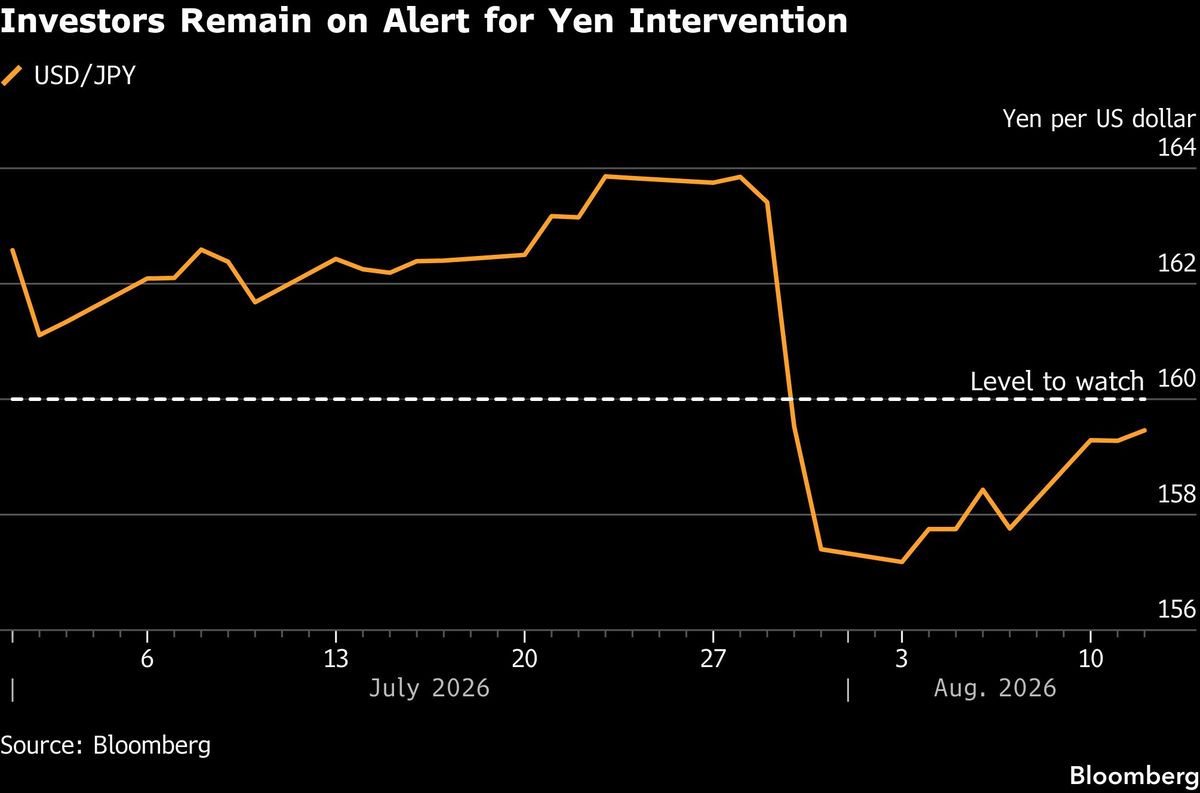
The benefits of the first joint US-Japan intervention with yen purchases since 1998 are already fading. Expectations are now building for the BOJ to join efforts to bolster the currency — a move US Treasury Secretary Scott Bessent has signalled he believes is necessary.
Speaking at a briefing after the central bank stood pat on July 31, governor Kazuo Ueda alluded to the possibility of accelerating the pace of rate hikes, citing concerns about the risk of upward pressure on prices. Later that day, the US stepped into the currency market in a coordinated move with Japan to bolster the yen.
The government had conveyed to the BOJ before the July meeting that it would support Ueda making hawkish comments at his press conference, according to one of the people.
Central bank officials still want to assess developments in the economy and prices before making any final decision on the timing of the next hike, but aren’t ruling out a September move, the people added. As of Thursday lunchtime in Tokyo, traders were pricing in a 74% probability of a rate increase when the BOJ next decides policy on Sept 18.
Takaichi has long been considered wary of taking interest rates too high, too fast and snuffing out an economic rebound that has excited investors the world over. The BOJ has already moved twice since she came to power last October, although its benchmark rate remains low at 1%.
A third hike would mark the central bank’s fastest pace of tightening in a 12-month span since 1989 — the height of the country’s economic asset bubble.
The wide gap between US and Japanese interest rates is one of the factors fuelling weakness in the yen. The fall in the currency is feeding into inflationary pressure, adding to a cost-of-living crunch that voters want Takaichi to address.
Government officials have stated in recent weeks that they back the BOJ’s independence, in a possible sign they are open to more tightening. Most recently, Growth Strategy Minister Minoru Kiuchi told Bloomberg Television on Monday that “we respect the bank’s independence”.
The government and central bank signed a joint accord in 2013 committing them to work together on strengthening growth. That accord set out the BOJ’s 2% inflation goal.
In the bank’s summary of opinions from its July meeting, one board member stated there was a greater need for flexibility in monetary policy.
Given that underlying consumer price index inflation has been approaching 2%, “it could be considered that the pace of policy interest rate hikes will be faster than market expectations”, one of the nine board members said.
Uploaded by Tham Yek Lee