

This article first appeared in Capital, The Edge Malaysia Weekly on August 10, 2026 - August 16, 2026
WITH Malaysia’s state elections closely watched amid geopolitical tensions, global interest rate uncertainty and the artificial intelligence boom, investors may turn to consumer goods companies that benefit from government assistance, blue chips favoured by foreign funds and selected infrastructure stocks that could gain from election-related spending.
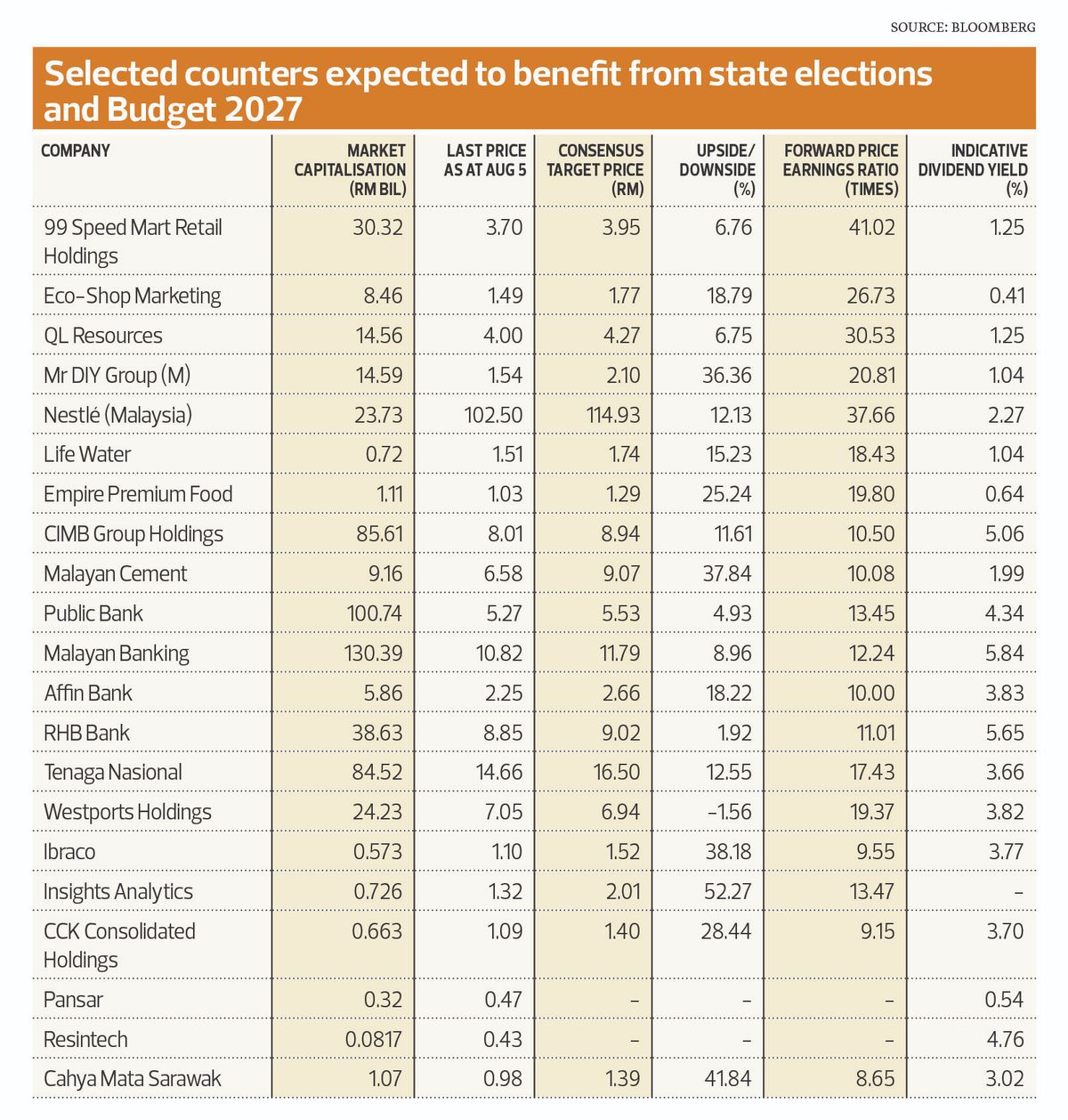
The heads of research and fund managers The Edge spoke to last week think retailers and essential consumer goods companies such as 99 Speed Mart Retail Holdings Bhd (KL:99SMART), Eco-Shop Marketing Bhd (KL:ECOSHOP), QL Resources Bhd (KL:QL) and MR DIY Group (M) Bhd (KL:MRDIY) could benefit if Putrajaya steps up its cost-of-living assistance ahead of the next general election.
In the meantime, banks, utilities and technology companies are expected to be among the first recipients of foreign fund inflows as governmental policies become clearer.
Two state elections held ahead of Budget 2027, which is scheduled to be tabled on Oct 9, are likely to provide some indication on future domestic policies.
Further ahead, Sarawak-linked construction, building material, utility and consumer stocks will be watched as the state prepares for an election that must be held no later than April 2027.
CIMB Securities head of Malaysia research and regional head of agribusiness and plantation research Ivy Ng Lee Fang tells The Edge the state elections provide a reading of voter sentiment ahead of the more consequential 16th general election, which must be held by February 2028.
Barisan Nasional won 48 of the 56 seats contested in the July 11 Johor state election, improving on its 40 seats in the last polls, while Pakatan Harapan, which helms the federal government, secured eight, down from 12 previously.
About two weeks later in Negeri Sembilan on Aug 1, an informal BN-Perikatan Nasional arrangement won a two-thirds majority.
Market experts say investors are trying to determine whether changing voter sentiment will weaken policy continuity, slow economic reforms or encourage more spending targeted at households and constituencies.
“This year, the incumbents have not been doing well, so people will be watching for a change in alignment. Political analysts are watching for the increased likelihood of the unofficial BN-PN alliance consolidating the Malay vote. And if so, investors will gauge how stable the governing party will be and whether the parties can work together. This is important because investors need to see a stable government. Its policies and direction will be closely watched,” Ivy observes.
The analysts agree that a more fragmented result or changing alliances could generate short-term concerns about government stability and future policy direction.
Politics, however, is only one component of the market outlook. MBSB Investment Bank head of research Imran Yassin Yusof believes election expectations will affect sentiment at the margin, while earnings recovery, US interest rate expectations, valuations, foreign fund flows and global risk appetite will carry more weight.
“We expect Malaysia’s equity market to gain further ground in 2026, supported by healthy economic growth, positive corporate earnings, undemanding valuations and pent-up foreign fund inflows,” he asserts.
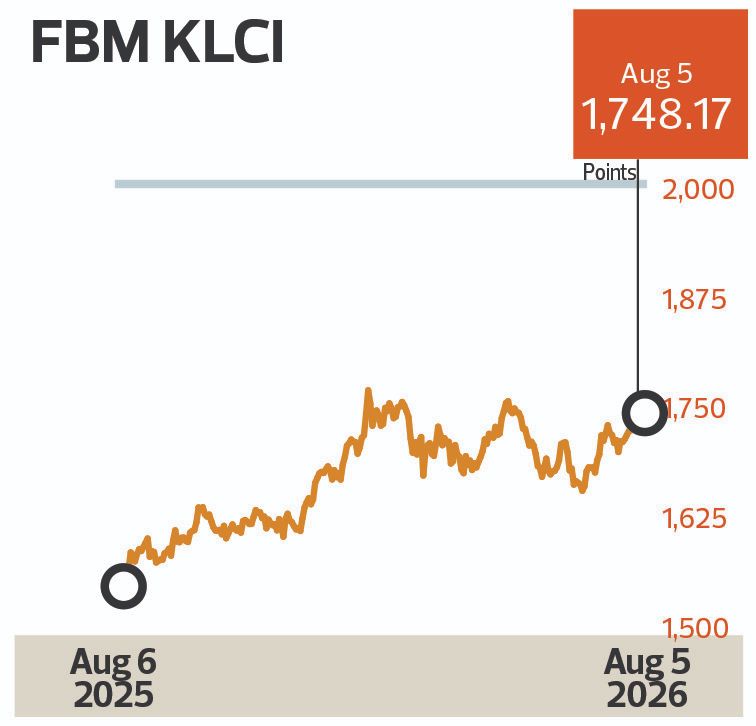
The majority of research houses expect the FBM KLCI to finish the year in the mid to high 1,700s. CIMB is retaining its year-end target of 1,746 points, while MBSB holds a “cautious but constructive” target of 1,770 points, owing to the US Federal Reserve interest rate hike risk, ringgit weakness, foreign fund outflows and lingering geopolitical uncertainty.
Maybank Investment Reseach is looking at 1,750 points, revised from 1,730 points, citing 7.5% earnings growth, sustained investment up-cycle effects, stable consumer essentials spending and steady foreign participation.
On the local currency, MBSB’s Imran forecasts: “We expect the ringgit to average at around RM4.01 per US dollar in 2026, and to move towards RM4.03 by end-2026.”
Retailers, staples stand to gain
Consumer goods companies could benefit if the government expands its cash transfers, subsidies or targeted assistance before the general election. Ivy notes that consumers are buying smaller basket sizes. “That tells us that the consumer play should be on basics, essentials and food and beverages.”
Tradeview Capital CEO Ng Zhu Hann says, “The consumer sector may benefit from government handout programmes such as an expanded Sara scheme. The sector stands to benefit if the incumbent government puts money in the hands of the people.”
Some analysts identify listed retailers such as 99 Speed Mart and Eco-Shop as potential beneficiaries of election-related spending as they sell low-priced necessities through extensive store networks, allowing them to capture incremental expenditure by lower- and middle-income households.
Ivy, however, notes that the businesses should be dominant, competitive and exposed to industries where demand is sticky. Otherwise, imports or rivals can erode their advantage. “Companies with pricing power are particularly important in the present environment,” she adds.
CIMB’s preferred consumer names include Nestlé (Malaysia) Bhd (KL:NESM), QL Resources, MR DIY, Life Water Bhd (KL:LWSABAH) and Empire Premium Food Bhd (KL:EMPIRE), the operator of Empire Sushi. It also names Malayan Cement Bhd (KL:MCEMENT) in the construction space as being able to benefit from firm demand while maintaining pricing discipline.
“Infrastructure-linked government companies could see ‘share price buoyancy’ from short-term project announcements,” says Zhu Hann.
Foreign investors return on regional rotation, stronger GDP data
According to MBSB, foreign investors were net sellers of about RM3.64 billion and RM2.27 billion worth of Malaysian equities in May and June respectively, before returning as net buyers in the weeks ended July 10 and July 17, with inflows of RM75.3 million and RM612.3 million respectively. The 12-month rolling sum of foreign net equities trade saw the week ended July 31 finish at -RM11.2 billion, an improvement from the -RM11.3 billion a week earlier and -RM17.7 billion a year ago.
Looking back, Zhu Hann recalls foreign fund flows began recovering in the first quarter of this year before the US-Iran conflict, while higher US bond yields and delayed interest rate cuts prompted investors to move into lower-risk assets. These pressures affected emerging markets in general. Malaysia also faced growing concerns about domestic political uncertainty.
“[In addition,] after selling in May and June, regional fund managers diversified away from concentrated artificial intelligence (AI) positions in markets such as South Korea. In July, Malaysia was a beneficiary of that regional diversification,” says Ivy.
Even so, the analysts point out that there is still room for improvement in Malaysia’s low foreign equity ownership, but stress that international funds are unlikely to return on valuations alone.
“The heavy foreign selling in 2025 has created pent-up demand for Malaysian equities should [the above-mentioned] conditions improve. As valuations remain undemanding, a sustained return of foreign funds could lift valuation multiples closer to their longer-term averages and provide broader support for the FBM KLCI,” says MBSB’s Imran.
Ivy points out that foreign funds tend to favour markets offering greater certainty and may reduce exposure ahead of the general election before reassessing Malaysia once the election results and political configuration become clearer.
Banks, utilities and port operators were among the beneficiaries of the regional diversification, supported by strong results and encouraging economic data.
CIMB Group Holdings Bhd’s (KL:CIMB) share price rose 8.1% to RM8.01 last Wednesday from RM7.41 on June 30, while that of Malayan Banking Bhd (KL:MAYBANK), Public Bank Bhd (KL:PBBANK) and RHB Bank Bhd (KL:RHBBANK) climbed 0.37%, 9.78% and 6.88% respectively during the period to close at RM10.82, RM5.27 and RM8.85 last Wednesday.
Tenaga Nasional Bhd’s (KL:TENAGA) share price, which stood at RM14.28 on June 30, climbed 2.66% to settle at RM14.66 last Wednesday. Westports Holdings Bhd (KL:WPRTS) saw its share price climb 16.34% to RM7.05 during the same period.
Malaysia’s stronger-than-expected advance second-quarter gross domestic product (GDP) growth of 5.8% also drew investor interest, says Ivy. Zhu Hann expects returning foreign funds to favour liquid blue chips in the banking, utility, plantation and technology sectors, supported by measures such as the proposed expansion of the FBM KLCI and MyValueUp programme.
Meanwhile, high-net-worth investor Ian Yoong, who expects the scope of interest to include attractively valued small- and mid-cap plantation stocks, observes continued investor interest in semiconductor-related stocks. Zhu Hann says further gains in technology stocks will depend on sustainable AI-related earnings.
Sarawak election puts state-linked stocks in focus
With the Sarawak state election due by April 2027, certain state government-linked stocks are being watched, particularly those with exposure to sectors such as construction, utilities, building materials, oil and gas, and household consumption. Premier Tan Sri Abang Johari Tun Openg said on Aug 1 that the election date had not been decided.
Zhu Hann says Sarawak’s reserves and political influence give it the capacity to pursue infrastructure upgrades and expansionary fiscal policies. He identified Ibraco Bhd (KL:IBRACO), Insights Analytics Bhd (KL:IAB), CCK Consolidated Holdings Bhd (KL:CCK), Pansar Bhd (KL:PANSAR), Resintech Bhd (KL:RESINTC) and Affin Bank Bhd (KL:AFFIN) as potential beneficiaries.
Market veterans highlight water technology firm Insights Analytics as one of the more direct Sarawak development plays because of its involvement in digital water management systems and state water projects. CIMB has a “buy” call on the stock, while Yoong notes that the company is in a net cash position and that its share price has risen significantly since its October 2025 listing.
CCK is another preferred name, with Yoong describing the Sarawak-based poultry and food distribution player as “well managed, trading at about 11 times trailing earnings and one time book value, with a dividend yield of 3.7%”. “It has net cash of RM217 million against a market capitalisation of RM688 million,” he points out.
Cahya Mata Sarawak Bhd (KL:CMSB) is viewed as a possible beneficiary of infrastructure spending through its cement, building materials and road maintenance businesses. Imran says stronger project flows could support demand for these operations, but cautions that investors must also consider earnings delivery, margin control, the recovery of its phosphate division and project conversion.
Zhu Hann, however, observes that governance uncertainty remains a concern. The Taib family is involved in an ongoing court dispute over 50 million Cahya Mata shares transferred to the late Tun Abdul Taib Mahmud’s second wife, Toh Puan Raghad Kurdi Taib.
Ibraco and smaller contractors could also benefit from trading interest in Sarawak stocks if infrastructure activity accelerates. Ivy cautions, however, that many Sarawak counters are relatively small, making their share prices more vulnerable to election-driven volatility, while higher raw material costs could pressure margins.
She also notes that the broader Sarawak investment theme has been in play for some time as the state promotes itself to investors, and cautions that the state election may not trigger a fresh or sustained rerating across all Sarawak-linked stocks.
‘Remain cautiously optimistic, defensive’
The experts broadly recommend staying defensive while participating selectively in domestic and AI-related growth themes.
CIMB’s Ivy advises investors to consider companies with pricing power, sticky demand and strong competitive positions. CIMB is also looking at dividend paying businesses to limit downside risk, as well as banks, telecommunications companies and exporters benefiting from an earnings up cycle.
MBSB’s Imran recommends an “optimistic but cautious” strategy for the rest of 2026. “We recommend maintaining a defensive core, while selectively adding exposure to recovery and growth themes.”
MBSB prefers utilities, consumer goods companies, banks, telcos, construction players and selected technology stocks with defensive earnings or clear domestic catalysts.
For fund manager Zhu Hann, dividing its portfolio into long-term holdings and shorter-term thematic positions will be key. Fundamentally sound dividend paying businesses can provide income, while a smaller trading allocation can capture fund flows and the election theme, he says.
“The market situation is too fluid, so adaptability is important. Keep between 25% and 40% in cash during the current AI enthusiasm and look for well-managed companies whose shares are trading at attractive valuations. The best time to invest is when almost everyone is negative,” he adds.
Save by subscribing to us for your print and/or digital copy.
P/S: The Edge is also available on Apple's App Store and Android's Google Play.