

This article first appeared in The Edge Malaysia Weekly on August 10, 2026 - August 16, 2026

Malaysian initial public offerings (IPOs) do not generally perform well beyond their first few days of trading and, sometimes, not even during that period. We have examined and written extensively about the reasons for this disappointing performance, including a valuation methodology that does a poor job of valuing companies because it is backward-looking, focusing on historical profits rather than future growth potential.
This leads owners to seek a listing when profits have peaked and the business has matured, maximising their IPO valuation. By this point, the equity market is a cashing-out machine. A meaningful portion of IPO proceeds goes to pre-IPO shareholders (founders, private equity funds and venture capitalists) rather than to the company to fund the next stage of growth. In short, public market investors are buying into a company well after its strongest growth phase. Low or negative growth expectations equal low valuations and weak share price performances post-IPO.
This brings us to a broader question: Is this problem unique to Malaysia? How about IPOs in the US? Have they performed better, on average, after listing?
After all, America is home to the world’s deepest capital market and the strongest technology ecosystem. It has the largest pool of institutional investors, the most active venture capital industry and the most liquid equity market globally. For decades, the US has been the natural destination for ambitious technology companies seeking capital, visibility and valuation.
It is the market where many of the world’s most important technology companies were born — from Microsoft and Apple to Amazon.com, Google, Nvidia and Meta Platforms. If there were an equity market for IPO outperformance, surely it would be the US — the market that offers investors access to the next generation of global winners.
In other words, the US is the equity market for growth. Unlike Malaysia, where many IPOs tend to come from more mature industries such as manufacturing, construction, consumer businesses or family-owned companies, the US IPO market is often associated with the fastest-growing sectors: software, fintech, artificial intelligence (AI), biotechnology, digital platforms and the broader internet economy. These are sectors that have strong growth prospects. And that is why the data evidence may come as a surprise.

US IPOs, too, have disappointed
We analysed US IPOs from 2023 to 2025, comparing their share price performance against the Standard & Poor’s 500 index. The results were similarly disappointing.
IPOs in all three years have, on a median basis, underperformed the S&P 500 over time (see Chart 1). The pattern appears consistent: IPOs often enjoyed a brief period of outperformance in the first few trading days, but once the initial excitement faded, their stock price performance began to deteriorate.


Even more surprising, technology IPOs were among the biggest drags on overall IPO performance between 2023 and 2025. A majority of IPOs from the sector underperformed the S&P 500, while the sector’s average share price performance was among the weakest across all IPO categories (see Chart 2).
This is counterintuitive. After all, high-growth technology companies are precisely what make the US IPO market appear more attractive than most other markets. They are supposed to offer exposure to the next generation of innovation — artificial intelligence (AI), software, digital platforms, fintech and other scalable business models. Yet the data suggests that these same technology IPOs have often been a source of disappointment for public market investors. We think there are two main reasons.
When reality meets overhyped storytelling
Perhaps more than any other capital market in the world, the US market thrives because investors believe in its ability to monetise innovation. And the US has a long history of rewarding shareholders for risks to prove this. That creates a large base of investors willing to accept great story telling — to fund long-term growth stories and moonshot bets. Many would rather overpay for a potential future winner today than miss out on the next Amazon, Meta or Nvidia.
Companies are able to make IPOs at huge valuations premised on narratives of ambitious total addressable market, future global dominance and, finally, the ability to turn that scale into enduring pricing power and profit margins.
But moonshot bets come with significantly higher risks. Yes, the few winners will win big and become hugely successful global champions, but many innovations will fail or do not deliver as promised. For every Google and Microsoft, there are many more start-ups that fail to live up to expectations and/or fade into history.
There has been no shortage of disappointments among high-profile US technology IPOs in just the last few years. Take Figma, for example. Best known for its browser-based design software, Figma became a leading platform for real-time collaboration. Investors were excited because it was seen as a category leader with strong growth and a large enterprise customer base. The hype was further boosted by Adobe’s previously abandoned US$20 billion acquisition attempt. Figma’s share price surged about 270% in the first two trading days of its listing, but the excitement wore off quickly. The stock is now down roughly 38% from its IPO price and about 83% below its peak.
Circle, best known as the issuer of USDC, one of the world’s largest US dollar-backed stablecoins, was seen as one of the few listed companies offering investors exposure to the growth of stablecoins. The excitement was supported by expectations that US regulation was moving in a more favourable direction for the industry. As a result, the stock surged almost 750% within 12 trading days of listing. After the initial hype subsided, however, the stock retraced and is currently trading 80% below its peak.
Looking further back, several once-celebrated technology IPOs have also struggled to deliver on their promises. These companies spanned some of the market’s most compelling growth narratives at the time: Roblox was seen as a gateway to the metaverse and user-generated gaming; Rivian, as a credible challenger to Tesla in electric vehicles; Mobileye, as a leader in advanced driver-assistance systems and autonomous driving technology; and Coinbase, as one of the most direct listed proxies for the growth of cryptocurrency trading and digital assets. Yet despite the initial enthusiasm surrounding these themes, all four companies are now trading below their IPO prices.
US investors may be more willing than many others to pay elevated valuations for companies with a compelling future growth story but, eventually, those narratives must be backed up by actual financial performance. Revenue growth must be sustained, losses must narrow, margins must improve and promises must turn into cash flows. When reality falls short of lofty expectations, the share price adjusts downwards.
In short, buying growth stocks comes with a price — the product, service and/or markets are still being developed. The risks are high. You may get only one or two success stories for every 10 moonshot bets. That is partly why more than half of the IPOs subsequently underperform the broader market, in absolute number of companies.
Private markets are the new public markets
The other main reason that IPOs are underperforming is, we believe, the dramatic rise of private capital in the past two decades.
Private equity assets under management had grown from less than US$700 billion in 2000 to almost US$10.5 trillion by 2024 (Chart 3).
Private equity, venture capital and other private-market funds are no longer niche investment vehicles. They have become major destinations for institutional capital and an increasingly important source of growth funding for companies.


Several forces helped drive this growth. The first was the long period of near-zero interest rates after the global financial crisis. With bond yields compressed, pension funds, endowments and other institutional investors were forced to search for higher-return alternatives, often by accepting higher risks.
Regulation also played a role. The 2012 JOBS Act reduced some of the friction around private capital formation. By easing certain restrictions on private companies and permitting broader marketing under Rule 506(c), it enabled private firms and funds to reach a wider pool of investors. This helped expand fundraising beyond traditional closed-door networks to the larger public. For instance, there are now exchange-traded funds (ETFs) that give public market investors exposure to private equity firms, private credit and assets.
There was also a powerful incentive from the fund managers themselves. Private equity and venture capital managers are typically paid management fees based on committed capital, often 1.5% to 2% annually. This creates a strong supply-side incentive for managers to raise ever-larger funds.
At the same time, sovereign wealth funds have become an increasingly important source of capital for private markets. With long investment horizons, large balance sheets and the ability to deploy capital at scale, these investors are natural partners for private equity firms. Their growth — from around US$1.2 trillion in assets in 2000 to US$15.8 trillion in 2025 — has created a much deeper pool of patient, long-duration capital, further supporting the expansion of the private equity industry.
As a result, the private market ecosystem has become large enough to fund companies through multiple stages of growth.
Start-ups are opting to stay private for longer
From the company’s perspective, raising money from private equity or venture capital can also be more attractive than going public early.
The first advantage is flexibility. In the public market, companies are constantly judged by quarterly earnings, near-term guidance and share price movements. This can be restrictive for fast-growing companies that are still investing heavily, burning cash or experimenting with their business models. Private capital allows them to grow away from the daily pressure of the stock market, giving management more room to prioritise long-term expansion over short-term profitability.
The second advantage is a lighter disclosure and compliance burden. Once a company goes public, it must meet extensive reporting requirements, bear higher compliance costs and regularly disclose financial, operational and strategic information to the market. By remaining private, companies operate under a more flexible disclosure regime, while keeping more sensitive business information away from competitors and public scrutiny.
Today, large venture-capital funds, private equity funds, sovereign wealth funds and crossover investors can provide billions of dollars before a company ever needs to list. This means companies can remain private for longer, grow larger outside the public market, and pursue an IPO only when conditions are most favourable.
What this means is that much of the value creation now happens before the IPO. The gains that used to accrue to public market investors from the earlier, high-growth stage are now captured by private market investors.
For instance, Amazon went public in 1997, just three years after it was founded at an IPO valuation of about US$440 million; Google listed six years after its founding in 2004 and was valued at US$23 billion; SpaceX stayed private for 24 years before its IPO earlier this month. The loss-making company founded by Elon Musk was valued at an eye-popping US$1.8 trillion.
Put another way, by the time these companies eventually list, they are already at a much later stage of their S-curves (growth). That leaves public market investors with a slower growth trajectory and less upside after IPO — a pattern similar to that seen in Malaysian IPOs.
This is underscored by the post-listing revenue growth of more recent IPOs versus earlier-generation technology companies. Amazon, Google and Meta went for IPO relatively early in their growth journey, allowing public investors to participate in a larger portion of their revenue expansion.
By contrast, companies such as Uber, Airbnb and Palantir stayed private for much longer — 10, 12 and 17 years respectively. By the time they listed, they had already scaled significantly in the private market. Their post-IPO revenue growth trajectory was slower — so were their value gains after listing (see Chart 5).

Conclusion
Malaysian IPOs are not alone when it comes to underperforming the broader market after going public. We observe the same trend in other markets, even in the US — but for different reasons.
The Malaysian IPO system rewards profits. So, companies are incentivised to maximise profits at the point of listing to gain the best valuation. This usually means when the business is mature and near peak profits. There is limited innovation and growth after listing, and the IPO is a cashing-out machine for owners.
The US equity market, on the other hand, rewards innovation, risk-taking and growth. Loss-making companies can seek a listing provided they meet other requirements such as minimum market capitalisation, a sufficient shareholder base and public float. Amazon, Tesla, Uber and Palantir were listed while still in the red — and shareholders have been handsomely rewarded with subsequent share price gains.
Given this track record, American investors are far more willing to accept and fund great storytelling, even extremely ambitious long-term growth narratives. Almost every tech IPO is marketed as a potential multi-bagger. Indeed, the bigger the story, the higher the valuations. Elon Musk predicts SpaceX’s revenue will hit US$1 trillion — from a mere US$18.7 billion in 2025 — in five short years and he projects a total addressable market of US$26.5 trillion for its AI segment, a figure equivalent to roughly one quarter of global GDP at 2025 levels. Its IPO valuation was fixed at more than 90 times trailing sales.
Another reason for IPO underperformance is the trend of companies staying private for longer — thanks to the rapid rise of venture capital and private equity funds. The early and strongest years of growth and value creation now accrue to these private market investors. When companies finally list, the IPO is often no longer the starting point of wealth creation but increasingly the exit point for early-stage investors.
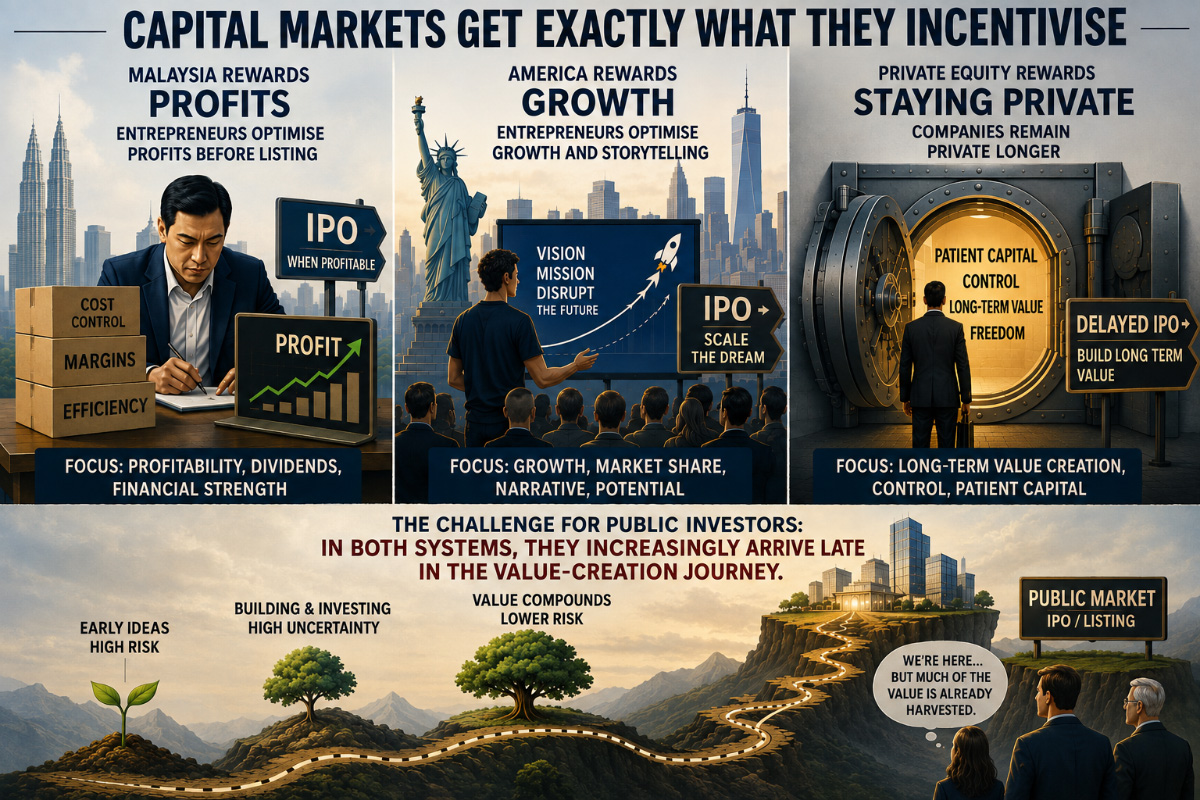
The deeper lesson is that capital markets get exactly what they incentivise. Malaysia rewards profits; so, entrepreneurs optimise profits before listing. America rewards growth; so, entrepreneurs optimise growth and storytelling. Private equity rewards staying private; so, companies remain private longer. The challenge for public investors is that, in both systems, they increasingly arrive late in the value-creation journey.
The real question is no longer whether a company goes public, but at what stage of its growth cycle public investors are allowed to participate. Increasingly, the greatest fortunes are being made before the IPO, not after it.
Yet, despite IPOs’ underperforming the broader market, on average, the US market remains the most attractive destination for global investors for growth. Investors understand and accept that not every story is a winner but believe that the one or two big eventual winners will more than compensate for others that fail. This ecosystem incentivises and funds innovation. It is a self-reinforcing feedback loop.
In Malaysia, companies must have a profitable track record, even if mediocre. They are incentivised to maximise profits at the point of listing. The problem is that this reflects the past. What if we have a shift in mindset? Take a page from the US market. Reward the behaviours we want more of — companies with compelling growth prospects. Place greater emphasis on the future. Allow the listing of those with great stories to tell — even if they are not yet profitable. Let investment bankers price the IPO and, ultimately, let investors and the market determine its long-term valuation.

Portfolio commentary
The Malaysian Portfolio fell 0.1% for the week ended Aug 5. The two gaining stocks were Public Bank (+2.3%) and United Plantations (+1.2%), while Kim Loong Resources (-3.9%), LPI Capital (-0.5%) and Hong Leong Industries (-0.4%) were the notable losers. Total portfolio returns now stand at 225.7% since inception. This portfolio is outperforming the benchmark FBM KLCI, which is down 4.5% over the same period, by a long, long way.
The Absolute Returns Portfolio, on the other hand, gained 6.5% on the back of the strong rebound in US stocks. The global market bellwethers, the Dow Jones Industrial Average and Standard & Poor’s 500 index, hit fresh all-time highs. Last week’s gains lifted total portfolio returns to 34% since inception. All the stocks in this portfolio ended higher save for Singapore Technologies Engineering, which was down 3.4%. The top gainers were Microsoft (+24.8%), Schneider Electric (+18.6%) and Nvidia (+15.4%).
The AI Portfolio also ended higher for the week, up 15.4%, with all stocks in the green. Total portfolio returns now stand at 33.6% since inception. The biggest gainers were Unusual Machines (+49.1%), Marvell Technology (+29.1%) and Amazon.com (+20.3%).
Disclaimer: This is a personal portfolio for information purposes only and does not constitute a recommendation or solicitation or expression of views to influence readers to buy/sell stocks. Our shareholders, directors and employees may have positions in or may be materially interested in any of the stocks. We may also have or have had dealings with or may provide or have provided content services to the companies mentioned in the reports.
Save by subscribing to us for your print and/or digital copy.
P/S: The Edge is also available on Apple's App Store and Android's Google Play.