


This article first appeared in City & Country, The Edge Malaysia Weekly on August 3, 2026 - August 9, 2026
The property market is narrowing towards quality, specialised formats and strategically located stock, particularly in the industrial and office sectors, even as demand holds up and occupiers turn more cost-conscious and cautious about expansion.
In the presentation of Knight Frank’s Real Estate Highlights 1H2026 report on June 6, Knight Frank Malaysia group managing director Keith Ooi said, “The first half of 2026 showcased a very dynamic outlook for the real estate market. Demand remains selectively strong, catalysed by the growth of the investment and services sectors, which measures incoming supply and saw differentiation in expansion — favouring quality, future-ready premises and specialised formats.”
According to the report, Malaysia’s gross domestic product grew 5.4% (preliminary) year on year (y-o-y) in 1Q2026, with the full-year figure forecast at 4% to 5%. Bank Negara Malaysia has held the overnight policy rate at 2.75% since its July 2025 cut from 3%, while foreign direct investment inflows reached US$22.9 billion (RM93.8 million) in the first quarter, up from US$21 billion a year earlier.
Industrial: Strong trade, but investment and costs give cause for concern
On the industrial sector, Knight Frank Malaysia senior executive director of land and industrial solutions Allan Sim said approved manufacturing investment has not kept pace with trade. “Malaysia is doing well in trade, but approved manufacturing investment is not enough yet,” he added, attributing the gap to geopolitical friction and escalating costs.
Total trade reached RM789.8 billion, the highest first-quarter figure on record. The Industrial Production Index (IPI) rose 4% y-o-y to 138.7 points and the Purchasing Managers’ Index (PMI) held above 50 points in four of the last six months. However, approved manufacturing investment came in at RM24.1 billion in 1Q2026, down from RM30.5 billion a year earlier, with foreign direct investment making up 66.6% of that approved sum.
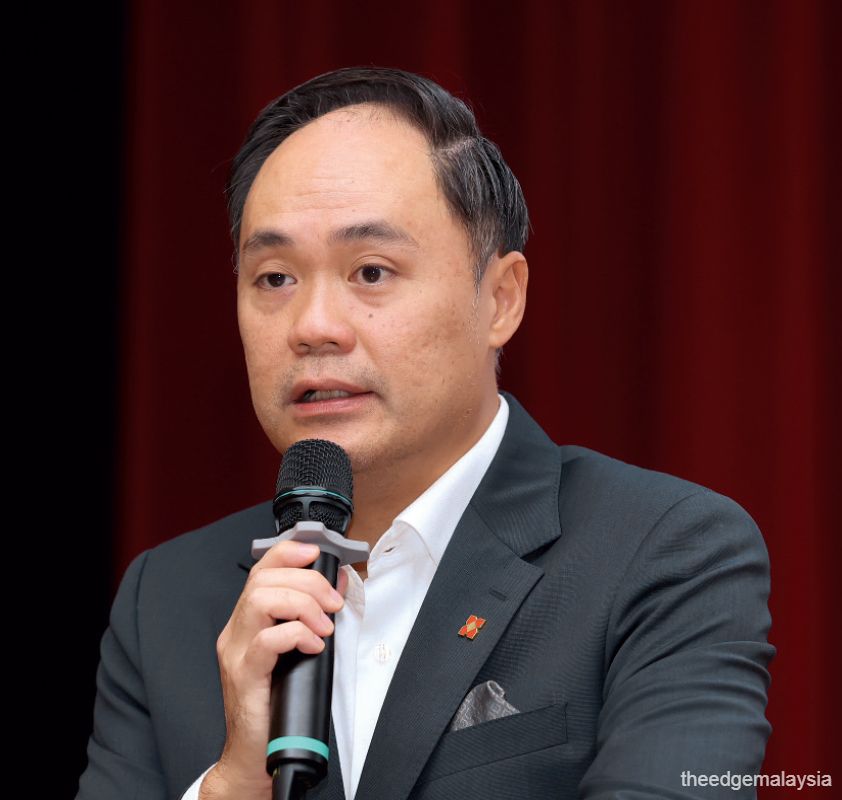
Sim noted that occupiers are holding back on expansion, particularly in the Klang Valley. “Occupiers are prioritising operational efficiency over expansion because of cost pressure. The first thing [being looked at] now in the Klang Valley is if space can be cheaper.”
As prime industrial land in the Klang Valley now exceeds RM180 psf, high-rise logistics warehouses are gaining ground. “Malaysia [will see more] high-rise logistic warehouses. This is where it’s headed, simply because land value has gone up,” he said.
Sim also noted that Penang is facing undersupply, pointing out that Grade A facilities in Penang and Johor are frequently secured pre-leasing — unlike those in the Klang Valley. Penang holds only 7.9 million sq ft of warehousing stock, whereas the Klang Valley has 65.5 million sq ft and Johor, 20.5 million sq ft.
Johor led approved manufacturing investment in 1Q2026 with RM7.2 billion, ahead of Penang at RM4.9 billion, the Klang Valley at RM4.8 billion and Negeri Sembilan at RM3.3 billion. Approved investments rose 137.3% y-o-y in Johor and 29.3% in the Klang Valley, but fell 26.8% in Penang.
“What is being built in the Klang Valley is more specialised and owner-occupied. In Johor, we are seeing large-scale industrial ecosystem expansions,” said Sim, adding that supply in the southern state is tightening as prices rise.
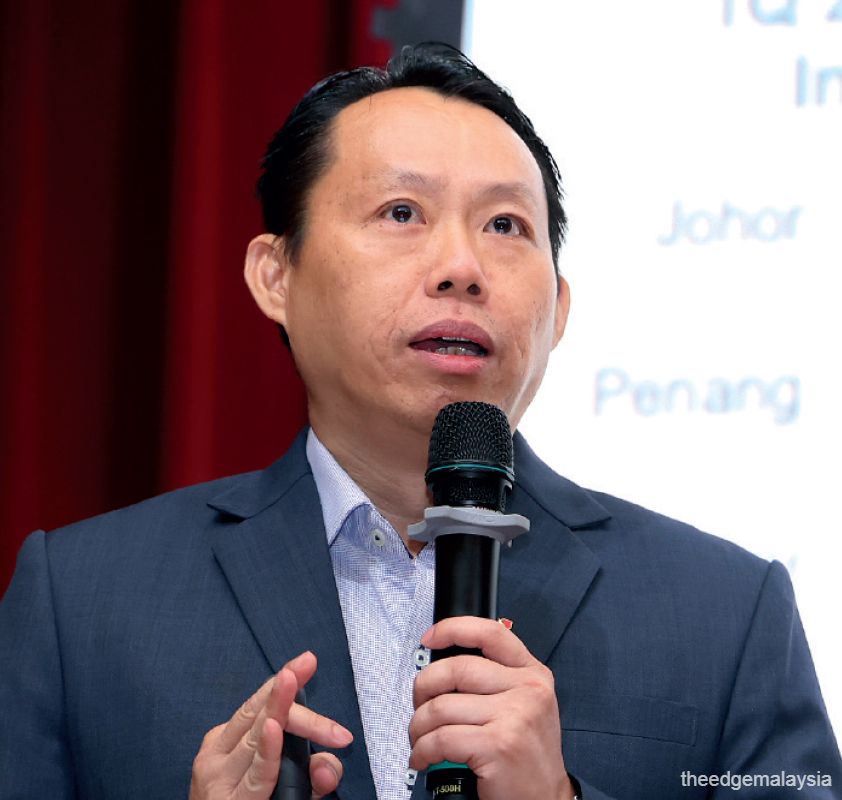
Transaction volumes and values diverged across the country in 1Q2026. Penang posted a 19% y-o-y increase in transaction volume and a 67.8% y-o-y rise in transaction value and Johor recorded a 0.8% y-o-y increase in transaction volume and a 33.1% y-o-y rise in transaction value, but the Klang Valley saw transaction volume fall 11.2% y-o-y and transaction value decline 17.5% y-o-y.
Specialised formats are expected to drive growth, including automated logistics, cold-chain storage, cooling, data centres and multi-storey industrial facilities. Meanwhile, workers’ accommodation is becoming an institutional asset class.
“Penang’s cooling corridor will continue to drive the next phase of industrial expansion. You can see a lot of investment on the manufacturing side that has moved to cooling [chains] in the last three years,” said Sim.
He added that undersupply is driving up costs significantly, noting that the price of land for cooling facilities has surged from less than RM20 psf to between RM55 and RM60 psf, with rents touching about RM2 psf.
Notable emerging corridors include Gurun in Kedah, for its proximity to Thailand, and Negeri Sembilan, where developers are planning more than 20,000 acres in the MVV2.0 corridor. In Johor, activity is concentrated in Kulai as industrial land in Johor Bahru tightens, led by large-scale developments like Nexus Sedenak and Johor Tech Smart City.
Office: Two-tier market as supply thins
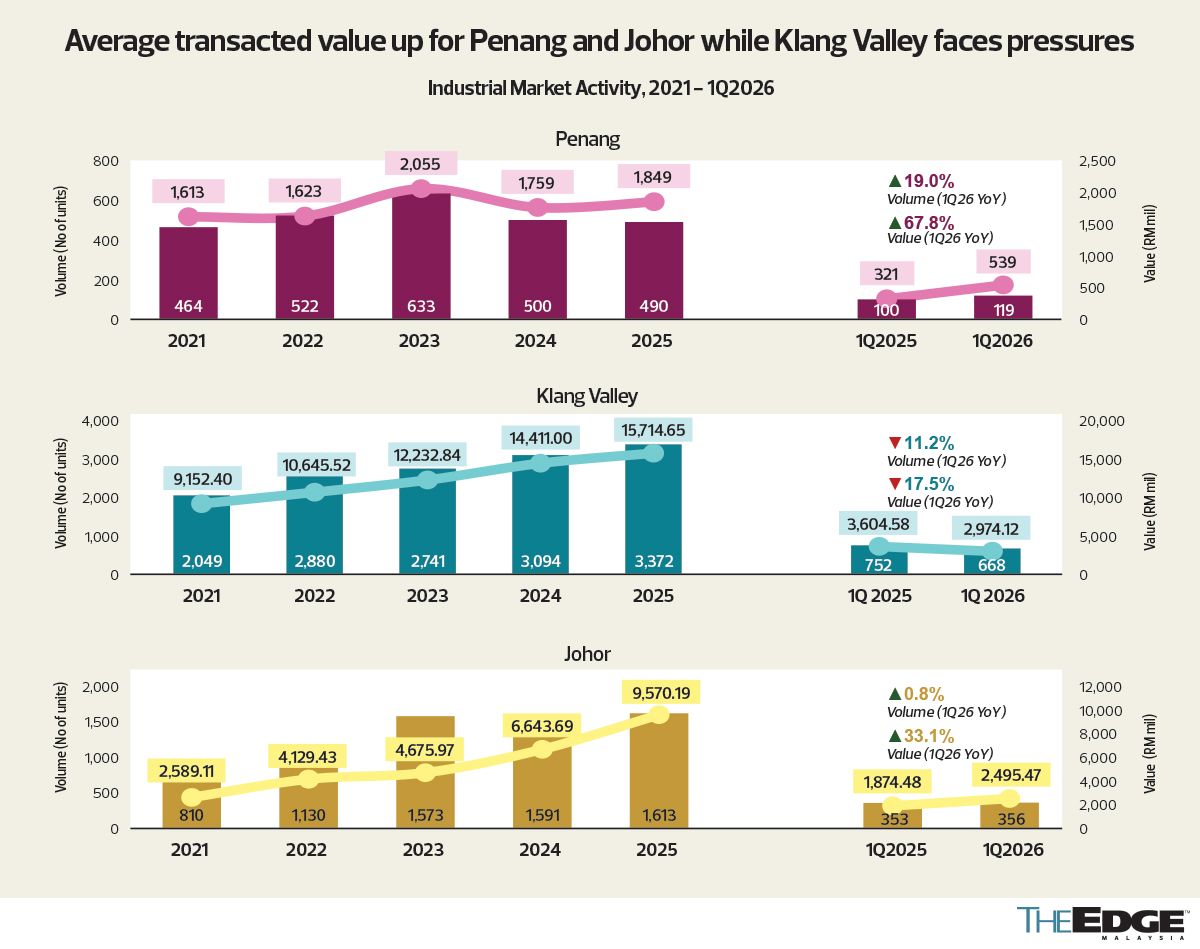
On the office sector, Knight Frank Malaysia senior executive director of office strategy and solutions Teh Young Khean said the supply constraints between grades is shaping the Klang Valley office market. Newer ESG-certified buildings are continuing to outperform less efficient assets as leasing pressure rises.
“[Office] supply is thinning, potentially good for landlords,” he added, noting that priority is shifting to well-located and amenity-rich areas.
No new office supply came onstream in 1H2026, leaving the existing Klang Valley stock at 120.6 million sq ft. According to the report, about 3.2 million sq ft will enter the market over the next two years — roughly 1.6 million sq ft annually — well below the 10-year compound annual growth rate of 2.81 million sq ft. KL Fringe and Selangor account for 87.8% of that incoming supply, while KL City makes up the remaining 12.2%.
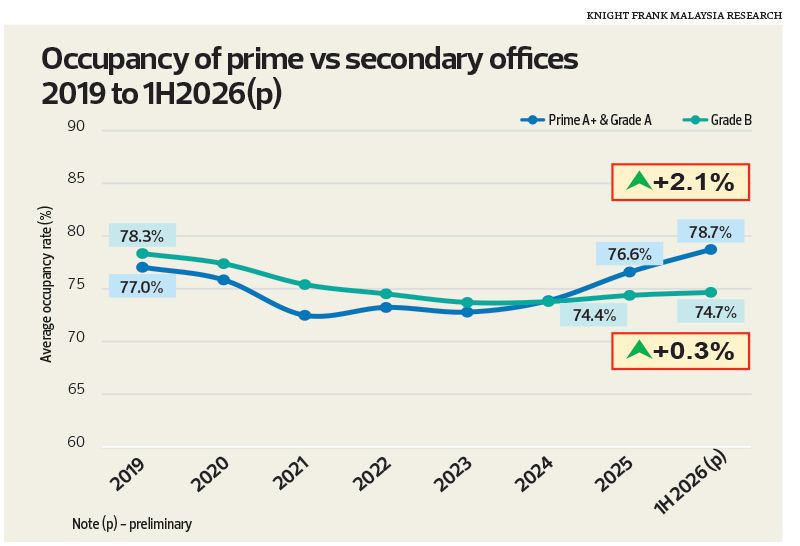
The average occupancy of Grade A offices rose, driven by steady demand, while that of Grade B offices declined. “Grade A has slowly picked up, trending to about 79% y-o-y, whereas Grade B is sliding down [to about 75%] y-o-y,” said Teh.
Meanwhile, Grade A+ and Grade A rents rose 1.7% in 1H2026 compared to 0.4% for Grade B. Average monthly rents reached RM6.82 psf in KL City, RM5.90 psf in KL Fringe and RM4.34 psf in Selangor, with TRX developments serving as a key catalyst for the rent pickup in KL City.

Beyond traditional banking and businesses are newer occupiers such as eSports and mainland Chinese enterprises. “We’ve observed take-up from eSports, supported by national initiatives such as MyDigital and the New Industrial Master Plan,” said Teh.
He added that “e-gaming or eSports have also attracted ecosystem partners such as game studios, eSports organisations, streaming platforms and training academies”, citing tenants such as EA Sports at Exchange 106. Mainland Chinese enterprises now account for more than two million sq ft of tracked office space, with 76% concentrated in KL City, including Huawei, Xiaomi, Ant Group and ByteDance.
About 36% or about 43.5 million sq ft of Klang Valley stock is over 25 years old. Out of this 36%, only an estimated 37% have undergone asset enhancement or refurbishment.
“Rising construction costs may support further transactions. People say, ‘If I build brand new, the cost is so expensive now.’ For myself, I look at older buildings — I may potentially buy and refurbish them,” said Teh.
Capital market activity remained active at 1H2026, which saw five office assets worth a total of RM1.42 billion changing hands. Key transactions included the acquisitions of Menara AmBank, Menara Liberty and Wisma HELP, alongside IOI Corp Bhd’s (KL:IOIPG) proposed injection of Puchong Financial Corporate Centre Towers 1, 2, 4 and 5 and IOI City Towers into its proposed IOI Properties Group real estate investment trust (REIT).

Looking ahead, new completions between 2026 and 2027 will include The Capitol, Menara Golden Eagle Realty, Menara Weld, Duo Tower and Pavilion Damansara Heights Corporate Tower 10.
In Johor, no new supply came onstream, but the occupancy rate improved to 54.6% compared with 2H2025, with monthly rents between RM3.10 and RM3.80 psf despite ongoing pressure on Grade B assets. Available Grade A space is tightening due to demand from multinational corporations like PwC and Grant Thornton, while market sentiment builds around the upcoming Johor Bahru-Singapore Rapid Transit System (RTS) Link.
In Penang, office supply expanded to 8.2 million sq ft following the completion of The Light Exchange. The occupancy rate rose to 81.4%, driven by strong demand from global business services (GBS) and technology firms, while prime rents remained at RM3 to RM6.50 psf.
Retail: Experience leads while REITs anchor capital
Consumer spending and capital market liquidity continued to support Malaysia’s retail sector, according to Knight Frank Malaysia director of property management and retail consultancy Yuen May Chee. “F&B, international brands and grocery operators remain key drivers in our market.”
Retail sales grew 3.7% in 1Q2026, moderating from 5.2% in 1Q2025 but remaining above the 2025 full-year average of 2.4%.

“This means 1Q2026 didn’t perform as well as 2025, but [2026’s full year performance] is projected to be higher than 2025’s average. This is proven by the successful retail IPO launches in 1H2026, said Yuen, noting the listing of Bentley Music Group Bhd (KL:BENTLEY), Semico Capital Bhd (KL:SEMICO), Empire Sushi (Empire Premium Food Bhd) (KL:EMPIRE), RT Pastry Holdings Bhd (KL:RT) and Rest N Go (RNG Tech Bhd) (KL:RESTNGO).
Other public listings included KK Super Mart, EMPG Group and Panda Eyes.
Meanwhile, the grocery sector consolidation accelerated with Lotus’s Malaysia’s acquisition of The Food Purveyor and XL Holdings’ acquisition of Giant Mini.
On the consumer front, physical retail is increasingly anchored by intellectual property (IP) flagships and experiential concepts such as Gundam Base, Godzilla Store, Pop Mart and Miniso, which are expected to boost dwell time and repeat visits.
Yuen explains that while artificial intelligence-driven shopping tools are in their infancy, consumer adoption is increasing.
The Klang Valley retail stock remained unchanged at 74 million sq ft in 1H2026, although a 2.2 million sq ft pipeline comprising four shopping centres is slated for completion in the second half of the year. These projects, mostly integrated within Kuala Lumpur mixed-use developments, include Ombak KLCC, 118 Mall, AEON KL Midtown and Coalfields Retail Park.
Strong retailer pre-commitments of 70% to 85% reflect a sustained tenant demand for well-located assets. Meanwhile, tracked REIT malls maintained occupancy above 90%.
Hospitality: Repositioning, not oversupply
Tourism recovery continues to support Malaysia’s hospitality market, according to Knight Frank Malaysia executive director of valuation and advisory Justin Chee.
The country welcomed 6.53 million international arrivals in 1Q2026 — a 2.5% y-o-y increase that brought volume to about 97% of the level recorded in 1Q2019. “We have actually achieved full recovery of tourism and international arrivals,” he said.
There were no new openings in the Klang Valley in 1H2026, following the addition of 2,200 rooms across six hotels in 2H2025. The second-half pipeline will see about 2,600 incoming rooms, with 70% concentrated in the five-star and luxury segments.
Chee noted that this incoming supply represents asset repositioning rather than speculative new construction. “Among all the previously launched in 2H2025 and incoming new hotels in 2H2026, five hotels are actually repositioned or refurbished hotels,” he said. Key examples include Waldorf Astoria (the refurbished former Hotel Istana), Irama KL (the former Dynasty Hotel) and Grand Mercure (the former Swiss-Garden Bukit Bintang).
Addressing concerns about market saturation, Chee noted: “In fact, [supply] is not so alarming. There is no actual huge influx of incumbent supply. It’s basically just the reintroduction of existing rooms or of previous stock back into the market. Structural demand is still present — there is no oversupply.
“Average daily rate (ADR) has been increasing throughout the three-, four- and five-star hotels. However, five-star ADR has seen a slight dip. Nevertheless, five-star quarter-on-quarter occupancy has picked up.”
Klang Valley five-star hotels recorded an average occupancy rate of 63%, an average daily rate (ADR) of RM416 and revenue per available room of RM251. Emerging trends driving asset value and investment strategy are experience-led hospitality concepts; independent hotels affiliating with global soft brands; ecosystem-led hospitality models such as Capital A’s hotel chain partnership venture; and asset enhancement initiatives such as the repositioning of Hotel Maya KL’s tech-led luxury concept under Kin Hotel Group.
Johor also posted gains in its tourism sector, recording about 6.1 million visitor arrivals in 1Q2026 (up 1.9% y-o-y). Singapore remained its primary feeder market, accounting for 77.4% (4.7 million) of visitors. Arrivals from China grew 14.6%, supported by the mutual visa exemption.
Save by subscribing to us for your print and/or digital copy.
P/S: The Edge is also available on Apple's App Store and Android's Google Play.