

This article first appeared in Digital Edge, The Edge Malaysia Weekly on August 10, 2026 - August 16, 2026
Filmmakers are increasingly turning to artificial intelligence (AI) to reduce the cost and time involved in visual effects and repetitive post-production work, allowing productions to stretch tighter budgets without giving up creative control.
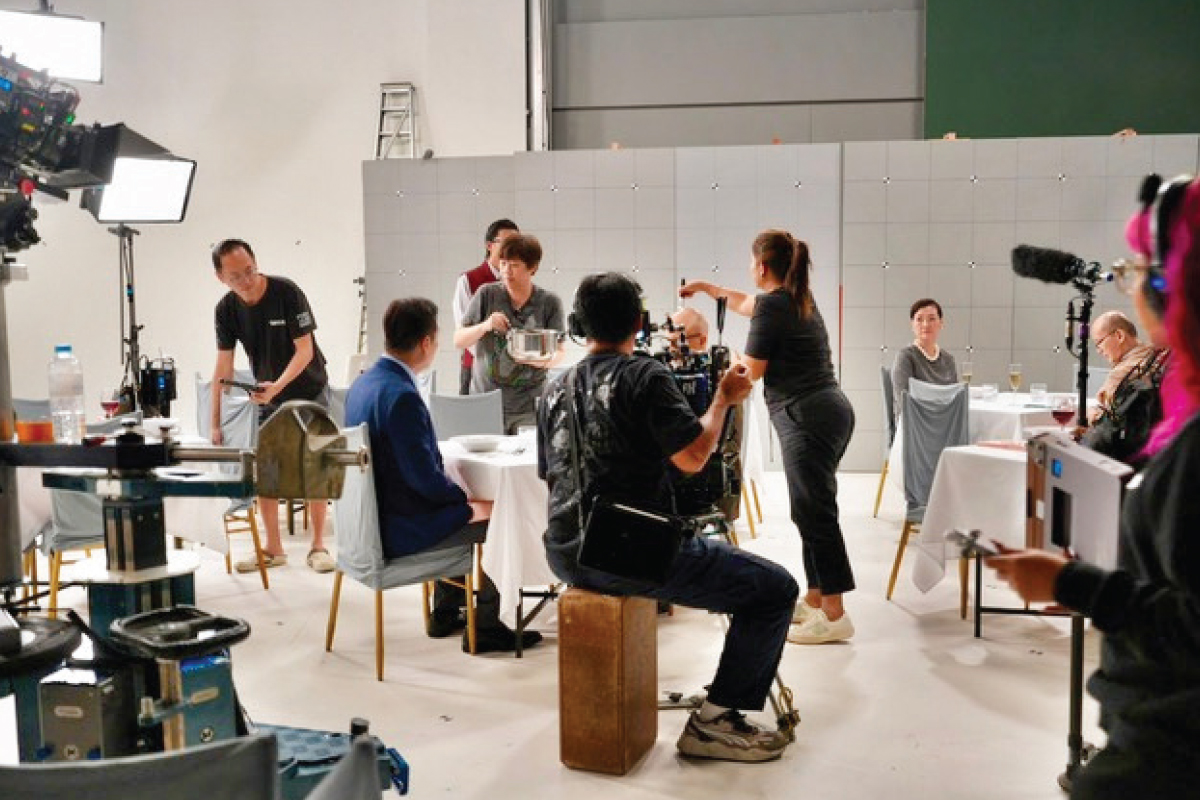
Singapore drama series Crooks is one such example. For producer Boi Kwong, whose previous credits include Geylang (2022) and Sui Yue: The Days (2008), AI is less a creative philosophy than a practical necessity.
“It is a very curated and conscious way of using AI to control our output,” Kwong says in an interview with Digital Edge.
That philosophy increasingly reflects how AI is finding its place in filmmaking. Rather than handing creative decisions to machines, productions are beginning to use the technology to automate expensive and repetitive work while leaving storytelling, performances and artistic judgement firmly in human hands.
The distinction matters to Kwong, who is wary of what happens when the technology is handed the wheel entirely. “If we go full AI, the industry will collapse. There is no creativity, no control.”

The project was already under way when one of its investors withdrew around the Chinese New Year period, taking about 40% of its funding with it. With grant deadlines fixed and few options available, the team spent three months developing an AI-assisted production workflow.
“It was scary. When we started, we really didn’t know what we were doing,” shares Kwong.
Working alongside him are veteran visual effects supervisor Jay Hong and AI researcher Lim Kim Hui, whose background lies in technology rather than filmmaking.
“Put a tech guy and a creative guy together and you get an uncomfortable space.” That discomfort, Kwang adds, was where the team’s workflow eventually emerged.
One of the biggest technical hurdles is consistency as large AI image and video models can generate a convincing single shot but begin to struggle when scenes grow crowded and the camera moves. “If you give it too much information in one generation, it will start to move and hallucinate,” says Lim.
Instead of simply altering backgrounds, the models quietly rewrite camera angles, characters and compositions. “The AI starts to change everything, including the director’s camera. The angle, the characters, they all change,” says Lim.

Rather than relying on AI to generate complete scenes, the team breaks each shot into separate layers, an approach long used in traditional visual effects. Backgrounds, lighting and performances are processed individually before being recombined.
To keep the models on a leash, the team builds a “control net” — a framework of guides and seed values telling the AI what it can alter and what must remain untouched.
“We built a pipeline, what we call a control net. A guider, or a seed number, that tells the AI what to change and what not to change,” says Lim. Hong then adjusts lighting by hand in software such as After Effects and Nuke before sending the shots back through the models for a final, realistic render.
“We repaint the lighting roughly in After Effects or Nuke, then throw it to the AI. The AI repaints everything to make it physically correct,” explains Hong.
The cost savings have been equally significant, Lim says, as the team cut the number of AI generations needed for a usable shot from as many as 30 to 40 in the early stages to about six, with simpler close-ups often achieved within one or two attempts.
“These are tools that turbocharge your man-hours. What usually took 10 hours now takes one,” says Lim.
Those savings are particularly valuable for expensive locations. Crooks requires a two-storey luxury restaurant, a location Kwong estimates would cost about S$10,000 a day to rent in Singapore, with even higher costs if production occupies it for several months.
Instead, the team photographs real spaces or builds simple geometry before letting AI generate convincing environments. Lighting work alone, Kwong estimates, is reduced by between 50% and 70%.
A prison sequence offers another example. Rather than hiring dozens of extras and asking actors to shave their heads, the production films only a handful of performers and lets AI generate the remaining inmates.
Across sets, logistics, post-production and equipment, Kwong estimates overall savings of around 30%.
More important than the cost reduction, he argues, is the creative freedom it unlocks. “With hybrid AI, we are no longer restricted to a S$2 million budget, for example. It allows filmmakers to dream bigger.”
For Hong, that freedom changes the mood on set. Where visual effects supervisors once spent shoots telling directors what could not be done, the new workflow turns the relationship around. “We didn’t restrict any department. Whatever the director could imagine, we just said go for it.”
The technology could also offer a lifeline to Singapore’s struggling visual effects industry, which Hong knows first-hand. “I went from no job to half a job,” he says, although all three acknowledge that the use of AI remains controversial.
AI models continue to improve rapidly, says Lim, who was struck by the increasingly realistic human expressions in ByteDance’s latest video model, unveiled just a day before the interview, although he admits the advances were also somewhat unnerving.
“All the actors are training the AI models. They are giving up their experience to the model,” he says.
The legal landscape remains equally ambiguous, however, as several leading AI companies continue to face lawsuits and cease-and-desist demands from Hollywood studios over copyright and the use of creative works as training data, while the sheer cost of running large video models has already pushed some of the best-funded tools offline.
Despite that, Kwong believes audiences ultimately care far less about how a film is made than whether it works on screen.
“If the film is engaging enough, you can’t really detect the AI. Once people know it is AI, they go looking for it. But if the story holds, they won’t notice,” says Kwong.
His advice to filmmakers tempted to let the machine do the thinking is blunt. “School of hard knocks is always the best school,” he says.
Save by subscribing to us for your print and/or digital copy.
P/S: The Edge is also available on Apple's App Store and Android's Google Play.