

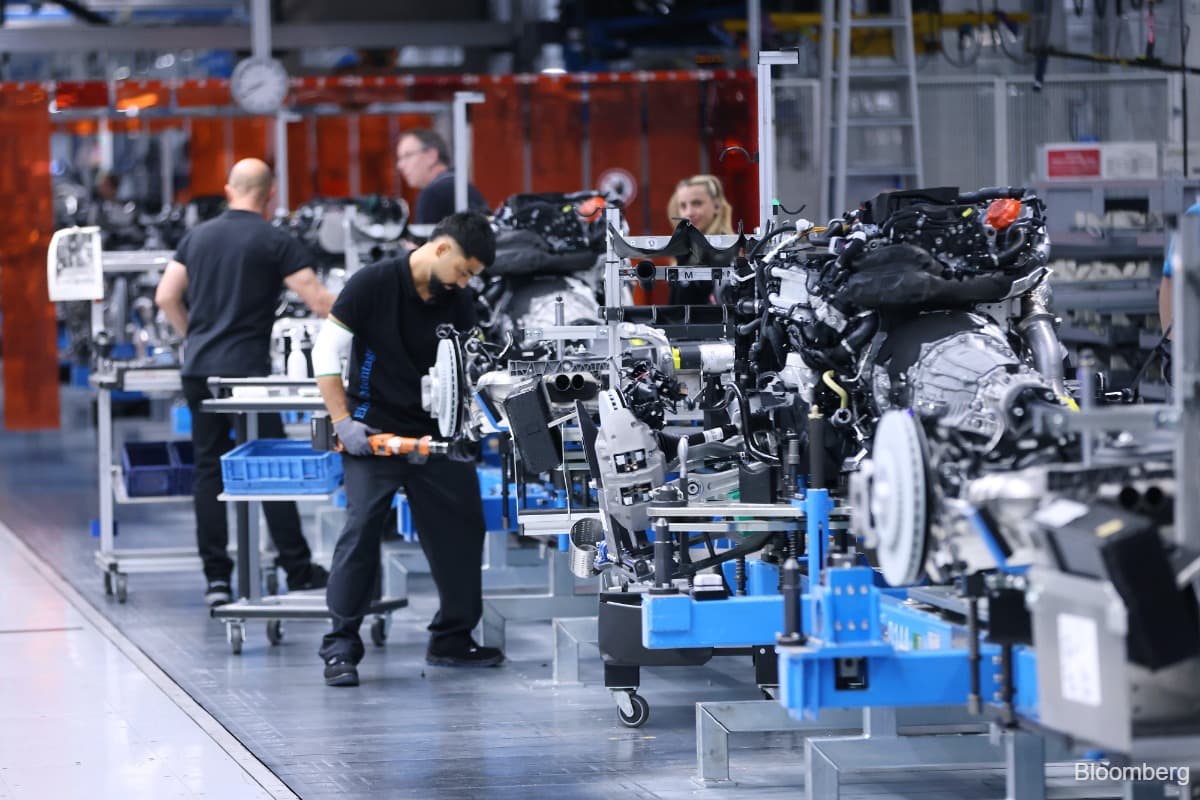
(Aug 7): German industrial production grew for a third month, another sign that Europe’s largest economy is resisting the drag from the Iran war.
Output increased 0.2% from a month earlier in June, the statistics office said on Friday. That’s down from a downwardly revised 0.7% and matches the median economist estimate in a Bloomberg survey.
The main driver of the growth was the automotive sector, which increased 3.6% from a month earlier.
Separate figures showed exports expanded for a fifth month, and imports also jumped. That resulted in a trade balance of €15.4 billion (RM72.8 billion), narrower than May’s €19.3 billion.
The numbers come after a string of surprisingly upbeat data, including better-than-expected second-quarter gross domestic product, and strong factory orders for July. On the back of a reform package from Chancellor Friedrich Merz’s government, gauges of business activity and confidence have also seen a boost.
“Despite external economic pressures, manufacturing output proved to be quite resilient in the past quarter,” the economy ministry said in a statement.
What Bloomberg Economics Says..
“Another slight increase in production in June, together with less gloomy business expectations and improving order intake, points to tentative signs of recovery in German industry. We expect industrial activity to expand modestly in the coming quarters.”
Still, ongoing uncertainty about the Strait of Hormuz and low water levels in the Rhine, Germany’s most important inland waterway, continue to threaten the economy.
The economy ministry acknowledged those issues, and highlighted firms’ efforts to restructure transportation logistics and maintain larger inventories to avoid the fallout from the dry river.
However, “temporary restrictions on the production activities of affected companies cannot be ruled out if reduced inland waterway transport capacities persist for an extended period,” it said.
There are already signs that more traffic has move onto land routes. The mileage covered by trucks subject to toll charges on German motorways increased by 0.8% in July from a month earlier.
Daimler Truck Holding AG is also noticing the impact from the low Rhine levels.
“We’ve already taken measures for alternative routings on the road instead of on the river to make sure that our customers receive their trucks,” chief financial officer Eva Scherer said on Friday. “And then, of course, we’re always looking at supporting — where we can — with providing as many trucks as we as we can.”
Uploaded by Evelyn Chan