

_20260811164829_theedgemalaysia.jpg&w=1920&q=75)
This article first appeared in The Edge Malaysia Weekly on August 3, 2026 - August 9, 2026
EVEN after building Malaysia’s largest minimarket chain with 3,086 outlets nationwide, 99 Speed Mart Retail Holdings Bhd (KL:99SMART) is showing little sign of slowing its expansion.
The convenience store operator plans to open 250 new stores annually over the next four years, adding 1,000 outlets to its network — one of the most aggressive expansion strategies among the country’s listed retailers.
For founder and CEO Lee Thiam Wah, the bigger opportunity no longer lies in simply adding new stores. As the business scales, he and his team are increasingly focused on extracting more value from each outlet by raising basket sizes, improving operating efficiency and leveraging technology to drive productivity.
This shift marks the next phase of 99 Speed Mart’s growth story. While opening more outlets will continue to underpin revenue growth, increasing customer spending and lowering operating costs will become equally important in sustaining earnings growth.
“We will still continue,” Lee says when asked whether the aggressive expansion programme will remain unchanged.
Despite concerns that Speed Mart could be approaching saturation, Lee remains confident Malaysia still offers ample room for expansion.
Even in the Klang Valley, where 99 Speed Mart has its highest store concentration, Lee believes the retailer can still expand its footprint by about another 20%. The East Coast states and Sabah, where the group has only recently established a presence, remain largely underpenetrated and offer a long runway for future expansion.
Population growth and household formation remain structural tailwinds for the retailer. As children move out and establish their own homes, the number of households rises even without a significant increase in population, supporting demand for neighbourhood convenience stores.
The group’s site selection criteria remain disciplined. A new outlet is typically set up only in locations with at least 1,500 households, consistent with its strategy of providing affordable daily necessities within walking distance of residential communities.
To put the rollout into perspective, 99 Speed Mart’s expansion plans remain among the most ambitious in the sector. Rival KK Super Mart, which operates about 996 stores, is targeting around 168 new outlets next year, while Mr DIY Group (M) Bhd (KL:MRDIY) plans to add about 155 stores to its network of 1,615 outlets. 7-Eleven Malaysia Holdings Bhd (KL:SEM), meanwhile, is targeting roughly 100 new stores on top of its existing 2,752 outlets.
Smaller families, bigger baskets
One structural trend Lee is watching closely is changing household demographics. He observes that Malaysian families are becoming smaller, changing purchasing behaviour in ways that favour higher-value products.
“In the past, when families had five or six children, affordability was the priority,” he says. “Today, households are smaller and consumers are more willing to spend on better quality products.”
That shift is encouraging 99 Speed Mart to gradually broaden its merchandise mix beyond traditional grocery staples.
Instead of focusing solely on low-ticket essentials, the retailer has begun introducing small household appliances through a collaboration with Chinese home appliance manufacturer Midea. The range comprises compact electrical appliances suited to neighbourhood convenience shopping rather than large-ticket consumer electronics.
Lee believes the category complements the needs of modern households who are increasingly seeking affordable but better quality household products without making a separate trip to larger hypermarkets. The move also illustrates how 99 Speed Mart intends to use its nationwide store network to broaden its merchandise mix without straying from its convenience-focused business model.
The collaboration extends beyond retail shelves. Midea is already one of 99 Speed Mart’s major equipment suppliers, providing air conditioners and lighting for its new and renovated stores. After years of using the products internally, management gained sufficient confidence in their quality to begin offering selected home appliances to customers as well.
If successful, higher-value merchandise could meaningfully lift average transaction values while preserving the retailer’s core positioning as a neighbourhood convenience store.
The strategy could also help address one of the group’s key operating metrics. Over the past three years, 99 Speed Mart’s average basket size has hovered around RM22. Introducing higher-value merchandise alongside everyday grocery staples could gradually lift average transaction values while preserving the retailer’s core positioning as a neighbourhood convenience store.
The lasting impact of Sara
Lee also believes the government’s Sumbangan Asas Rahmah (Sara) programme has created benefits extending beyond the immediate boost in sales.
Initially, the subsidy programme brought thousands of first-time customers into 99 Speed Mart outlets to redeem the government assistance.
Many of those shoppers previously purchased premium grocery items from supermarkets rather than minimarkets.
However, once they experienced the retailer’s product range, Lee says many discovered that 99 Speed Mart offered comparable branded products at competitive prices. The experience has encouraged repeat visits even outside the subsidy programme.
“They came because of Sara, but many found our premium products were competitively priced and started buying them from us as well,” Lee says.
The phenomenon illustrates what retailers often describe as customer acquisition through government programmes.
Instead of merely generating one-off transactions, Sara introduced new shoppers to the chain, allowing 99 Speed Mart to demonstrate its broader value proposition.
For Lee, the opportunity now lies in retaining those customers by continuously expanding the range of products they purchase.
Bringing bulk buying to households
Another business gaining traction is 99 Speed Mart’s bulk sales programme launched in September 2023, which Lee sees as a meaningful avenue to raise basket sizes beyond its traditional walk-in business.
Initially introduced to serve commercial customers, particularly food and beverage (F&B) operators, the platform is now being expanded to target household consumers buying groceries in larger quantities.
The concept is straightforward. Customers who spend above a minimum threshold of RM500 qualify for free delivery or free collection from their nearest 99 Speed Mart outlet, encouraging larger purchases while keeping fulfilment costs low. To make bulk purchases more affordable, the retailer has also partnered with Alliance Bank to offer instalment payment plans for eligible purchases.
Lee says the business that currently makes up about 1% of group revenue is growing by more than 20% this year, driven mainly by demand from commercial customers. The next phase, however, is to penetrate the household segment, where he sees an even larger opportunity.
Instead of making several small shopping trips each week, families can consolidate their grocery purchases into one or two larger orders, naturally lifting average basket sizes without relying on higher customer traffic.
The initiative also plays to one of 99 Speed Mart’s biggest competitive advantages — its extensive nationwide store network. With thousands of outlets located close to residential neighbourhoods, stores can double as fulfilment hubs, keeping delivery distances short and logistics costs manageable.
Unlike pure e-commerce retailers that rely on dedicated distribution centres, 99 Speed Mart can leverage its existing physical footprint to support online and bulk purchases with minimal incremental investment, giving it a structural cost advantage as it expands the service.
Boosting margins through efficiency
As 99 Speed Mart’s store network continues to expand, Lee believes the next phase of growth will depend as much on improving operating efficiency as opening new outlets.
One of management’s biggest priorities is reducing electricity consumption, which ranks among the retailer’s largest operating expenses. With stores operating long hours and running refrigerators, freezers, lighting and air conditioning around the clock, even small improvements in energy efficiency can translate into meaningful cost savings across a network of more than 3,000 outlets.
Rather than relying on a single initiative, the company has been systematically upgrading its stores with inverter air-conditioning systems, energy-efficient refrigeration equipment, LED lighting, improved freezer insulation and redesigned display chillers.
One notable improvement involves replacing conventional anti-fog heating systems used in display freezers with enhanced insulation technology that delivers the same visibility while consuming significantly less electricity.
Lee says the initiatives have already begun paying off. Despite opening another 253 new stores compared with a year ago, the group’s electricity bill for the first quarter was about RM6 million lower year on year, that could translate into annual savings of roughly RM24 million. The improvement was driven largely by the group’s own energy-efficiency measures.
Only about half of the group’s store network has completed the upgrades, suggesting further savings remain achievable as the retrofit programme continues.
“Every small improvement becomes meaningful when you have thousands of stores,” Lee says.
Pragmatic about AI
Technology forms another pillar of 99 Speed Mart’s next phase of growth.
It is investing a few million ringgit in artificial intelligence (AI) and upgraded software systems to enhance inventory management, procurement and operational planning. Years of data collected through its point-of-sale systems have given the company a rich database of purchasing patterns across different regions, store formats and product categories.
Lee says management is working with technology partners to better analyse the data to optimise inventory levels, improve replenishment schedules, evaluate supplier performance and refine product assortments.
While AI is expected to make decision-making more efficient, he believes the scope for automation in grocery retail remains constrained by economics and operational complexity.
Unlike manufacturing, where robots repeatedly handle identical products, convenience retailers deal with thousands of stock-keeping units of varying sizes, shapes and packaging configurations. That makes fully automating distribution centres significantly more complicated and, at least for now, uneconomical.
Instead of pursuing full automation, 99 Speed Mart is taking a pragmatic approach by adopting technologies that deliver clear productivity gains while retaining conventional warehouse operations where automation remains uneconomical.
The same philosophy extends to its stores. Although digital tools can improve efficiency, Lee says retailing remains a people business. Many customers, particularly elderly shoppers, still prefer asking store staff where products are located rather than relying entirely on self-service technology.
“Technology should help us become more efficient, but customer service still needs people,” he says.
Steady growth ahead
Looking ahead, Lee remains confident the group’s earnings will continue outpacing its store expansion. While annual store openings are expected to increase the store network by about 8% a year, he believes net profit should continue growing at a faster pace.
“We should be able to grow by more than that,” he says.
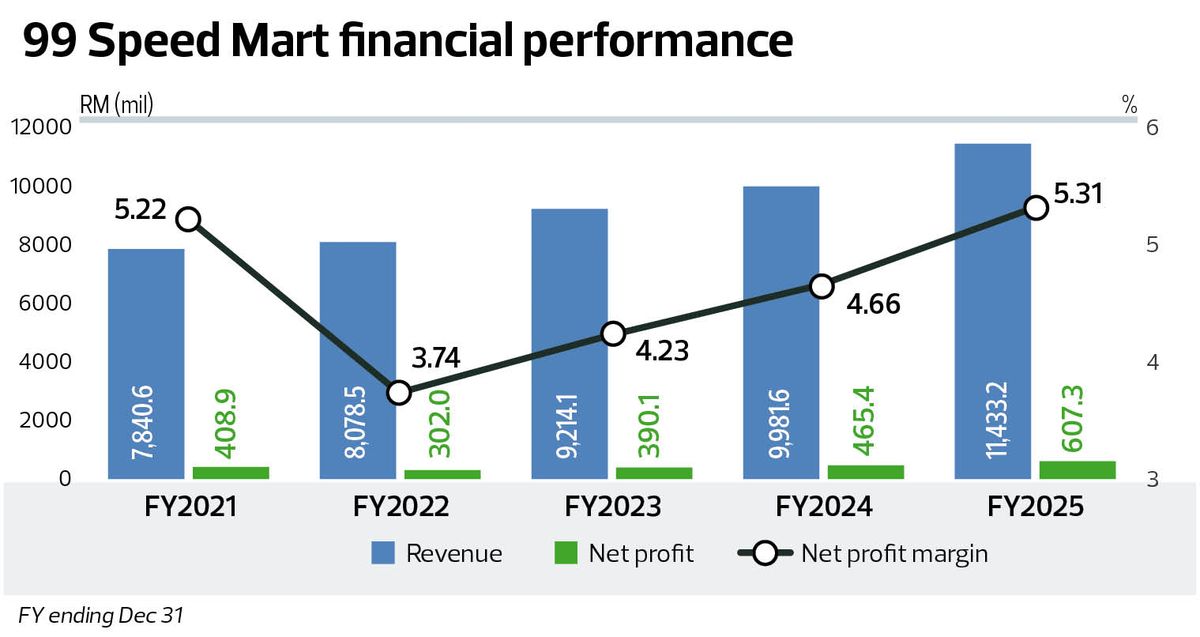
The optimism is underpinned by the group’s recent financial performance. Revenue grew 8.3% in FY2024 and a further 14.5% in FY2025, driven by continued outlet expansion, longer operating hours across its store network and implementation of Sara. Net profit, meanwhile, rose at a faster pace of 19.3% and 30.5% respectively, reflecting the benefits of operating leverage as the business scaled.
The benefits of scale are also evident in profitability. Net profit margin compressed from 5.31% in FY2021 to 3.74% in FY2022 as the group accelerated store expansion and invested heavily in its supply chain, profitability has steadily recovered. Profit after tax (PAT) margin rose to 4.2% in FY2023, 4.7% in FY2024 and 5.3% in FY2025 as the enlarged store network matured and economies of scale began to take hold.
The stronger earnings were also supported by higher supplier-related income. Other operating income — comprising product display fees, target incentives and distribution centre fees paid by suppliers — increased 15.3% to RM939.61 million in FY2025 from RM814.77 million a year earlier.
Lee, however, dismisses suggestions that these fees are subject to automatic annual increases. Instead, he says the group remains flexible in its dealings with suppliers, with the emphasis on ensuring products continue to move off the shelves rather than maximising fee income.
“We don’t have such arrangements. The most important thing is to make sure the products move,” he says.
The retailer also has ample financial resources to fund its expansion. As at end-2025, the group had yet to utilise RM324.21 million, or nearly half, of the RM660 million raised from its September 2024 initial public offering (IPO).
Of the remaining proceeds, RM193.88 million has been earmarked for new store openings, RM70.18 million for new distribution centres, RM36.94 million for the purchase of delivery trucks and RM23.22 million for upgrading existing outlets.
Its IPO proceeds aside, 99 Speed Mart continues to generate strong cash flow. The group reported free cash flow of RM730 million in FY2025, giving management considerable financial flexibility to fund future expansion while maintaining a healthy balance sheet.
Despite the sizeable cash pile, Lee says management remains disciplined in capital allocation. Rather than committing to higher dividends or share buy-backs, the priority is to retain sufficient financial flexibility to execute its expansion plans. While the group’s dividend policy targets a payout ratio of about 50%, it returned RM378 million to shareholders in FY2025, equivalent to a payout ratio of 62.2%.
On the ownership front, Lee, who holds a 79.68% stake in the company, says he has no plans to place out any of his shares. His wife, Ng Lee Tieng, owns another 3.32%.
“There is no such arrangement,” he says, adding that the stock already enjoys sufficient trading liquidity. Lee has not sold a single share since the post-IPO share sale moratorium expired.
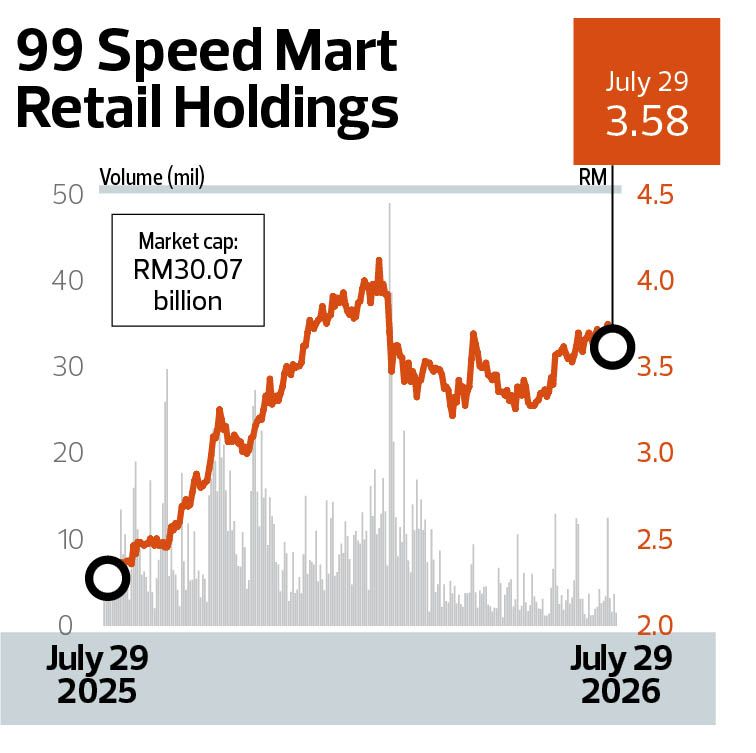
99 Speed Mart’s shares touched an all-time high of RM4.15 in February before easing to RM3.58 as of last Wednesday. Even after the pullback, the stock has gained 56.3% over the past 12 months, reflecting investors’ preference for defensive consumer staples amid a still-inflationary environment.
At its last traded price, the stock was valued at a trailing price-earnings ratio of 46.1 times and a forward PER of 40.7 times.
Analysts remain largely positive on the company. Of the 16 research houses covering the stock, 12 have “buy” recommendations, three rate it a “hold” and one recommends “sell”. Their target prices range from RM2.90 (AmInvestment Bank) to RM4.51 (Affin Hwang Investment Bank), with the consensus target price of RM3.93 implying a potential upside of 9.7% from its close of RM3.58 last Wednesday.
Save by subscribing to us for your print and/or digital copy.
P/S: The Edge is also available on Apple's App Store and Android's Google Play.