

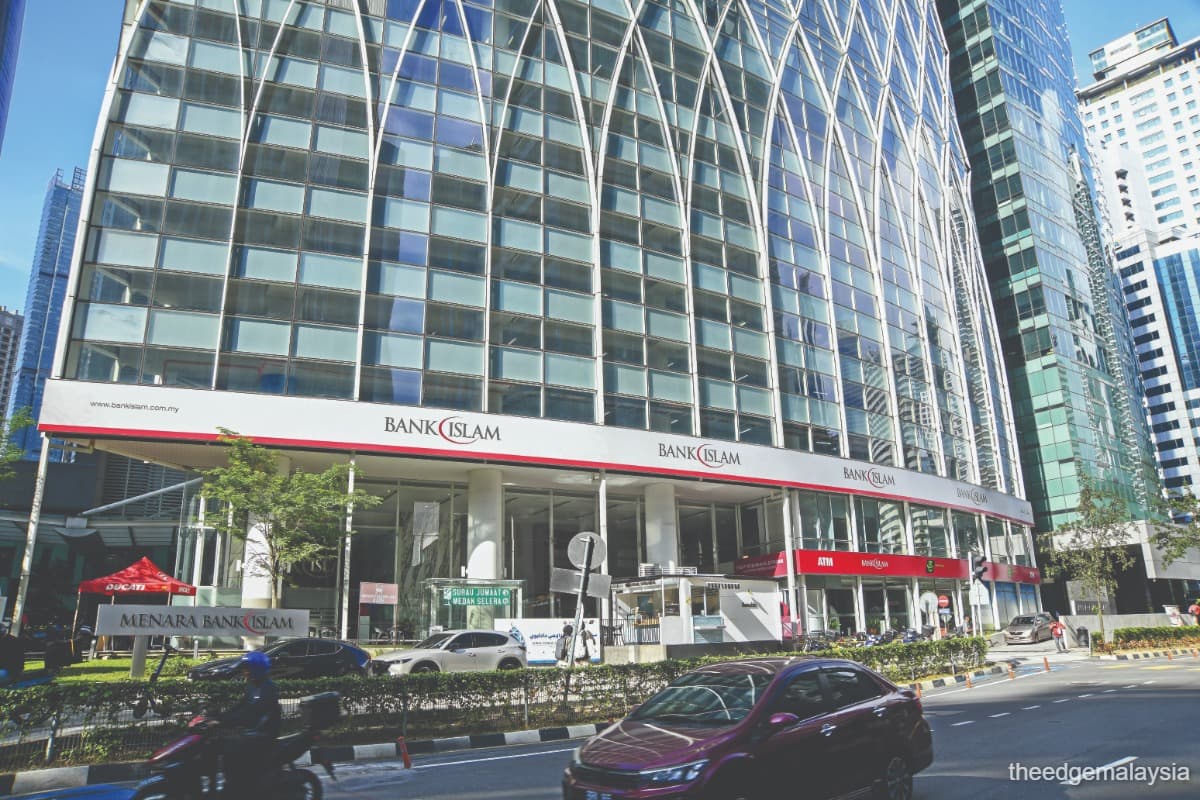
This article first appeared in The Edge Malaysia Weekly on August 3, 2026 - August 9, 2026
BANK Islam Malaysia Bhd (KL:BIMB) is moving away from an era of pursuing strong balance sheet expansion, with its next medium-term strategy set to prioritise profitability and shareholder returns over asset growth, its new chief says.
The Islamic lender, whose five-year strategic plan LEAP25 concluded last year, has yet to unveil its next multi-year strategy and financial targets — details investors are keenly awaiting amid a slump in its share price.
Bank Islam group CEO Raja Datin Paduka Teh Maimunah Raja Abdul Aziz, who took the helm on April 1, provided some insights into the upcoming strategy in an email response to questions from The Edge.
She says the next phase of the group’s journey will be guided by a simple principle: moving beyond asset growth towards “sustainable value creation”. Recall that a key target under the group’s previous LEAP25 strategy was to grow assets sizeably, as it needed to build scale to strengthen its competitive position.
“Over the last decade, the group has significantly expanded its balance sheet, and our focus now is on improving profitability, productivity and shareholder returns. This means being disciplined in where we deploy capital, improving returns from existing assets, and driving greater operating leverage across the organisation,” Raja Teh says.
The shift in strategy comes as Malaysia’s banking sector enters a more challenging operating environment. Lenders are facing mounting pressure on margins and asset quality amid growing headwinds, including geopolitical tensions in the Middle East, making earnings quality and capital efficiency increasingly important.
Raja Teh shares that, under the new plan, Bank Islam’s strategic priorities are expected to centre around four areas. It will focus on strengthening its core retail, business and corporate banking franchises while accelerating digitalisation and automation to improve customer experience and operational efficiency. It also plans to optimise capital, liquidity and balance sheet utilisation to enhance returns, while building new growth engines in wealth management, transaction banking and fee-based business.
“From a financial perspective, investors can expect management to remain focused on improving return on equity (ROE), lowering the cost-to-income ratio (CIR), sustaining healthy asset quality, and delivering sustainable earnings growth. The overarching objective is to enhance profitability and drive efficiency and create long-term shareholder value,” she says.
While Raja Teh did not indicate when the new strategy would be announced, analysts reckon Bank Islam — controlled by Lembaga Tabung Haji — may launch it around the time it reports its second-quarter financial results later this month.
Several analysts cut their earnings forecasts for the group after it delivered a lower-than-expected profit in the first quarter of the financial year ending Dec 31, 2026. Net profit for 1QFY2026 came in at RM115.03 million — down 8.9% year on year and 34.3% quarter on quarter — and made up only about a fifth of consensus expectations for the full year.
In FY2025, after two straight years of profit growth, its net profit fell 2.4% to RM557.24 million due mainly to higher costs as it invested further in technology. ROE fell to 7.1%, from 7.6% in FY2024 and 7.8% in FY2023.
The weaker financial performance of late is a key reason for the slump in its share price in recent months, analysts say. The shares are currently trading near their one-year low.
Under LEAP25, Bank Islam accelerated digitalisation by investing in digital banking capabilities and technology — something the group is expected to double down on in the next few years — and diversified its earnings by increasing non-fund-based income (through wealth management and investment banking) to reduce reliance on financing income.
The group achieved most of its LEAP25 targets. By end-2025, Bank Islam’s total assets had grown to RM104.12 billion — surpassing the target of RM100 billion — from RM80.16 billion at end-2021. Assets, which grew 7.6% last year, have moved up further to RM106.8 billion as at end-March 2026.
The group also exceeded its RM28 billion sustainable financing target (FY2025: RM31.3 billion) and its non-fund-based income ratio target range of 8% to 9% (FY2025: 12.5%).
Where it fell short was in the CIR, which rose to 66.1% — one of the highest in the industry — against a targeted range of 63% to 64%, as it continued to invest in digital transformation initiatives.
Raja Teh flags that cost pressures may persist over the short term. “We are undertaking a deliberate multi-year transformation programme to modernise our technology architecture, simplify processes and digitise customer journeys. These investments are necessary to strengthen resilience, improve scalability and position the bank for future growth in an increasingly digital banking environment. As a result, some cost pressures may persist in the near term. However, we do not view this as a permanent structural increase in costs.”
She points out that the reason for these investments is precisely to reduce Bank Islam’s long-term cost base. “Our focus is therefore not merely on cost reduction, but on creating a more efficient operating model.

“As transformation initiatives mature and operational efficiencies are realised, we expect productivity gains to contribute positively towards improving the group’s CIR and ROE over the medium term. The end goal is not simply to be a larger bank, but to be a more productive and more profitable one.”
Prior to joining Bank Islam, Raja Teh was the CEO of Islamic digital bank AEON Bank (M) Bhd.
As at last Friday (July 31), Bank Islam’s stock had gained a marginal 0.8% over the last 12 months to close at RM2.13, for a market value of
RM4.83 billion. After having reached a 12-month closing high of RM2.49 on Feb 12, the stock has since shed 14.6%.
Bloomberg data shows that of eight research houses that track Bank Islam’s performance, seven have a “hold” call on the stock and only one, an “add”. The average 12-month target price was RM2.35, which suggests potential upside from its close of RM2.13 last Friday.
“The group has several tailwinds: excellent dividend yields and asset quality, strong loan and top-line growth prospects. However, our concerns lie within upcoming transformation projects, as part of the soon-to-be announced multi-year plan. Initiatives such as a tech infrastructure revamp and business line restructuring will likely ramp up cost pressure significantly,” MBSB Research, which has a “hold” call, says in a report following Bank Islam’s 1QFY2026 results.

Analysts expect no upside to Bank Islam’s dividend payout ratio of 60% despite an expected capital uplift from Basel III revisions.
“The 35bps (basis points) to 40bps final Basel III uplift is not earmarked as excess capital, which is sobering, given [Bank Islam] made clear that capital management is firmly off the table for now,” AmInvestment Research, which also has a “hold” call, says in a May 28 report. Bank Islam’s gross dividend per share amounted to 14.45 sen last year, following 15.12 sen in 2024 and 16.81 sen in 2023.
Although Bank Islam’s gross impaired financing ratio ticked up to 1.02% in the first quarter from 0.97% in the preceding quarter, the research house believes this is “seasonal” and that the impact from the Middle East conflict will be manageable, within the group’s 28bps to 33bps net credit cost guidance for the year (FY2025: 21bps). “Moreover, RM58 million expected credit cost overlays and loan loss coverage ratio at 100% provide a comfortable cushion,” it says.
Tabung Haji has a 48.87% stake in Bank Islam while the Employees Provident Fund holds 16.2% and Amanah Saham Nasional Bhd, 5.74%.
Save by subscribing to us for your print and/or digital copy.
P/S: The Edge is also available on Apple's App Store and Android's Google Play.