

This article first appeared in The Edge Malaysia Weekly on August 3, 2026 - August 9, 2026
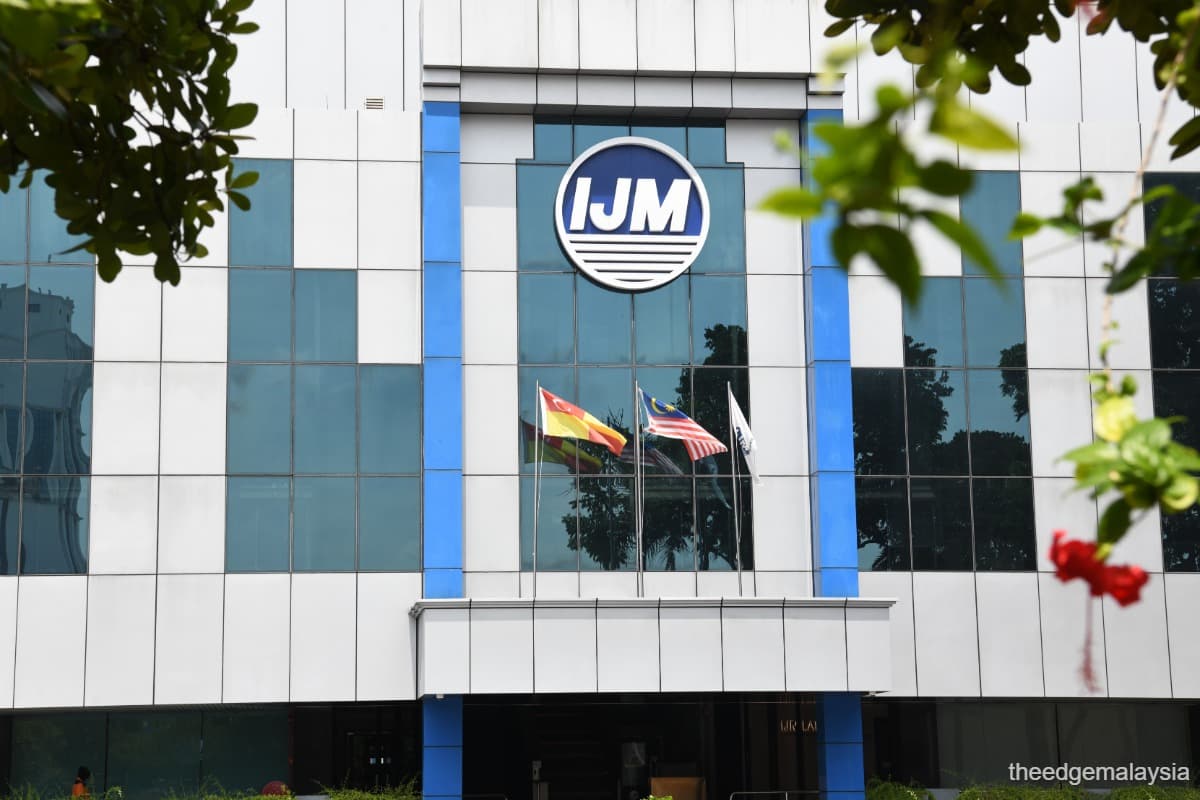
ONE of the rare qualities of IJM Corp Bhd (KL:IJM) is that it is the only construction company in the big league of Bursa Malaysia that is not managed or operated by stakeholders.
IJM’s competitors such as Gamuda Bhd (KL:GAMUDA), Sunway Construction Group Bhd (KL:SUNCON), YTL group, WCT Holdings Bhd (KL:WCT) and Kerjaya Prospek Group Bhd (KL:KERJAYA) are all driven by individuals who also have an equity stake in the company.
IJM is the only construction company that is managed by professionals and owned by institutions led by the Employees Provident Fund (EPF), Kumpulan Wang Persaraan (Diperbadankan) and Permodalan Nasional Bhd (PNB).
Managing the expectations of IJM’s shareholders is no easy task.
The institutions expect good returns or they just reduce their interest in the company or consider any good offers that come along. Consequently, this makes IJM a target of acquisition by parties within and outside the construction industry when its valuations are low.
The construction industry in Malaysia is a difficult business because of the leakages and need for an experienced team with strong execution skills. Six months of delays, a procurement process that is not transparent and a weak execution team can cause projects to bleed. This is why the successful construction companies are those whose owners have skin in the game.
Moreover, big jobs in Malaysia require political lobbying due to the nexus between industry and political power. This has been a feature of the business since the 1980s.
Over the years, IJM has built a team with strong execution skills. It rarely completes a job at a loss, a trait that is severely lacking in other government-linked construction companies.
This is mostly due to a seasoned hand like Tan Sri Krishnan Tan Boon Seng firmly steering the IJM ship. For the last 42 years, Tan has seen it all as part and parcel of the construction company that has now diversified into running highways and a port, manufacturing pre-cast construction beams and owning a huge property land bank.
The 74-year-old Tan, who has opted not to seek re-election at IJM’s upcoming annual shareholders meeting, has been in the top leadership of the company since its formation in 1983. He started out as the financial controller in 1983 and has been on the company’s board since 1990.
He was the longest serving managing director, holding the position between 1997 and 2010. After retiring as managing director, Tan was the executive deputy chairman until 2013 and became non-executive deputy chairman between 2014 and 2019.
In August 2019, Tan became the chairman of IJM, a position that used to be reserved for a nominee of EPF.
Expansion via acquisition
In 2003, Tronoh Mines Malaysia Bhd, now known as Zelan Bhd (KL:ZELAN), emerged in IJM as the single largest shareholder with an 18.5% stake after acquiring the block from IGB Corp Bhd.
Tronoh was under the MMC group, which was owned by Tan Sri Syed Mokhtar Albukhary.
“A year later, speculation was rife that IJM was becoming a target of Syed Mokhtar. As EPF and PNB had a combined stake of 20%, the talk was that they would sell if the offer was good. One way of making it difficult for Syed Mokhtar [to take over the company] was to make IJM more expensive,” recalls an investment banker.
An opportunity came in 2005 when the late Tan Sri Chan Ah Chye’s Talam group was in financial distress and needed a steady hand to complete thousands of homes. Talam group, which restructured to become Kumpulan Europlus Bhd, was the largest builder of affordable homes in Selangor at the time.
Word reached IJM and Tan saw an opportunity. He was instrumental in IJM buying a 25% stake in Kumpulan Europlus, which is now known as WCE Holdings Bhd (KL:WCEHB).
The transaction was only completed in 2007 due to the many regulatory and creditor approvals required. But IJM’s entry into Kumpulan Europlus ensured that the houses were completed, taking a major problem off the hands of the Selangor government.
IJM gradually increased its stake in Kumpulan Europlus and took control of a huge land bank in Selangor, which IJM Land is developing until today. One of the developments that IJM inherited from Kumpulan Europlus is the township of Bandar Rimbayu in Selangor.
Apart from land, Kumpulan Europlus also paved the way for IJM to build a highway along the west coast of Peninsular Malaysia. Today, the West Coast Expressway from Klang to Taiping is almost completed. Its next phase is from Klang to Pasir Gudang in Johor, making the highway almost parallel to the North-South Expressway.
The highway also provides IJM Construction with constant work orders.
The biggest corporate exercise for IJM under Tan was the takeover of Road Builder (M) Holdings Bhd in December 2006. This came just a year after the Kumpulan Europlus deal and saw the transformation of IJM.
“For a professionally run construction company in Malaysia, mergers and acquisitions were rare. The deal with Road Builder moved IJM to a new level altogether,” says the investment banker.
In December 2006, IJM launched a mandatory general offer for Road Builder — a RM1.56 billion deal that was to be paid in cash and shares. The deal was dilutive to existing IJM shareholders.
“But at the same time, it was value accretive as Road Builder had infrastructure assets such as highways and a port in Kuantan. Road Builder was also the developer of the Seremban 2 township,” says the banker.
IJM’s share price almost doubled after the deal was concluded. Syed Mokhtar’s Tronoh’s stake was diluted and the company eventually sold out.
“Tan managed to convince the IJM board that Road Builder offered more than just assets. If it was just assets, the board may not have approved the deal because IJM could have just acquired the vital infrastructure and the case to undertake a complete merger was less compelling.
“Tan told the board that Road Builder had many young people in the second-tier management level who could be groomed to take over senior positions at IJM. He saw Road Builder for more than its assets,” says the banker.
True to his vision, the IJM of today is led mainly by ex-employees of Road Builder: IJM’s current group managing director, Datuk Lee Chun Fai, and group chief financial officer, Datuk Edward Chong, are both from Road Builder. Former IJM group managing director, Datuk Soam Heng Choon, was also from Road Builder.
By 2008, IJM was already out of the reach of prospective predators. The company’s plantation subsidiary was fairly large while Road Builder became IJM Land. The group became too expensive for any party wanting to take it over.
Not all of IJM’s acquisitions and ventures under Tan turned out well.
Its 2012 acquisition of a stake in Scomi Group Bhd did not benefit IJM. In fact, it brought the company more pain than gain. Until today, the question as to why IJM did not take firm control of Scomi like it did at Kumpulan Europlus is unknown.
IJM’s expansion outside Malaysia, especially into toll highways in India, has also been challenging. IJM has several highways in India but it has been unable to come up with a good deal to exit the highways.
Unlocking value
With Tan’s departure from IJM, the challenge for the new team, headed by Lee, is to keep the predators at bay and at the same time appease its institutional shareholders.
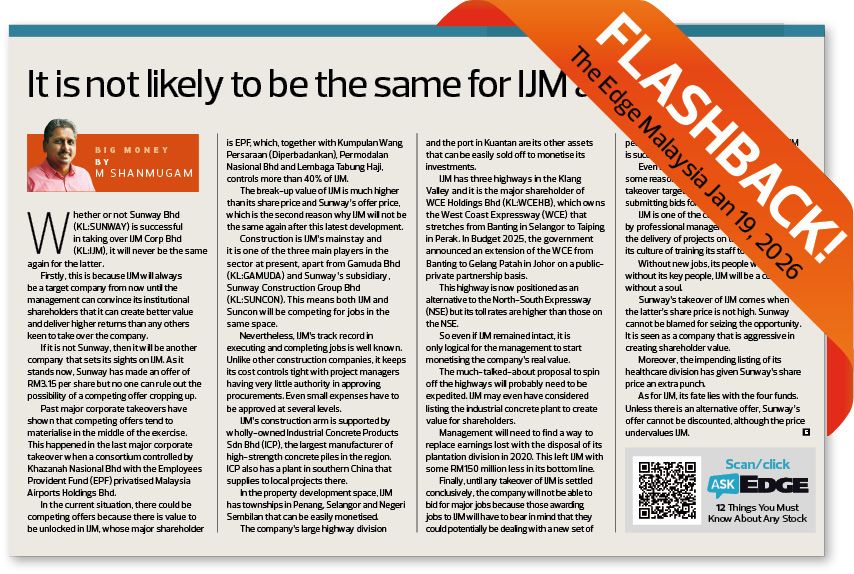
In January this year, Sunway Bhd (KL:SUNWAY) made a general offer to take over IJM at RM3.15 per share, valuing the company at RM11 billion. And the situation became more difficult for IJM and its management as the Malaysian Anti-Corruption Commission (MACC) started a probe into the company just 10 days after Sunway’s offer was made.
The IJM board fended off the offer by commissioning two independent advisers to evaluate the value of its shares. The range was between RM4.80 and a maximum of RM6.48 per share. The institutional shareholders rejected the offer and the deal did not progress.
The MACC has also since cleared IJM and Tan of any wrongdoing.
Following the failed Sunway takeover, IJM’s management has accelerated its plans to unlock value within the group. For starters, IJM is looking at listing its construction arm in 2027.
The Edge reported that the construction unit is looking at a valuation of RM5 billion, which is far more than analyst expectations. To get that kind of valuation, a research house states that IJM’s construction unit needs to double its profit from the current level of RM143.15 million recorded in its financial year ended March 31, 2026.
“After rejecting the offer from Sunway, the institutional shareholders would want to see IJM’s management create value. Taking cognisance of the matter, the management is already looking at ways to create value,” says a source.
Other assets that hold value at IJM are its urban highways. Both the New Pantai Expressway and Sungai Besi Expressway are churning out strong cash flow.
Sources say PNB is keen on the highways to enhance the value of Prolintas Infra Business Trust (KL:PLINTAS).
“The question is about the valuation and how it will benefit the shareholders of IJM,” says the source.
IJM has assets that can be unlocked at valuations forecast by independent advisers. But for that to happen, Lee needs a firm hand in doing what’s best for the company and its shareholders.
As long as Tan was around, he could easily command the respect of the board and the institutional shareholders. Although no longer holding any executive positions, he was the face of IJM in the eyes of the institutional shareholders and top government officials as well.
Now, the board needs to give Lee some leeway for him and his team to establish themselves. They know the business well. The question is whether the person replacing Tan will give Lee and the IJM team the opportunity to prove themselves without undue interference.
This is why Tan’s replacement is something that should be closely watched because it will determine the future direction of IJM and what the institutional shareholders want from it.
Save by subscribing to us for your print and/or digital copy.
P/S: The Edge is also available on Apple's App Store and Android's Google Play.