

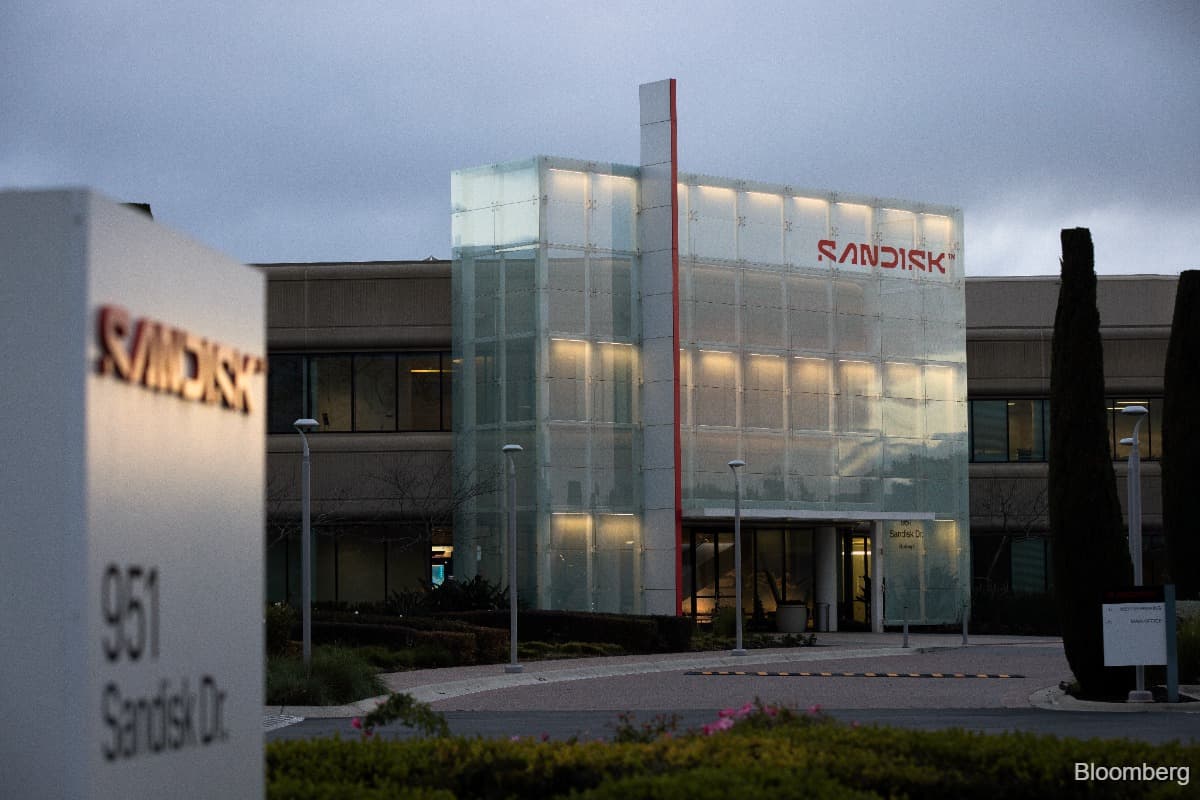
(Aug 5): Sandisk Corp’s high flying stock tumbled back to Earth last month. Its earnings after the market closes on Wednesday will test whether strong results are enough to entice investors to buy in again.
Shares of the maker of memory storage components plunged 47% in July, erasing more than US$150 billion (RM614.03 billion) in market value in their worst monthly performance since going public in February 2025. The stock remains the best performer in the S&P 500 Index this year, soaring 501%, but that’s a substantial comedown from the end of June when it was up 858% in 2026. It’s back on a roll this week, jumping 6% on Monday and another 11% on Tuesday.
Sandisk is widely expected to report soaring profit and revenue growth and, perhaps more importantly, to give a rosy forecast after tech giants including Amazon.com Inc and Microsoft Corp pledged last week to keep spending heavily on artificial intelligence (AI) computing infrastructure. Those two stocks raced higher following the companies’ strong earnings, but it’s unclear if similar results from Sandisk can spark a similar rally in its shares.
“This market is so fickle right now that we don’t know how the market is going to see what Sandisk has to say,” said Larry Tentarelli, chief technical strategist of Blue Chip Daily. “If Sandisk traded in a 10% or 15% up or down range after earnings, neither one would surprise me.”

Sandisk’s selloff was triggered by rising concerns about the durability of Big Tech’s massive spending commitments on computing capacity for AI. And the Milpitas, California-based company was hardly alone in getting punished amid the sentiment shift.
Western Digital Corp, which also reports earnings after the bell on Wednesday, has lost 26% since hitting a record on June 18. The Philadelphia Stock Exchange Semiconductor Index, or SOX, suffered its worst month since 2008 in July, falling 21%. Plenty of other AI-related stocks dropped more than 35% last month, including Marvell Technology Inc. and Intel Corp.
Sandisk is expected to report net income of US$5.5 billion in its fiscal fourth quarter, which ended on June 30, up from a loss of US$23 million in the same period a year ago, according to the average of analyst estimates compiled by Bloomberg. Revenue is projected to more than quadruple to US$8.6 billion.
Last week’s disappointing results from SK Hynix Inc, the South Korean memory chipmaker that is closely aligned with Sandisk, showed what can happen if earnings come up short of expectations. The shares sank after it reported operating profit and revenue in the June quarter that fell short of analysts’ expectations, losing as much as 30% intraday in South Korea trading before recovering at the end of the week.
“Storage fundamentals are the best they have been in a decade and expectations are priced accordingly, so nothing short of a big beat with a bigger guide will clear the high bar,” said Dave Mazza, chief executive officer at Roundhill Financial. “Sandisk and Western Digital sit at the higher beta end of the memory trade, meaning they get the upside torque when the cycle’s working and the sharpest drawdowns when it does not.”
Even with Sandisk’s downturn, the company is likely facing elevated expectations for its results and outlook. Estimates for its earnings per share in fiscal 2027 have risen 14% in the last month, according to data compiled by Bloomberg.
“We think Sandisk is differentiated because they have a lot of momentum with new business model agreements,” Melius analyst Ben Reitzes said. “We also think they can buy back a ton of stock and probably have a willingness to do so.”
Wall Street remains overwhelmingly bullish on the shares. Of the 30 analysts tracked by Bloomberg that cover the company, 25 have buy ratings — and none recommend selling. The average price target of US$2,433 implies a gain of about 70% over the next 12 months. The options market is pricing in a move of 14% in either direction for Sandisk shares after the earnings report.
One big factor in the company’s favour is that last month’s selloff has left its shares trading at their cheapest level in more than a year. At about seven times earnings estimated over the next 12 months, Sandisk is priced well below its average multiple of 11 times since the stock’s debut.
“The valuation has gotten much more attractive because of the selloff that we’ve seen starting at the end of June,” said Rob Thummel, senior portfolio manager at Tortoise Capital Advisors, which owns Sandisk shares. “But the expectations will still be high.”
Uploaded by Felyx Teoh