

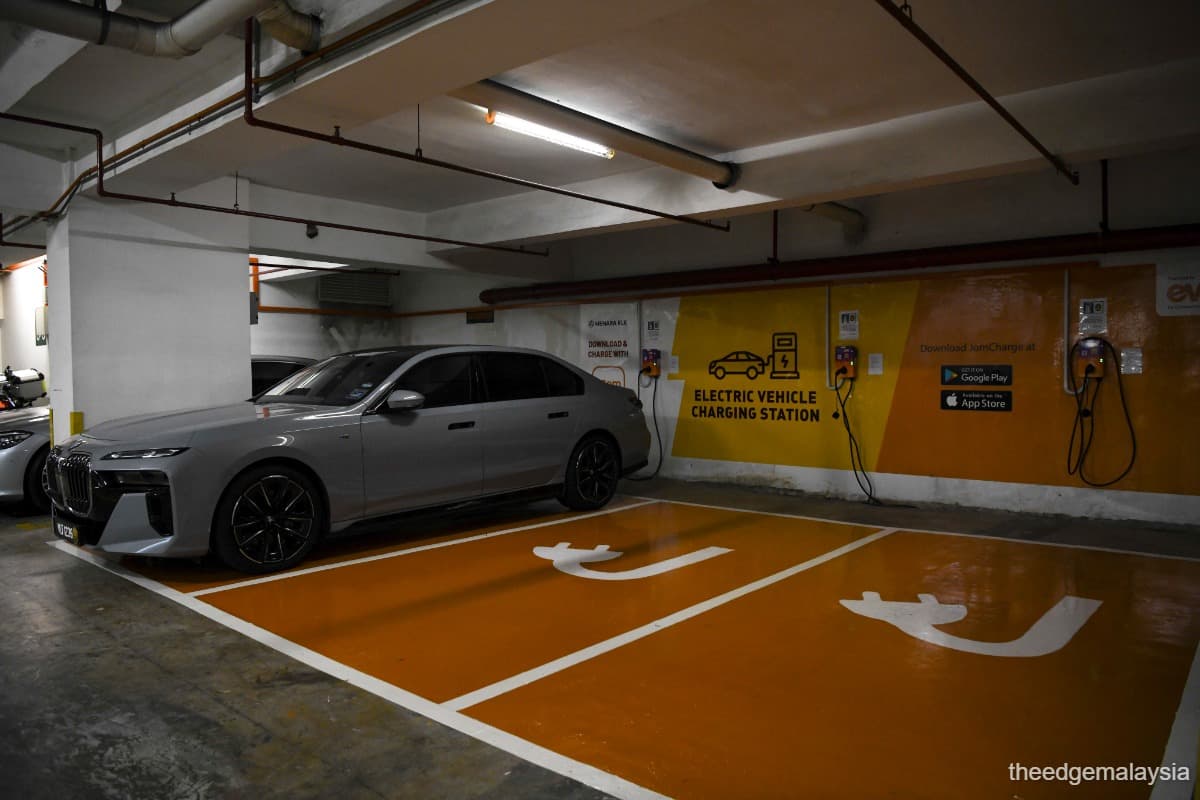
Investment, Trade and Industry Minister Datuk Seri Johari Abdul Ghani announced this week that the government is studying a levy on every electric vehicle (EV) sold, with the proceeds placed in a dedicated fund to finance public chargers. The rationale is twofold: EV manufacturers and distributors cannot be relied upon to build the charging network; secondly, it contrasts Malaysia’s RM3.3 billion in forgone EV taxes with China’s public investment in charging infrastructure. As of May 2026, Malaysia had only installed 6,416 charge points, including just 240 across Sabah and Sarawak, falling short of the 10,000 target by end-2025 set out in the Low Carbon Mobility Blueprint 2021-2030. The government has since raised the target to 30,000 by 2030.
The proposal, however, is based on a flawed diagnosis of the problem.
First, the proposal misidentifies who actually builds and operates Malaysia's EV charging network. The public charging network is dominated by energy companies, utilities and specialised charging companies, not vehicle manufacturers or distributors. Operators such as ChargeSini, Gentari by PETRONAS, TNB Electron, Time Charge n Go and Shell Recharge account for the bulk of Malaysia's charging network, while Tesla is the only major EV automaker operating a sizeable proprietary network. Just as petrol stations do not have to be built and run by car manufacturers, EV charging points do not have to be operated by EV makers too. EV manufacturing and charging infrastructure are two distinct ecosystems, and policy should recognise that distinction.
Second, the RM3.3 billion figure conflates two entirely different policy objectives. The tax exemptions from import duty, excise duty and sales tax were introduced primarily to accelerate EV adoption and develop Malaysia's domestic EV industry. The government's strategy was straightforward: stimulate domestic demand through imported EVs, attract foreign manufacturers to establish local assembly, and eventually deepen local supply chains and component manufacturing. These tax incentives are distinct from those available to charging operators, which includes a separate three-year tax exemption on 70% of statutory income for qualifying EV-related green services. Moreover, the government has never disclosed how much of the RM3.3 billion was attributable to charge point operators (CPOs). Given that Malaysia's charging industry is still in a relatively early stage and requires substantial upfront capital investment, it is unlikely that CPOs have contributed materially to the tax revenue forgone.
Third, a levy on EVs risks worsening the very problem it seeks to solve. The commercial viability of any charging station depends on electricity sales (throughput), which ultimately depends on the number of EVs on the road. By increasing the effective purchase price of EVs, a levy would dampen demand and lengthen the payback period for charging investments. This comes just as tax exemptions for imported completely built-up (CBU) EVs have expired and new imports are subject to a minimum cost, insurance and freight (CIF) value of RM200,000 and a minimum motor output of 180kW. At the same time, subsidised RON95 petrol remains available to more than 14 million eligible Malaysians at RM1.99 per litre, further reducing the financial incentive to switch to EVs, which slows Malaysia’s energy transition ambition.

A better policy response begins with understanding the nature of Malaysia's charging shortfall. The original target of 10,000 public charge points comprised 9,000 AC chargers and 1,000 DC fast chargers. As of May 31, 2026, Malaysia had already installed 2,143 DC fast chargers, more than double the original target but only 4,273 AC chargers, less than half the intended target. The largest gap lies in slower, lower-cost AC charging at workplaces, apartments, commercial buildings and public car parks, rather than in DC fast charging. The network is also heavily concentrated in Peninsular Malaysia, with only 240 public chargers serving the entirety of Sabah and Sarawak.
The first challenge is commercial viability. Unlike petrol stations, where almost every refuelling takes place at a commercial outlet, a large share of EV charging occurs at home or at the workplace. Public chargers therefore compete for only part of the market, resulting in highly uneven utilisation across locations. Meanwhile, installing a charger, particularly a DC fast charger, requires significant upfront investment in equipment, substations, grid connections and maintenance. Although charging tariffs may appear attractive, profitability ultimately depends on achieving sufficient utilisation. The policy challenge is therefore not simply financing more chargers but making investment commercially viable in locations where utilisation is structurally low.

The second challenge is regulatory and institutional. The government itself has acknowledged that insufficient substations and grid capacity constrain deployment and is working with Tenaga Nasional Bhd (KL:TENAGA) (TNB) to address these issues. In addition, residents of stratified properties such as condominiums and commercial buildings continue to face legal and administrative hurdles in installing home chargers because Malaysia still lacks a clear statutory framework governing installation right. Meanwhile, the approval process often involves multiple agencies, including the Energy Commission, TNB, local authorities and the Fire and Rescue Department, adding complexity, time and cost to each project.
Regional experience suggests that removing these barriers is more effective. Singapore, for example, introduced the Electric Vehicles Charging Act 2022 to establish a clear licensing framework for CPOs, standardise technical and safety requirements, and streamline charger deployment. It also amended the Building Maintenance and Strata Management Act to reduce the approval threshold for installing chargers in condominiums from 90% to a simple majority, removing one of the biggest obstacles to residential charging.
The proposed fund could still play a useful role, by providing matching grants or gap funding for chargers in rural and semi-urban areas. However, such a fund cannot substitute for reforms that improve commercial viability and remove regulatory bottlenecks. Nor should it be financed by taxing EV buyers, who are already helping to reduce the government’s exposure to fuel subsidies. In principle, any levy intended to accelerate the shift to cleaner transport would be better imposed on higher-emission vehicles, using the proceeds to support charging infrastructure and encourage motorists to switch to EVs.
Malaysia's EV transition does not suffer from a shortage of ideas. It suffers from a misdiagnosis of the problem. Until policymakers address the commercial and regulatory barriers that constrain charging deployment, the new target of 30,000 charge points risks becoming simply a larger version of the 10,000 charge point target that was already missed.
Sum Dek Joe is an economist by training and assisting with policy formulation at Parti Bersama Malaysia.