

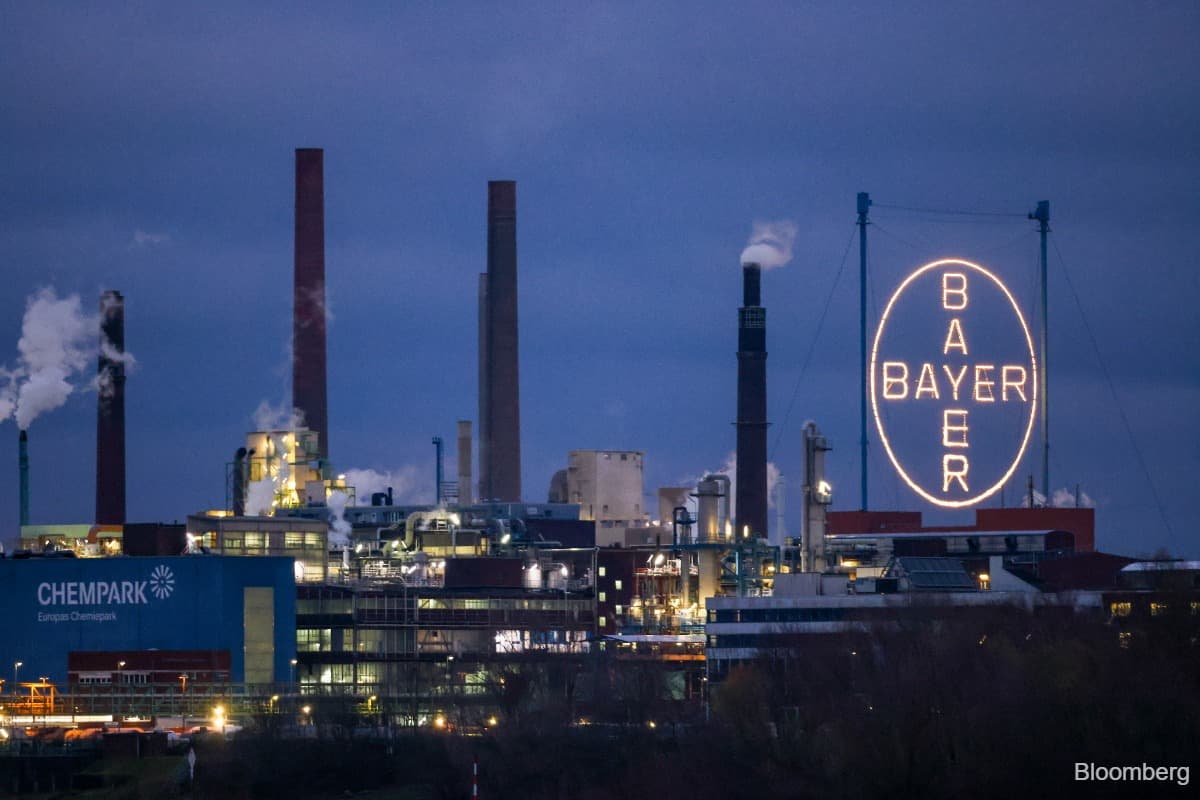
(Aug 4): Bayer AG’s profit unexpectedly rose in the second quarter, helped by strong demand for soybean seeds and weedkillers at its crop science division.
Adjusted earnings before interest, taxes, depreciation and amortisation rose 1.9% to €2.14 billion (RM10.1 billion), Bayer said Tuesday, exceeding analysts’ estimates.
The shares jumped as much as 5% in Frankfurt, the most in a month.
Since taking over in mid-2023, CEO Bill Anderson has been grappling with fallout from mass litigation tied to its Roundup weedkiller, while also trying to improve performance across the group by trimming management layers and eliminating thousands of jobs.
Earnings at the crop science division jumped 30%, driven in part by higher volumes and prices for its glyphosate-based herbicides. Bayer recently separated the US glyphosate business into an entity called Ruveon, a move seen as an attempt to limit litigation risks.
“These are good results that may stoke hopes of longer-term margin recovery in crop science,” Berenberg analyst Sebastian Bray said in written comments, pointing to the benefit of the reapproval of soy crop herbicide dicamba.
The shares have gained more than 30% this year, in part on investor hopes that Bayer is getting its arms around its long-running legal problems in the US.
Anderson pledged to significantly contain the legal overhang by the end of this year, including via a settlement to resolve claims that Roundup causes cancer — an allegation the company rejects. Bayer inherited the litigation with its 2018 acquisition of Monsanto and has already paid more than US$10 billion (RM40.96 billion) to resolve Roundup claims.
Bayer received a favourable US Supreme Court ruling in June that weakened a key argument underpinning the majority of Roundup-related legal cases.
“Overall, our containment strategy is in a strong place, with some important milestones ahead,” Anderson said in written comments.
The next big legal decision Bayer and its investors are awaiting is an Aug. 19 fairness hearing by a Missouri court of Bayer’s US$7.25 billion settlement proposal, which is designed to address current and future Roundup cases. Bayer has only received preliminary approval so far.
Possible breakup?
Bayer’s progress in dealing with its legal troubles has revived questions about a possible breakup. Anderson told reporters that “the structure topic is one that is always with us because we have three divisions that are different and that’s not the normal way of things in the world today”.
While Bayer is keeping an open mind about its options, Anderson said the immediate priority was to remain “laser-focused” on other goals, including to rejuvenate its pharma pipeline, contain the litigation and reduce debt.
“They will make us better in any scenario, in any structural scenario, whether we’re staying together, whether we’re selling something or divesting something,” Anderson said on the call.
In its pharmaceutical division, Bayer suffered from generic competition from Xarelto, with sales of the blood thinner slumping by 42% in the quarter, as well as eye medicine Eylea. The company is betting cancer drug Nubeqa and kidney therapy Kerendia, along with new launches, can return the unit to growth by 2027.
Like other drugmakers, Bayer is facing pressure from recent healthcare reforms in Germany that raise mandatory rebates paid by pharmaceutical companies. That could make launching medicines in Germany less attractive as US policymakers seek to link American drug prices to the lower prices paid in other countries.
Anderson said it’s in discussions with authorities in Germany and Europe over the launch of its potential blockbuster stroke-prevention drug Asundexian.
“We hope to launch Asundexian around the world, including in Europe and in Germany,” he said. “But we certainly need to have conversations, and we’re having those conversations, to make sure that it’s appropriately valued.”
Consumer health, Bayer’s smallest unit, posted slight sales growth on an adjusted basis in the quarter, with digestive health products showing the strongest growth, though it continued to face weakness in the US.
To help finance its litigation costs, the company agreed to sell a minority stake in its long-acting contraceptives business to Apollo Global Management Inc for €3 billion in July.
The company confirmed its full-year outlook on a currency-adjusted basis while lowering its forecast for net financial debt following the Apollo transaction.
Uploaded by Arion Yeow