

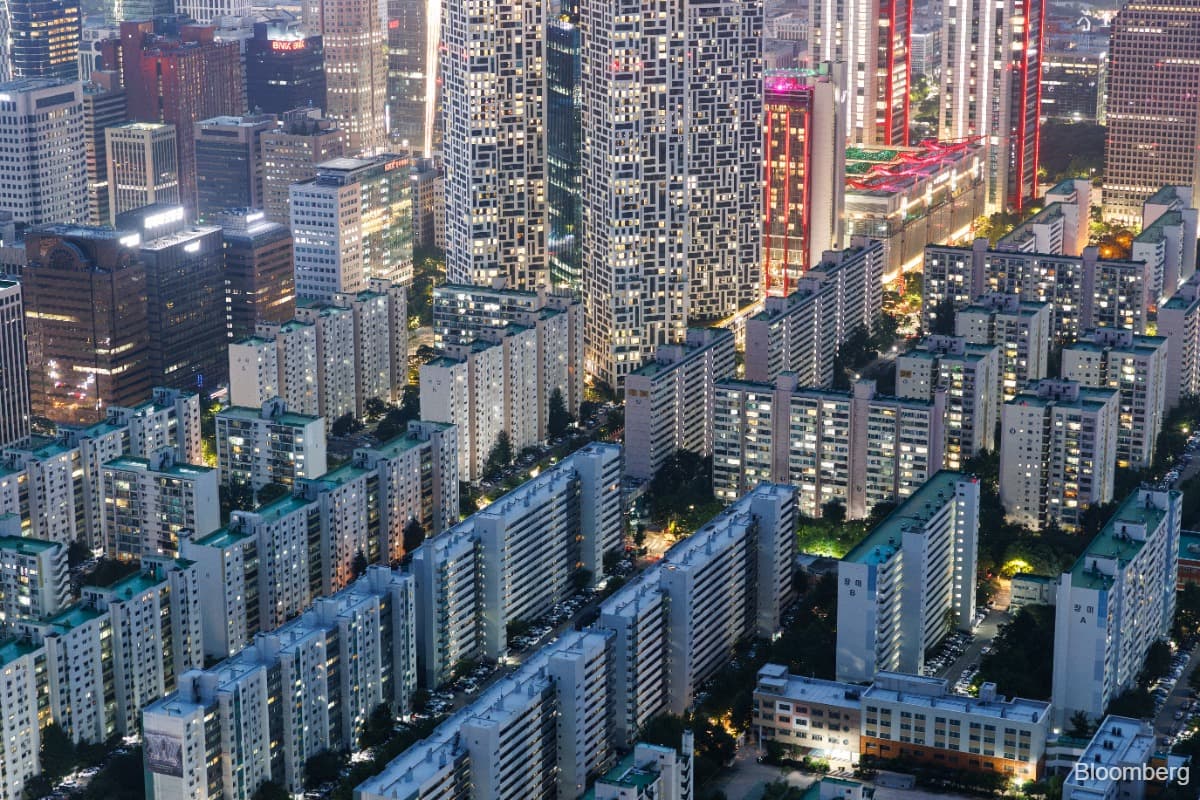
(Aug 3): South Korea proposed a property tax overhaul that would increase levies on high-value homes and investment properties as President Lee Jae Myung’s administration seeks to curb speculation in a housing market that has posted relentless gains.
The measures would raise holding taxes on expensive homes while preserving or expanding breaks for owner-occupiers, with the government casting the changes as a way to improve fairness by shifting more of the burden to expensive properties. Tax benefits would also increasingly depend on how long owners actually live in a property, rather than how long they have owned it.
“Under the principle that a home is a place for living, not an asset for buying, we will rationally reform the real estate tax system so that a housing market centered on actual residence can take root,” Finance Minister Koo Yun Cheol said in a briefing.
Most owner-occupied homes valued at up to about three billion won (RM8.48 million) would continue to receive preferential tax treatment under the proposal. Homes above that threshold would gradually face higher holding taxes under what the government described as a normalisation of the property tax system. The package would also tighten taxes on multiple-home owners and non-resident homeowners.
The tax overhaul marks the latest attempt by Lee’s administration to rein in a housing market that has defied months of restrictive policies. Despite stricter mortgage rules, warnings against speculation and pledges to accelerate home construction, prices have continued to climb, leaving the government searching for new ways to cool demand without inflicting broader economic damage.
That has prompted the government to tackle the issue by tax revision. It plans to phase in higher comprehensive real estate taxes through 2028, while temporarily easing capital-gains tax surcharges for owners of multiple homes to encourage them to sell properties before the tougher tax regime takes full effect.
The tax package is part of a broader housing tightening measure. Properties in designated speculative areas are already subject to stricter mortgage rules and land transaction permit requirements. The tax changes add another layer by increasing the cost of holding high-value and investment properties.
The overhaul comes as Seoul apartment prices extended their weekly gains to about 18 months, underscoring the housing market’s resilience despite a series of government measures, including expansion of speculative zones around Seoul and major semiconductor hubs. Persistently rising home prices have also added to financial stability risks watched closely by the central bank.
The tax revision package is due to be submitted to the National Assembly before Sept 3.
Uploaded by Felyx Teoh