

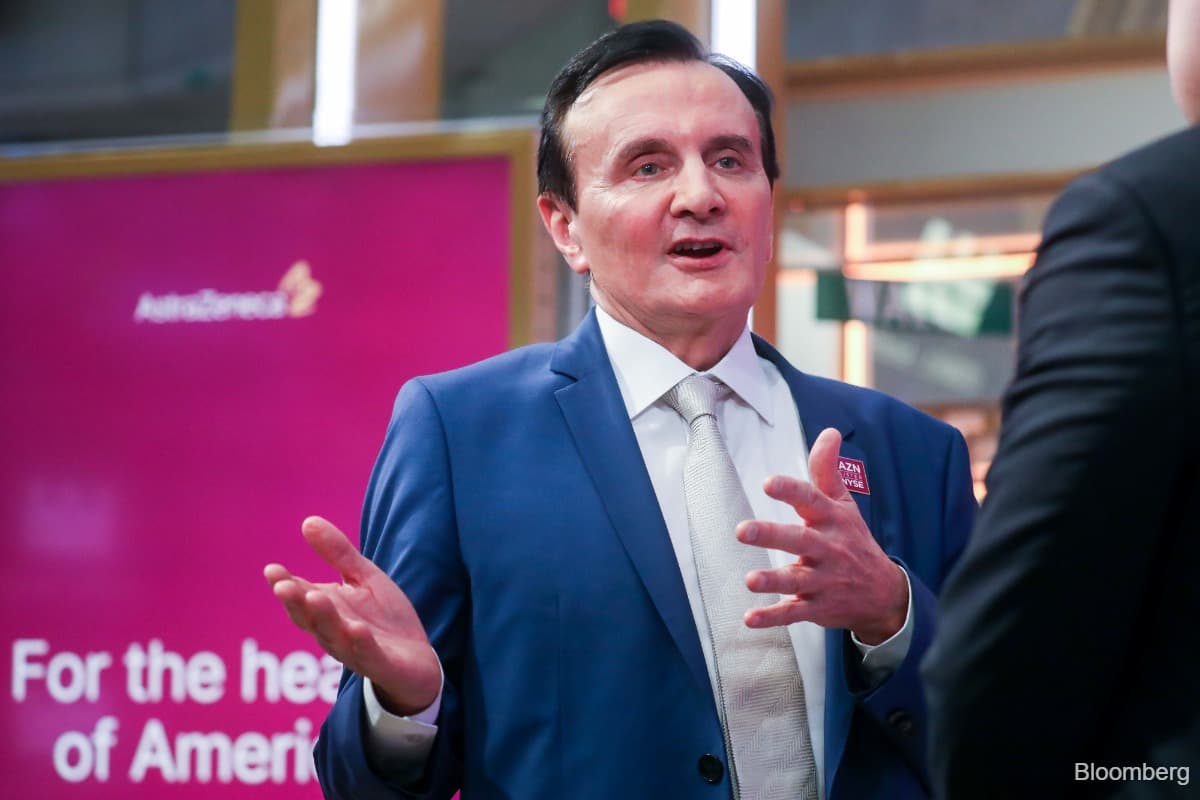
(Aug 3): AstraZeneca plc investors had a clear message for the UK drugmaker on Monday: they don’t like the idea of a US$400 billion (RM1.63 trillion) merger with Bristol-Myers Squibb Co.
Astra shares plunged as much as 7.8% to their lowest level in 10 months.
Shareholders were surprised that the biggest pharma deal of all time could be in motion when chief executive officer Pascal Soriot told them only late last year that large transactions were “really low on the probability scale”.
It’s unclear if the early-stage discussions are ongoing, said people familiar with the matter who asked not to be identified.
Such a tie-up would produce a combined company that would leapfrog to the top of the pharma ranks and merge two large cancer portfolios, with competing blockbuster medicines such as Opdivo and Imfinzi. Yet Astra is growing swiftly and has a full pipeline of promising drugs while Bristol faces a patent cliff for some top medicines.
A deal “makes neither strategic nor financial sense,” said Markus Manns, a portfolio manager at Union Investment in Frankfurt, which holds Astra shares. “AstraZeneca has always prioritised R&D and positioned itself as an innovation powerhouse. A mega-merger would not fit with the company’s culture.”
Cancer overlap
Neither company commented on the talks, which were first reported by the Financial Times.
Other investors and analysts expressed doubts about the deal rationale, saying a combination would expose Astra to Bristol’s looming patent troubles and potential antitrust scrutiny. Bristol shares gained as much as 8.7% in premarket trading.

The overlap in cancer will “likely trigger thorough antitrust review”, said RBC Capital Market’s Trung Huynh. “We see potential divestitures.”
Bristol’s Opdivo and Astra’s Imfinzi belong to a class of drugs known as immune-checkpoint inhibitors. They both treat tumors including non-small cell lung cancer.
One investor said the move could be an attempt by Soriot to exit the UK.
In November, Astra announced it would list regular shares on the New York Stock Exchange to attract more investors in a further tilt towards the US, where it makes about 40% of its revenue. Soriot has described Astra as “a very American company” and has made significant investments to boost its presence in the US.
Other shareholders pointed to Astra being able to generate more cash and gaining access to Bristol’s commercial infrastructure.
The timing of a deal, however, could be just right.
“Given the pivot to the US, and this US administration that tends to look favourably at big mergers in certain industries, the time to do this may be now,” said Diederik Stadig, senior healthcare economist at ING.
The highly complex merger would be legacy-making for Soriot, who has been at the helm since 2012 and fended off a takeover attempt from another US drugmaker, Pfizer Inc.
Fifa parallel
The Frenchman’s defence rested on the potential damage large-scale M&A does to pharmaceutical companies with the disruption caused by trying to create synergies and meld company cultures, ultimately hurting patients.
“What will we tell the person whose father died from lung cancer because one of our medicines was delayed,” he said at the time, “and essentially was delayed because in the meantime our two companies were involved in saving tax and saving costs"?
A deal would also test the limits of what US President Donald Trump is willing to allow in terms of large-scale transformation of the pharmaceutical industry, creating the world’s biggest drugmaker with about US$107 billion in annual revenue.
Manns likened the potential tie-up, if it were to happen, to Fifa president Gianni Infantino’s aborted plan to create a commercial entity that would have opened the door to outside investors for the football World Cup.
“This would be the pharmaceutical industry’s ‘Fifa privatisation moment,”’ he said. “In other words, a poorly thought-out proposal that is met with bewilderment by many market participants.”
Uploaded by Felyx Teoh