

This article first appeared in Forum, The Edge Malaysia Weekly on August 3, 2026 - August 9, 2026
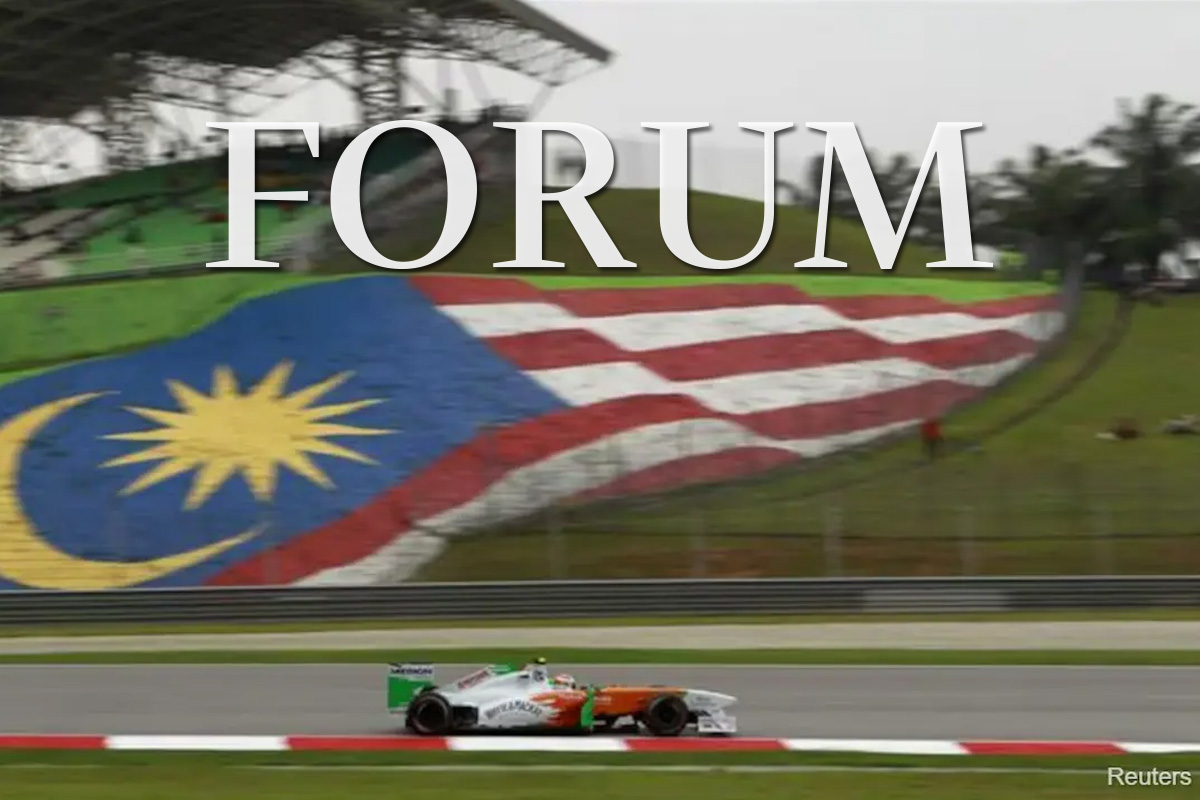
Come October, the screeching roar of Formula One (F1) engines, absent from the Sepang International Circuit (SIC) since 2017, will make its return. For a generation of F1 fans, this homecoming is not merely about the spectacle of blistering speed, raw power and technological brilliance. It is also a moment for wistful reminiscence, when the Malaysian Grand Prix was once a highly anticipated highlight of the nation’s annual sporting calendar.
Yes, this is a one-off race, as Malaysia steps in to host the Bahrain Grand Prix that was cancelled in April due to uncertainties in the Gulf region, sparked by the ongoing conflict between the US-Israel alliance and Iran.
Nevertheless, it remains a race that is warmly welcomed and eagerly anticipated by the F1 business fraternity, local and international fans, motoring enthusiasts and pundits as well. But beneath the nostalgia lies a deeper question: is F1 still a wise investment for Malaysia and Petroliam Nasional Bhd (PETRONAS)?
The Malaysian race, sponsored by Bahrain and officially titled the F1 Gulf Air Bahrain Grand Prix, signifies that F1 has successfully reinstated another round to its crowded schedule. The Oct 2-4 event, sandwiched between the Azerbaijan Grand Prix and the Singapore night race, means there will be three consecutive races in as many weeks, adding a formidable resilience factor to the already adrenaline-charged, speed-driven thriller.
One critic has described this triple-header as a war of attrition. This is not merely about sheer speed; rather, it is a gruelling test of who can best manage fatigue, logistics and mechanical reliability to emerge victorious. Compounding this challenge is the brutal heat and oppressive humidity, which can instantly transform into torrential tropical downpours, rendering the SIC’s leg potentially one of the most punishing rounds of the entire season.
F1 drivers, teams, fans and critics alike hold the SIC in high regard. With its expansive track width and a challenging combination of 15 fast, sweeping corners and long straights, the circuit offers exceptional overtaking opportunities while pushing the speed demons to their absolute limits.
When Malaysia hosted the race, the SIC was widely acclaimed as one of the finest and most demanding tracks in the world. To many in the racing fraternity and spectators, the SIC, which now hosts the MotoGP world series, remains among the world’s elite circuits to this day.
With temperatures soaring to 32°C-35°C and humidity levels reaching 70%-90%, drivers can lose over 4kg of fluid during a single race. Such an extreme physical toll prompted seven-time Formula One World Champion Lewis Hamilton to label it as the “most challenging” and “most extreme” race track in his illustrious career.
Having secured his first world title with McLaren in 2008, Hamilton went on to claim six further championships with the Mercedes-AMG PETRONAS F1 Team in 2014, 2015, 2017, 2018, 2019 and 2020. Malaysia played host to F1 races for 19 seasons, spanning from 1999 to 2017.
During those years, the SIC was also regarded as a de facto home race for the national oil corporation, PETRONAS. Owing to this close affinity, Malaysian fans and critics have taken to social media, with many expressing enthusiastic support for the race’s return, while some are urging the government, PETRONAS and the private sector to bid for a permanent racing slot should one become available. They firmly believe that the resulting economic and tourism-related spin-offs would far outweigh the associated costs.
Those opposing the move, while welcoming this one-off race, argue that it is premature to re-enter the F1 hosting arena, as the country continues to grapple with financial constraints, with the government still resorting to borrowing for its development expenditure. They contend that such funds would be better allocated to financing socioeconomic initiatives.
The hosting rights fee, payable directly to the Formula One Group, owned by Liberty Media, and its regulatory partner, the Federation of International Automobile (FIA), can amount to about RM300 million per annum. This implies that a standard five-year contract could cost Malaysia RM1.5 billion, representing a colossal investment for a sport that predominantly attracts spectators from higher-income brackets.
Additionally, between RM40 million and RM50 million is needed to cover operational costs to organise the event and maintenance of the track.
Some critics have also questioned why PETRONAS, which is currently navigating a challenging business environment, including an energy supply crisis exacerbated by the US-Iran conflict and the closure of the Strait of Hormuz, continues to sponsor an F1 team.
As with many other F1 team sponsors, PETRONAS’ exact expenditure remains unknown, as such disclosure is not industry practice. However, according to various motoring sources and sports magazines, PETRONAS’ annual spending on sponsoring the Mercedes-AMG PETRONAS F1 team is estimated to be in the range of US$75 million (RM306 million) to US$80 million.
The return of the F1 race to the SIC has certainly piqued the interest of Malaysians, setting proponents against opponents in a spirited debate that is likely to continue well beyond the October race.
I will not add to the fray, but perhaps it is also worthwhile to revisit the reasons why PETRONAS first ventured into F1 sponsorship, and why Malaysia subsequently built a world-class SIC and decided to host F1 races.
Taking the F1 global branding route
PETRONAS was established in 1974, a year when the world was still reeling from the impact of an energy crisis triggered by the Arab oil embargo following the 1973 war with Israel.
That crisis bears a striking resemblance to the current global shortage, albeit with one crucial difference: at that time, Malaysia did not have control over the domestic supply of its own hydrocarbon resources. With PETRONAS now managing the country’s oil and gas assets, Malaysia has gained much better oversight over the security of fuel supply to power its economy, even when facing an energy crisis.
PETRONAS was a fast learner, and by the mid-1980s, it had become an established domestic player in both the upstream and downstream sectors. However, to survive and prosper in this industry, alongside giants like Exxon Mobil and Shell, it needed to evolve into a global player. This was the challenge that then-prime minister Tun Dr Mahathir Mohamad set for PETRONAS and its senior management.
While PETRONAS had developed the necessary technological and engineering expertise to bid for overseas projects by the early 1990s, and was already a Fortune 500 company, it still faced the obstacle of being an unknown entity that would have to prove that it could reliably deliver on its promises.
Its image at the time was that of a government-owned company, competent and reliable at home, but untested on the international stage. Questions abounded: did PETRONAS possess the requisite financial strength, technological know-how, expertise and experience to compete effectively with the oil majors? Or, as a potential joint-venture partner, could it contribute meaningfully to large-scale projects?
The late Tun Azizan Zainul Abidin, who served as CEO and chairman between 1988 and 2004, related to this writer in 1996 that PETRONAS’ achievements were largely unknown, even to many in the oil and gas industry, let alone to those outside the sector with whom they wished to do business.
“There was one occasion when we entered a bid, and a competitor asked who PETRONAS was to bid for and operate oil fields internationally,” he recalled. “To compete in the world market, PETRONAS must be judged by its overseas successes. But we would not secure contracts, let alone compete with the likes of Shell, Exxon and Chevron, if we failed to capture the world’s attention.”
PETRONAS declared that the world was its market, and Azizan added: “It was time for us to become better known internationally. We considered embarking on an advertising campaign, but that would have been prohibitively expensive. What, then, would be the most effective way to create global brand awareness?”
This was when PETRONAS identified F1, where many of the oil majors were already present, as the ideal platform. Involvement in F1 promised not only a worldwide branding exercise but also a venue for testing engineering capabilities, gaining insights into engine technology, electronics and composite materials.
On the commercial engineering front, F1 offered expertise in motor management systems, engineering plastics and retail business knowledge, including advanced technology for engine oils, fuels and lubricants.
Companies that succeed in this market segment often leverage F1 to test and enhance the standards and performance of their fuel, engine oil and lubricant products. F1 represents the ultimate benchmark, attesting to the viability of products manufactured by oil companies.
There is no more powerful marketing tool than the notion that if a product is good enough for F1, it is good enough for the world. It is this very acceptance that has made products used within the F1 fraternity highly sought after by discerning consumers worldwide. Today, PETRONAS ranks among the top 10 lubricant players globally.
PETRONAS’ foray into F1 began modestly, with sponsorship of the Swiss-based Sauber team, during which it acquired technical and marketing expertise before moving on to partner with BMW. It later joined forces with Mercedes, beginning in 2010.
This collaboration with Mercedes was structured as a title and technical partnership from the outset, with PETRONAS supplying fuel and lubricant solutions for the cars. The partnership also encompasses other areas, such as advanced sustainable fuel and technology solutions, as well as lower CO2 emissions.
While F1 served as the platform for PETRONAS to enhance its global reputation as a competent and reliable company, Mahathir’s vision for Malaysia hosting F1 races, complete with a world-class track, was similarly motivated: to give Malaysia the international recognition and identity it deserved as a modern, developed nation, one that tourists would want to visit, while simultaneously generating substantial economic spin-offs.
Should the F1 route continue?
For PETRONAS, its partnership with Mercedes, which has yielded multiple championships, should undoubtedly continue, as the return on investment remains attractive.
A study cited by Marketing Interactive, an Asia-Pacific news, marketing intelligence and advertising publication, reported that PETRONAS’ global media exposure from its F1 partnership with Mercedes could be worth up to US$901.08 million in a single year. This figure measures the estimated value of brand exposure gained notably from live and repeated race broadcasts.
Although the team is not currently in title-winning form — having last secured both the Constructors’ and Drivers’ championships in 2020, and the Constructors’ crown in 2021 — 2026 is widely anticipated as the year Mercedes and PETRONAS are expected to reclaim their dominance.
As it stands, after the Hungarian Grand Prix on July 26, the Mercedes-AMG PETRONAS team is leading in both the Drivers’ and Constructors’ championships. It currently sits atop the Constructors’ standings with 379 points, ahead of Ferrari and McLaren, while on the Drivers’ side, it boasts two drivers in the top three, with rookie Andrea Kimi Antonelli leading the championship with 219 points.
Antonelli holds a 50-point advantage over his closest rival, Lewis Hamilton of Ferrari, making him a strong favourite for the title as the season progresses. George Russell is a close third, just nine points behind Hamilton.
Let us hope that by the time the Bahrain race comes around, these leads will have widened further.
As for Malaysia bidding to host F1 races again, at RM300 million per annum, the timing is still not right, as the math and economic benefits simply do not add up — unless a consortium within the private sector emerges to consider such an investment.
Until then, come October, let us simply sit back and relish the spectacle of this one-off race.
Azam Aris is an editor emeritus at The Edge
Save by subscribing to us for your print and/or digital copy.
P/S: The Edge is also available on Apple's App Store and Android's Google Play.