

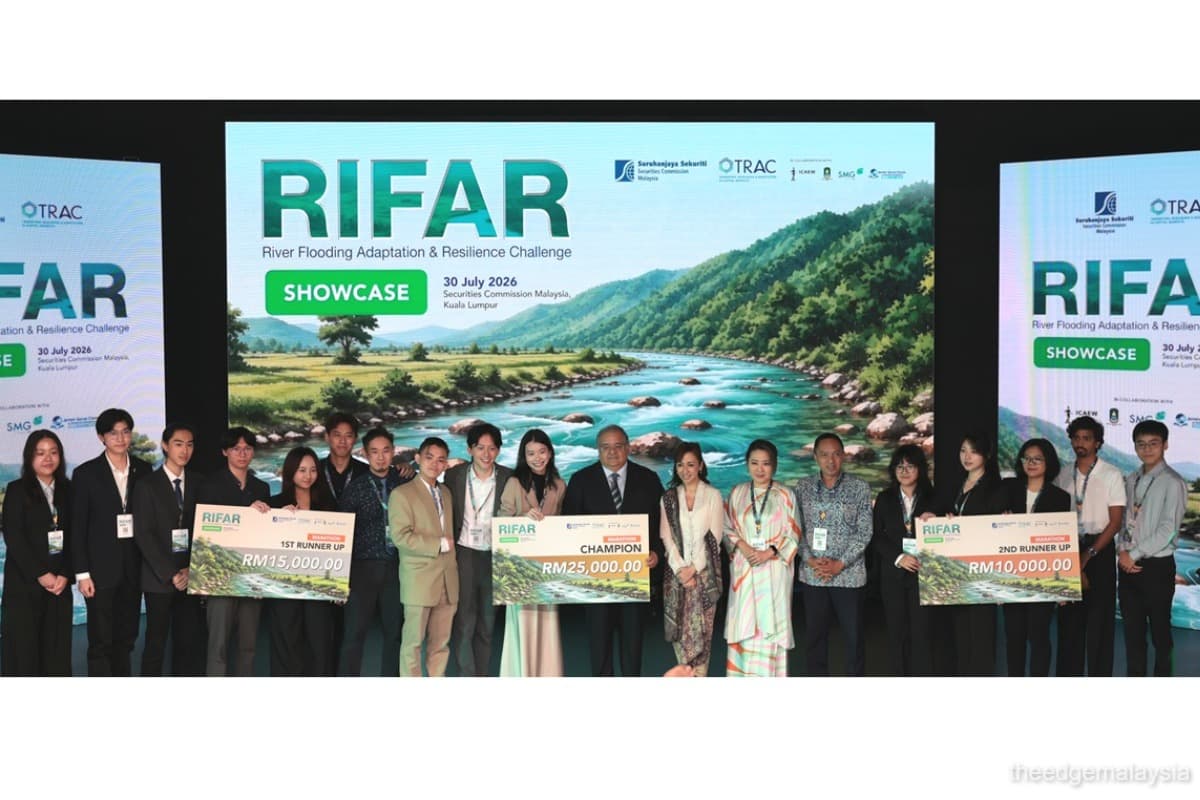
KUALA LUMPUR (Aug 3): Financing needed for climate adaptation in Malaysia is estimated at nearly RM3.5 trillion by 2050, according to the Securities Commission (SC) chairman Datuk Mohammad Faiz Azmi at the River Flooding Adaptation and Resilience (RIFAR) showcase last Thursday (July 30), citing data from the recent World Bank Malaysia Country Climate and Development Report 2026.
“Adaptation financing will likely require blended finance solutions. This is because the viability of projects depends on public sector involvement and patient capital or credit enhancements, to de-risk projects before private capital can follow,” he said.
During a panel discussion moderated by Boston Consulting Group managing director Datin Nurlin Mohd Salleh, Ministry of Natural Resources and Environmental Sustainability undersecretary Ahmad Farid Mohammed said Malaysia needs to focus not only on climate mitigation but also on investing in climate adaptation. He also outlined how the National Adaptation Plan (MyNAP) fits into the country's broader climate financing strategy.
“For many years, we have been investing in climate mitigation. Until now, we have developed a few plans [for climate adaptation financing], such as the National Energy Transition Roadmap and Nationally Determined Contribution Roadmap and Action Plan, where we are estimating to get RM1.2 to RM1.5 trillion,” Ahmad said.
He added that, alongside these plans, the government is looking to appoint its own accredited entity, as Malaysia currently relies on internationally accredited entities.
On the considerations of undertaking potential climate adaptation projects, Think City managing director Datuk Hamdan Abdul Majeed said effective adaptation initiatives must begin with a clearly defined climate challenge. They should be designed to address the needs of affected areas while working closely with the communities impacted by climate change.
“Therefore, it must be supported by credible evidence and not with a predetermined solution. When undergoing vulnerability assessment on an affected area, one of the key things we always need to look at is what the challenges will look like in the future because the reality is that we are designing for the future,” he added.
From the banking sector’s perspective, RHB Bank Bhd head of group sustainability strategic management and governance Joel Khaw said adaptation financing remains less clearly defined than mitigation financing because it is more difficult to quantify the economic value of adaptation projects.
In a fireside chat moderated by SC chief sustainability officer Neetasha Rauf, Princess of Selangor and environmental advocate YAM Tengku Datin Paduka Setia Zatashah Sultan Sharafuddin Idris Shah said authorities and communities need to adopt a more preventive, rather than reactive, approach to climate-related disasters.
She also said government agencies and local communities should be better coordinated through government applications during climate-related emergencies or issues.
“We need to have coordination, and I think that coordination and communication are key aspects most of the time. If we’re not coordinated and not communicating, how do we know what’s happening?” said Tengku Zatashah.
The RIFAR Challenge featured two categories: Sprint and Marathon. Under the Sprint category, participants produced short social media videos highlighting the pressures facing Malaysia's rivers and encouraging public action. In the Marathon category, teams were tasked with designing a flood mitigation solution for Taman Sri Muda.
A total of 21 teams competed in the Sprint category, while 37 teams participated in the Marathon category.
Team BDR by University Malaya and Monash University Malaysia were champions in the Marathon track, followed by Team Anak Sungai (Sunway University, Monash University Malaysia, National University of Singapore, University of Hong Kong) winning first runner-up and Team Blues Bonds by Monash University Malaysia taking home the second runner-up prize.