

This article first appeared in The Edge Malaysia Weekly on July 27, 2026 - August 2, 2026
AEON Credit Service (M) Bhd’s (KL:AEONCR) earnings proved to be resilient in the first quarter ended May 31, 2026, despite operating through the early months of the Middle East conflict, when oil prices surged to their highest levels this year and heightened cost of living pressures. The non-bank lender’s customers are predominantly from the bottom 40% (B40) and middle 40% (M40) income groups.
Be that as it may, the group is not ready to declare the worst over, saying persistent geopolitical uncertainties and cost of living pressures continue to warrant caution.
“While Malaysia’s economy remains resilient and inflation is expected to stay manageable, we continue to closely monitor their potential impact on consumer sentiment and repayment behaviour,” its chief financial officer Lee Siew Tee says in response to questions from The Edge.
AEON Credit provides personal, motorcycle and automotive financing, among other easy-payment services. The B40 and M40 mass-market groups make up 60:40 of its customer base, according to CIMB Securities in a recent report.
Asked whether defaults were on the rise, Lee says: “At this stage, we are not observing any significant deterioration in portfolio performance beyond our expectations.”
Relatively higher stress is visible among some younger and lower-income customers. “As part of our portfolio monitoring framework, we continue to observe relatively higher stress among certain younger and lower-income customer segments, particularly within the personal financing and used-car financing portfolios, where customers tend to be more sensitive to changes in living costs and economic conditions,” Lee says.
Nevertheless, she points out that these portfolios remain within AEON Credit’s risk appetite and are actively managed through “prudent underwriting standards, enhanced portfolio monitoring and targeted collection strategies”.
“To date, we have not observed any significant deterioration in any single segment that would materially impact our overall portfolio outlook,” Lee remarks. Overall repayment behaviour is in line with expectations and remains broadly stable, she adds.
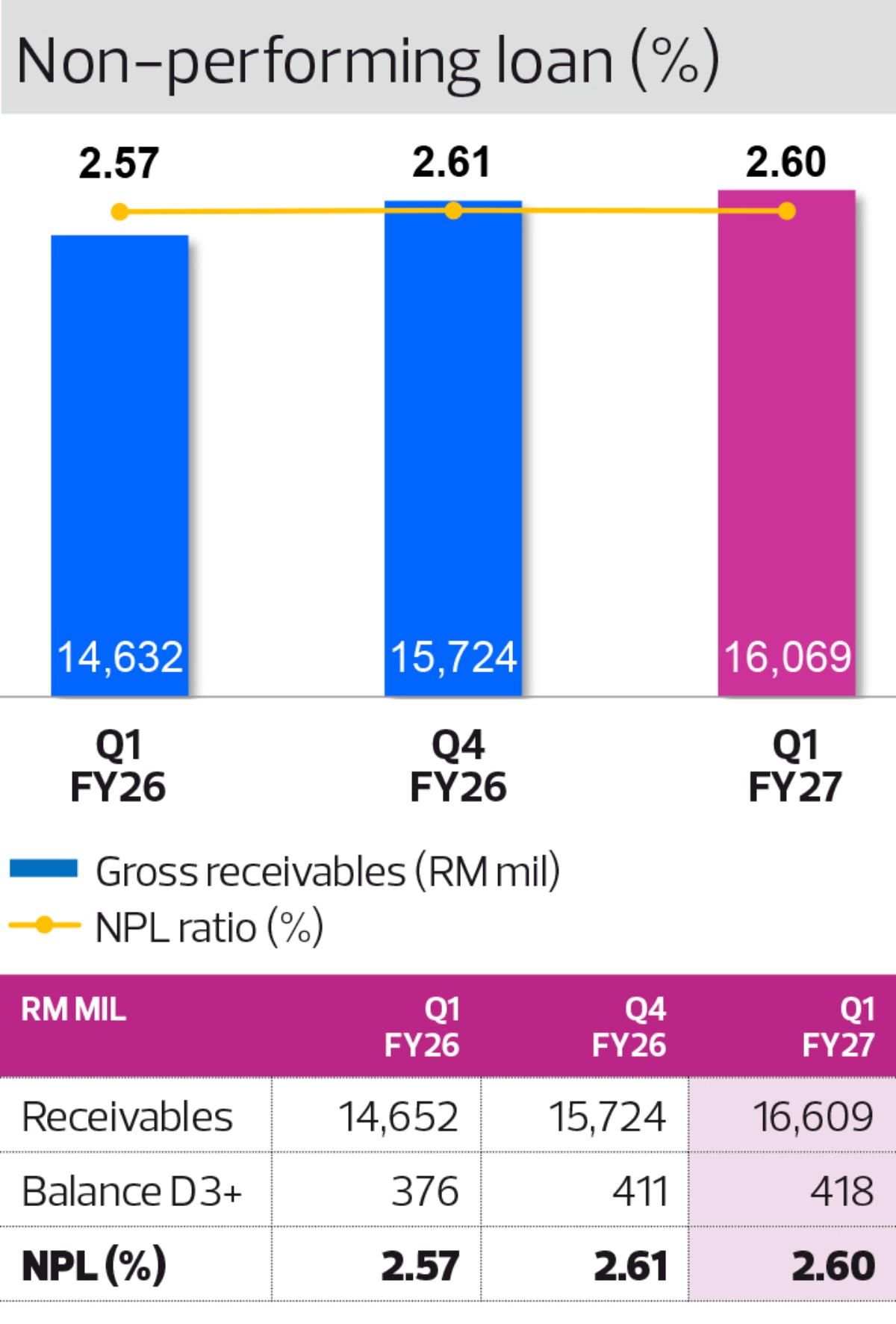
The group’s non-performing loan (NPL) ratio was a “manageable” 2.6% as at 1QFY2027 — a sight deterioration from 2.57% a year earlier and a marginal improvement from 2.61% in the previous quarter.
However, there is reason to be cautious given the recent escalation of geopolitical tensions between the US and Iran, which sent Brent crude hitting US$100 a barrel late last week for the first time since May.
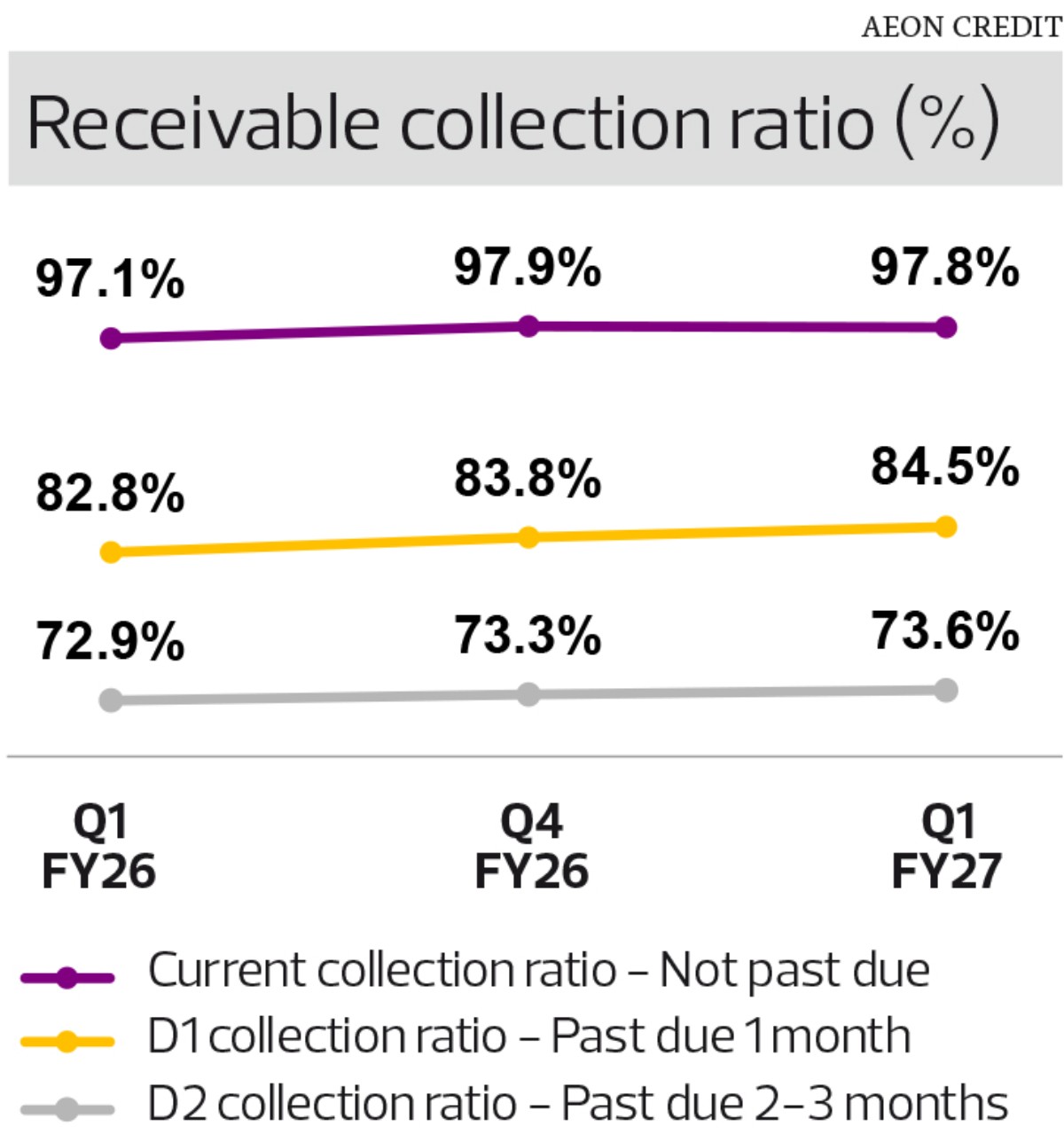
“We continue to closely monitor portfolio performance and strengthen our collection capabilities through enhanced D3+ collection management, targeted recovery initiatives and artificial intelligence-enabled tools, including AI voice bots. These measures have helped maintain asset quality within our risk appetite while improving operational efficiency and customer engagement,” Lee says. D3+ refers to receivables or accounts that are past due by more than three months.
AEON Credit’s collection performance in 1QFY2027 was affected by seasonal factors such as the Hari Raya festive period and several extended public holiday periods, particularly at the end of May, she notes.
The group recently rolled out automatic salary deduction services via the Malaysian National Cooperative Movement (Angkasa).
“Since its launch, we have generated interest from the government employee segment. Response has been encouraging and we are focusing on converting the prospective customers into application. Our focus currently remains on improving conversion through product offering and simplifying the onboarding journey,” Lee says, of the new service. Civil servants make up about 18% to 20% of its customer base.
Meanwhile, a major focus for the group this year is to reduce its quarterly receivables write-off ratio to a targeted level of 1.3%, following a sequential rise to 1.4% in 1QFY2027.
“Historically, our quarterly write-off ratio has averaged approximately 1.3%. While it increased marginally to 1.4% in 1QFY2027, the ratio remains within a manageable range. Barring any unforeseen economic changes, we aim to maintain the write-off ratio around the historical level of 1.3%, supported by stronger collection efforts, enhanced recoveries and disciplined credit risk management,” Lee says.
In its recent report, CIMB Securities notes: “In our view, the write-off ratio has emerged as a key operating [performance indicator], alongside return on equity and receivables growth, as a successful reduction would support lower expected credit loss provisions, stronger earnings growth and ultimately, a valuation re-rating.”
AEON Credit’s 1QFY2027 net profit stood at RM95.16 million — up 22.7% year on year (y-o-y) but down 34.1% quarter on quarter — which came in within analysts’ expectations.
At its mid-July results briefing to analysts, AEON Credit reaffirmed its full-year guidance, projecting steady financing growth of 8% y-o-y (FY2026: 11.4%) as well as credit costs of about 4% by FY2027.
“While these suggest AEON Credit will post stronger earnings ahead, we trim our FY2027 to FY2029 [net profit] forecasts by 3% to 8% following higher-than-expected credit costs and associate losses in 1QFY2027,” RHB Research says in a July 13 report. “Management noted the possibility of 2Q continuing to see collection challenges due to inflation and unemployment pressures, but was hopeful of mitigating these risks by enhancing collection efforts.”
RHB Research maintained a “buy” on the stock but reduced its target price by 20 sen to RM6.60.
To improve collection efforts, AEON Credit has deployed AI-powered voice bots to automate selected reminder calls and payment follow-ups, particularly for lower-risk customer segments.
“This enables us to engage a larger customer base while allowing our collection officers to focus on higher-risk and more complex cases. As a result, we have improved productivity, increased customer contact rates and strengthened overall collection effectiveness,” Lee says. “AI also supports our credit assessment, portfolio monitoring and customer analytics capabilities, enabling more data-driven decision-making.”
In its bid to grow loans by 8% this year, the group plans to prioritise customers with stronger credit profiles and FinPlus members, the latter being those who have enrolled in its digital membership programme via the AEON Wallet app.
“We expect the [loan] growth to be primarily driven by the payment business, personal financing and motorcycle financing segments, where borrowing demand continues to remain healthy,” Lee says.
Bloomberg data shows that all five research houses that track the stock have a “buy” call, with the 12-month average target price at RM6.88, which suggests further upside from its closing price of RM5.65 last Friday (July 24). At that price, it had a market value of RM2.88 billion. The stock has gained a marginal 1.5% year to date.
One of the reasons the stock is not doing better is because of the drag from AEON Credit’s loss-making 50%-owned digital bank, AEON Bank (M) Bhd. It recently told analysts that the digital lender is on track with plans to break even by FY2029. For FY2027, it guided that its share of losses is likely to be around RM75 million — versus RM85.2 million in FY2026 — due to continued investments in technology infrastructure and customer acquisition.
Save by subscribing to us for your print and/or digital copy.
P/S: The Edge is also available on Apple's App Store and Android's Google Play.