

This article first appeared in The Edge Malaysia Weekly on July 27, 2026 - August 2, 2026
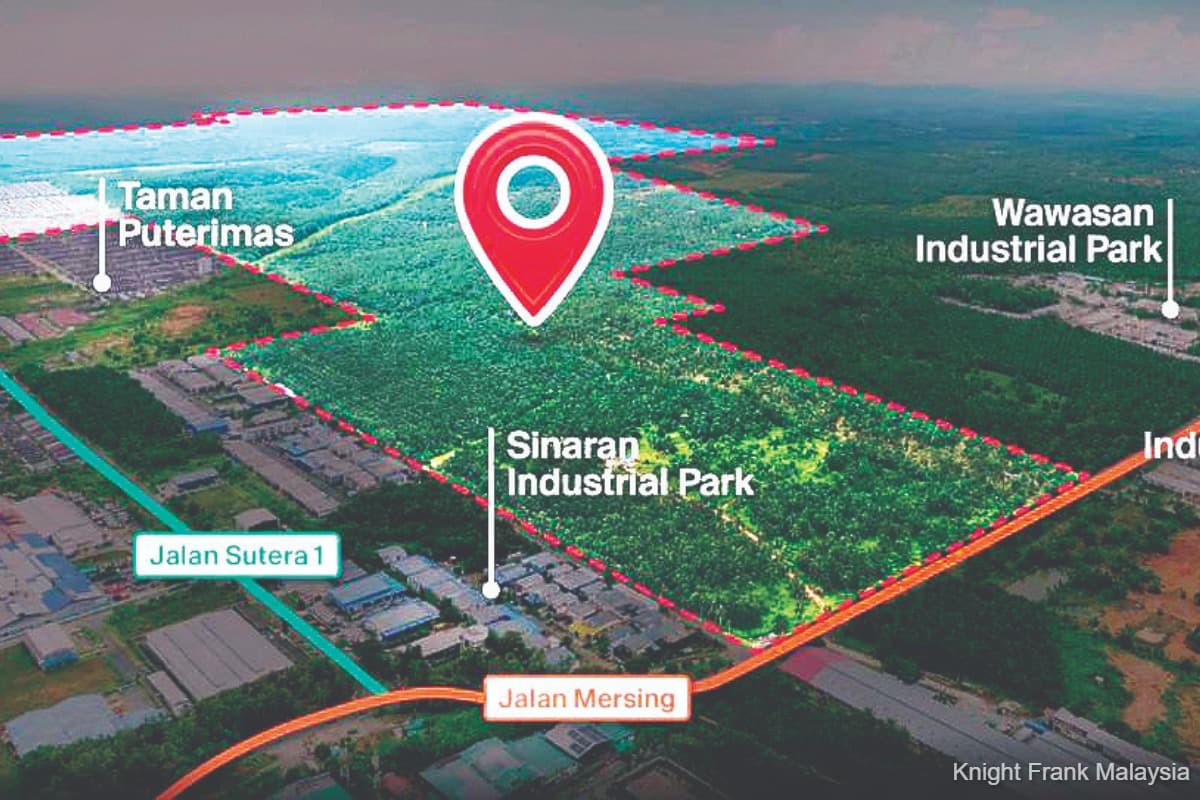
ANOTHER sizeable oil palm estate is up for sale in Johor via an expression of interest exercise, this time with an asking price of about RM400 million, or around RM8.20 per sq ft (psf). Said to be one of the largest tracts of privately held freehold development land in Kluang, the 1,124-acre agricultural estate is close to three industrial parks — Sinaran Industrial Park, Matahari Industrial Park and Wawasan Industrial Park — along Jalan Mersing.
The Edge understands that the contiguous industrial and residential zoned land is owned by Alor Setar-based Homebase Properties Sdn Bhd. A search on the Companies Commission of Malaysia website shows its top three shareholders are Pek Eng Chee (20%), Pek Wooi Wong (20%) and Pek Woei Shyong (20%).
The site is said to be slightly undulating, historically planted with oil palm and suitable for either plantation use, large-scale farming, agro-based activities or long-term land banking. But the scale of the parcel has drawn attention less for its crop potential than for what it could become — a master-planned township.
Knight Frank Malaysia has been appointed as the exclusive marketing agent for the deal. Asked to comment, its senior executive director of land and industrial solutions Allan Sim tells The Edge that opportunities to acquire more than 1,000 acres of contiguous freehold land in Kluang are exceptionally rare: “Combined with its strategic location and the flexibility offered by its industrial and residential zoning, the site presents an ideal platform for an integrated master-planned township. As investors increasingly look beyond traditional urban centres for scalable opportunities, Kluang is emerging as a compelling growth corridor supported by improving infrastructure, a diversified economic base and strong long-term fundamentals.”

Industry observers point to a pattern that has repeated itself across the peninsula for decades. Well-connected and established neighbourhoods such as Bangsar in Kuala Lumpur, Bandar Utama in Petaling Jaya and Puchong, Selangor, were rubber and oil palm estates before being redeveloped into townships. “The Johor Premium Outlets complex sits on what used to be an oil palm estate owned by Genting Plantations Bhd (KL:GENP). Large plantation owners have increasingly treated land bank not as a permanent crop asset but as a store of value to be unlocked when location catches up to the land,” an agent tells The Edge.
That unlocking has become highly lucrative in southern Johor specifically. Land values there have surged on the back of infrastructure and cross-border investment tied to the Johor-Singapore Special Economic Zone, data centre demand and renewable energy projects competing for large flat parcels.
In January 2022, Boustead Plantations Bhd sold its 664ha Kulai Young Estate in Johor to SIPP Power Sdn Bhd, a subsidiary of YTL Power International Bhd (KL:YTLPOWR), for RM428.8 million cash. The sale was reportedly priced about 10% above the market valuation of RM390 million.
In February, The Edge reported that another oil palm plantation in Johor had been put up for sale. The freehold land of about 1,153 acres, located about 22km from Segamat town, is said to be priced between RM173 million and RM200 million.
Meanwhile, according to Mohammad Haikal Adam, Johor Bahru branch manager for Raine & Horne International Zaki + Partners Sdn Bhd, Kluang’s residential market has evolved around several established townships that continue to set pricing benchmarks for the district. “Among the largest is Bandar Seri Impian, a master-planned township spanning approximately 1,210 acres. New double-storey terraced houses are generally marketed within the RM500,000 to RM800,000 range, while comparable properties in more established neighbourhoods typically transact between RM300,000 and RM600,000, depending on factors such as age, land size, design and condition.”
Taman Parkland Kluang has also distinguished itself as one of the stronger-performing residential addresses in the district. The development has recorded healthy capital appreciation over the years, underpinned by its integrated planning, quality residential offerings and comprehensive supporting infrastructure. This reflects an increasing preference among purchasers for developments that offer not only housing, but also a complete living environment.
Another notable township is Taman Sri Kluang, which continues to serve the district’s mainstream housing market. Double-storey terraced houses in the approximately 1,000-acre freehold development generally transact in the RM320,000 to RM450,000 range, while single-storey terraced houses are commonly in the RM250,000 to RM350,000 bracket, subject to their age, condition and micro-location.
From a market perspective, Haikal says Kluang remains a measured and fundamentally driven residential market. “Price movements have generally tracked improvements in local purchasing power and infrastructure rather than speculative activity. In this context, a plantation land parcel exceeding 1,000 acres represents an uncommon opportunity to create a new township of meaningful scale. However, translating land potential into market value will depend on a disciplined development strategy, supported by infrastructure investment, appropriate product positioning and a development timeline that aligns with the market’s capacity to absorb new supply,” he says.
Against that backdrop, industry observers say that plantation owners holding ageing, lower-yielding estates near growth corridors must weigh their options as replanting a mature estate is capital-intensive and takes years to bear fruit again, while selling the same land for industrial, energy or residential development can realise many times its value as farmland — sometimes 10 times or more per acre.
Whether the Kluang estate is ultimately converted into a township, industrial park or simply changes hands as a land bank will likely depend on rezoning approvals from Majlis Perbandaran Kluang and the broader Johor government. However, the size and pricing of the deal make it one to watch as an indication of how far the plantation-to-township conversion trend has spread beyond the traditional Kulai-Iskandar corridor in the state.
Save by subscribing to us for your print and/or digital copy.
P/S: The Edge is also available on Apple's App Store and Android's Google Play.