

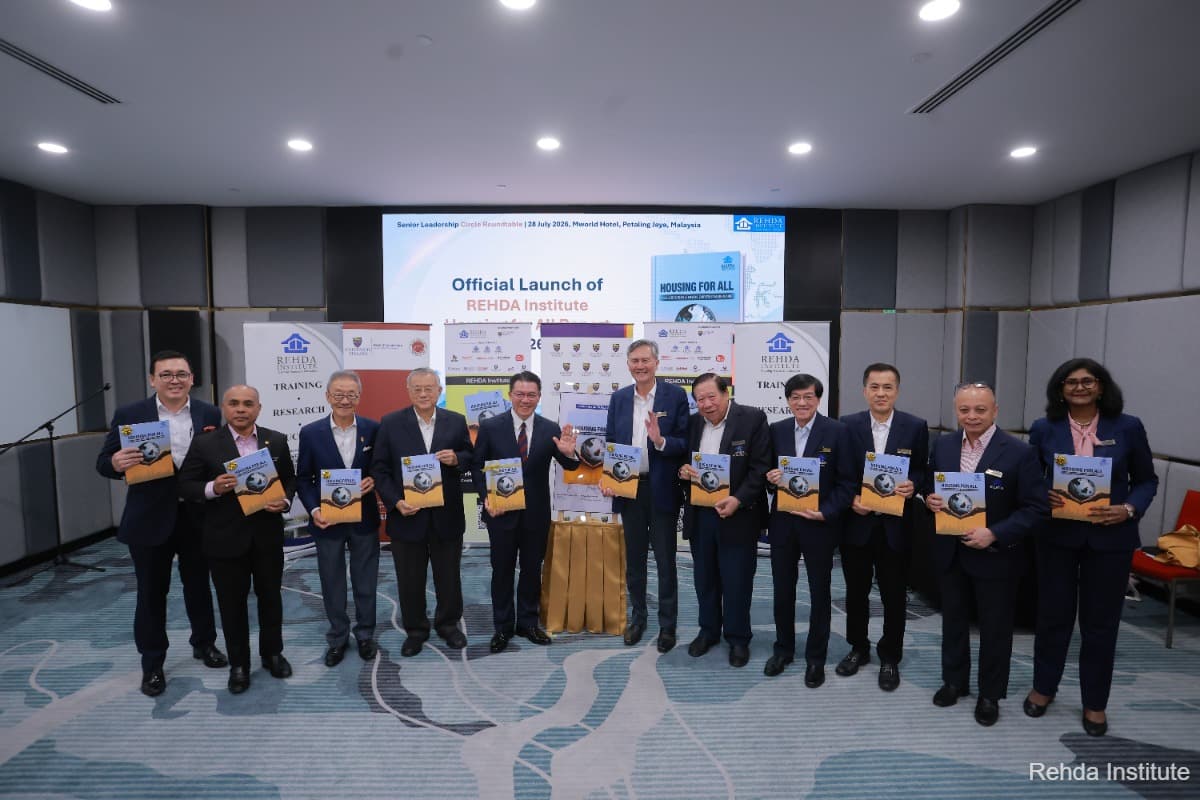
From left: Rehda Institute COO David Chong, PLANMalaysia director general Datuk Alias Rameli, Rehda Institute trustee Michael KC Yam, Rehda Institute trustee Tan Sri Teo Chiang Kok, Minister of Housing and Local Government Nga Kor Ming, Rehda Institute chairman Datuk Jeffrey Ng Tiong Lip, Rehda Institute trustee Datuk Ng Seing Liong, Rehda Malaysia immediate past president Datuk Ho Hon Sang, Rehda Malaysia secretary general Datuk Tan Hon Lim, Rehda Malaysia national treasurer Datuk David Lim Boon Huat and Rehda Institute director of research and education Malathi Thevendran (Picture by Rehda Institute)
PETALING JAYA (July 28): Malaysia’s housing strategy needs to move beyond headline supply figures towards ensuring homes are built in the right locations and at realistic prices, according to Rehda Institute.
In a press statement issued on Tuesday by Rehda Institute, its chairman Datuk Jeffrey Ng Tiong Lip highlighted the need for a more complete understanding of household affordability and location-based demand.
“Malaysia’s housing challenge is not simply about how many homes we build. We must also ask whether we are building the right homes in the right locations and at prices that households can genuinely afford — not only at the point of purchase but throughout the period of ownership,” said Ng in the statement.
The call was raised in the Senior Leadership Circle Roundtable held today at M World Hotel in Bandar Utama, Petaling Jaya.
The closed-door event marked the inaugural programme under the Malaysia–Cambridge Urban Platform (MCUP), an initiative led by the Ministry of Housing and Local Government (KPKT) with Rehda Institute as a strategic collaboration partner.
The session brought together representatives from government, academia and industry to examine housing issues from different perspectives.
It focused on two main priorities, including "Demystifying Housing Affordability" to inform policy interventions across housing supply, subsidies, financing and infrastructure investments.
It also examined the integration of smart city tools — such as advanced data and modelling — to optimise spatial planning while balancing sustainability, liveability and affordability.
Addressing the role of academic collaboration, Ng noted that the platform aims to bridge the gap between research and practical implementation.
“Academic research can sometimes focus on criticising existing policies without proposing a viable alternative or demonstrating why another approach would work better,” Ng remarked. “At other times, solutions may be proposed without a sufficient understanding of the practical constraints faced by policymakers or the wider political context. This is where the MCUP can make a difference.”
He added that today’s session marks the beginning of a problem-discovery process and the discussions have provided all the stakeholders with considerable food for thought.
“We will carry the conversation into the Regional Housing Conference, where Malaysian and international experts will explore how policy reform, smarter planning and more sustainable financing can support better housing and urban outcomes,” Ng said.
Meanwhile, Housing and Local Government Minister Nga Kor Ming, who joined today’s session to share government insights, noted that MCUP has strong potential as an intellectual bridge.
“By bringing together scholars, governments and industry leaders, this platform can help translate research into practical solutions, not only for Malaysia, but also for the wider Asia-Pacific region,” Nga said in the statement.
The session today also featured a briefing and photo session marking the official launch of Rehda Institute’s latest research report, titled Housing For All: Co-Creating a Needs-Driven Framework.
The findings and roundtable outcomes will be further explored at the Regional Housing Conference 2026 on July 29 at the Malaysia International Trade and Exhibition Centre (Mitec) in Kuala Lumpur.