

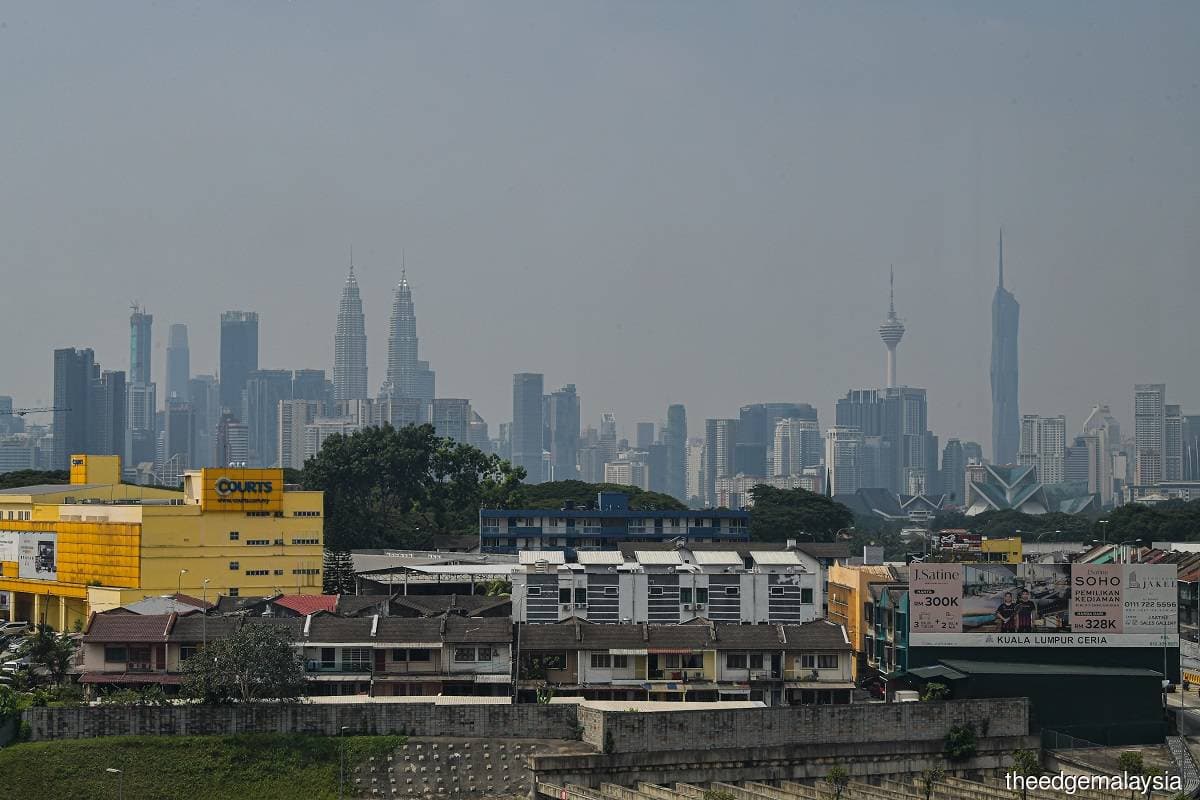
Every June and July Malaysian business leaders make a familiar calculation. Some years the air turns thick. The Air Pollutant Index (API) creeps upward. Outdoor meetings get rescheduled, construction slows, a few school days are cancelled. And then — mostly — everyone gets back to work. The haze is unpleasant. It is also, by now, expected. That expectation is the problem.
Let’s be clear, what we have built, across three decades of seasonal smoke rolling in from Sumatra and Kalimantan, is not resilience. It is normalisation. We have reclassified a public health emergency as a management inconvenience. The same cognitive move, accepting what should be refused, is now playing out inside Malaysian organisations in another and equally insidious way: the adoption of artificial intelligence. The two stories look unrelated, but they share a back story.
The air pollution calculus
Air pollution costs Malaysia approximately US$73 billion (RM298.6 billion) annually in combined health and productivity losses, roughly 15% of per capita GDP. In 2025, Kuala Lumpur’s fine-particle air pollution improved from 2024, but at 15.7 μg/m³ it remained more than three times above the WHO guideline of 5 μg/m³. Meanwhile, long-range forecasts for the second half of 2026 signal rising fire and haze risk as El Niño conditions return across the region.
The Asean Agreement on Transboundary Haze Pollution has been in force since 2003. Ministerial meetings are convened annually. Progress is noted. And the smoke comes back. Two decades after its ratification by most member states the system produces documentation. It has not yet managed to produce clean air.
The sociologist Diane Vaughan coined the phrase ‘normalisation of deviance’ to describe what happened at Nasa in the years before Challenger: warning signs were observed, rationalised, and eventually redesignated as acceptable. Cybersecurity researchers are now applying the same concept to AI deployment. When we stop reacting to hazardous API readings with urgency, we have not adapted. We have lowered the bar.
The deeper danger is desensitisation. When unhealthy air becomes seasonal, leaders learn to manage around it instead of treating it as a signal that systems are failing. Meetings move indoors, masks return, productivity dips, and the routine continues. The same pattern is emerging with AI. A tool produces an unexplained recommendation; a manager accepts it because it saves time; a team stops asking how the answer was generated. In both cases, the warning sign does not disappear. It becomes familiar. That familiarity is where standards begin to erode.
Agency decay: The invisible parallel
The AI-related normalisation is subtler, and spreads faster. Across Malaysian organisations — financial services, logistics, professional services, communications — AI tools are rapidly entering workflows. Decisions about credit, hiring, procurement, and customer triage are being delegated to systems that most operators cannot explain, audit, or question. The handover often happens incrementally, one convenience at a time.
This is the foundation of agency decay: the gradual erosion of human judgement, not through crisis but lulling comfort. Frequent AI use has been linked to lower critical thinking, suggesting that offloading thought comes with a delayed cost. Somewhat predictably, younger users appear most exposed, with higher dependence on AI and lower critical thinking scores. The risk is high that AI flows that are too effortless, eventually replace the mental work that good decisions require.
What might this look like in a Malaysian company? A procurement manager approves a vendor shortlist generated by an AI tool she has never tested for bias. A bank relationship manager accepts a credit score without reviewing the inputs. A factory floor supervisor overrides his own read of a safety situation because the monitoring software shows green. Each incident is small. The aggregate is an organisation that has outsourced its judgement without noticing and a Board that has an incomplete picture of what’s happening.
Just as we have learned to breathe through the smoke, we are learning to decide (or not) through the algorithm. Both forms of learning cost us something we do not immediately see.
Why this is both a business problem and a policy issue
Haze is a complex transboundary issue; the same can be said about AI deployment. Both transcend boundaries; both cause friction.
Haze affects worker health, attendance, and concentration. An outdoor construction workforce operating for three months in elevated pollution conditions is likely to be less productive, more prone to error, and face higher medical costs. Tourism, agriculture, and logistics suffer in ways that do not appear in AI dashboards or ESG slide decks. A projected total economic impact of up to RM 41.2 billion from Malaysia’s 2026 double-threat climate event, combining El Niño and a positive Indian Ocean Dipole, signals that climate risk has become a driver of fiscal volatility, sitting alongside interest rate risk and supply chain exposure on any serious risk register.
When AI handles the thinking, people lose the skills they were hired for, and that has a price tag. Organisations that are allowing and, arguably, unconsciously encouraging critical thinking to erode will suffer from lower-quality decision-making exactly when conditions become novel or stressful, which is when crises, including climate crises, tend to arrive. The performance paradox is subtle but clear: AI boosts immediate task output while reducing the human learning and reasoning that organisations actually need. A company can look operationally sharp on Tuesday and be genuinely unprepared on Wednesday.
The common root
Both dynamics, haze normalisation and agency decay, share a single logic: the repeated absence of immediate catastrophe is being read as evidence of safety. The smoke did not close the exchange today. The AI did not produce a visibly wrong decision this quarter. Each non-event quietly shifts the threshold, until what was once a warning sign becomes wallpaper. The correction does not require alarm, but attention, and the will to call out what has been normalised for too long.
What Malaysian businesses can do
Malaysia already has the tools in place for a better approach. The National Guidelines on AI Governance and Ethics provide a framework for responsible deployment. The ProSocial AI Index gives organisations concrete metrics for evaluating whether AI tools serve people and planet alongside profit, what the index calls the Return on Values perspective. The question is whether business leaders will treat these as compliance checklists or as operational tools. That choice, more than any single policy or platform, will determine whether Malaysia's AI ambitions hold up under pressure.
Practical takeaway: HAZE
H — Hold the line on human judgement. For every significant AI-assisted decision around credit, hiring, procurement, safety, ensure a human retains authority to override decisions and assumes accountability for the outcome. Efficiency gains that require completely removing humans from the decision chain should be rejected.
A — Audit what you have normalised. List the four AI tools most embedded in your operations. For each, ask: when did you last test its outputs for bias or error? When did you last ask whether the tool serves the original purpose or has it quietly substituted that purpose? If the answer is “never” or “not recently”, you have begun to permit normalization without realising it. Run the audit before the crisis arrives.
Z — Zero tolerance for invisible costs. Haze costs are real and routinely excluded from business planning. Agency decay costs are real and routinely excluded from human resource planning. Both become visible only after damage has accumulated. Add haze exposure and the AI-related habit of reaching for the tool before engaging the mind to your risk register this year. Not as footnotes: as line items, with owners and review dates.
E — Expect more from your systems, not less from your people. The goal of AI adoption is to strengthen human capacity, not replace it. Design every deployment so that employees who use AI tools are stretched to think more carefully, not relieved of the need to think at all. The same logic applies to environmental systems: demand that haze agreements produce outcomes, not just communiqués. Accountability is the discipline that separates progress from performance.
Normalisation is not neutral. Every time a society accepts what it once found unacceptable, it narrows the range of futures it can imagine. Malaysia is capable of better standards on both counts — in the air and in the algorithm. The starting point is the same: stop calling it normal.
Dr Cornelia C Walther is associate professor at Sunway University’s Institute for Global Strategy and Competitiveness (IGSC) and Senior Fellow at the Sunway Centre for Planetary Health (SCPH). She is a senior fellow at Harvard, the Wharton School and an external adviser on Hybrid Intelligence at UNFPA.