

This article first appeared in City & Country, The Edge Malaysia Weekly on July 20, 2026 - July 26, 2026
The Jalan Telawi commercial area in Bangsar — one of Kuala Lumpur’s busiest and best-known commercial hubs — continues to see robust occupancy and capital appreciation, driven by consistent market demand, according to property consultants.
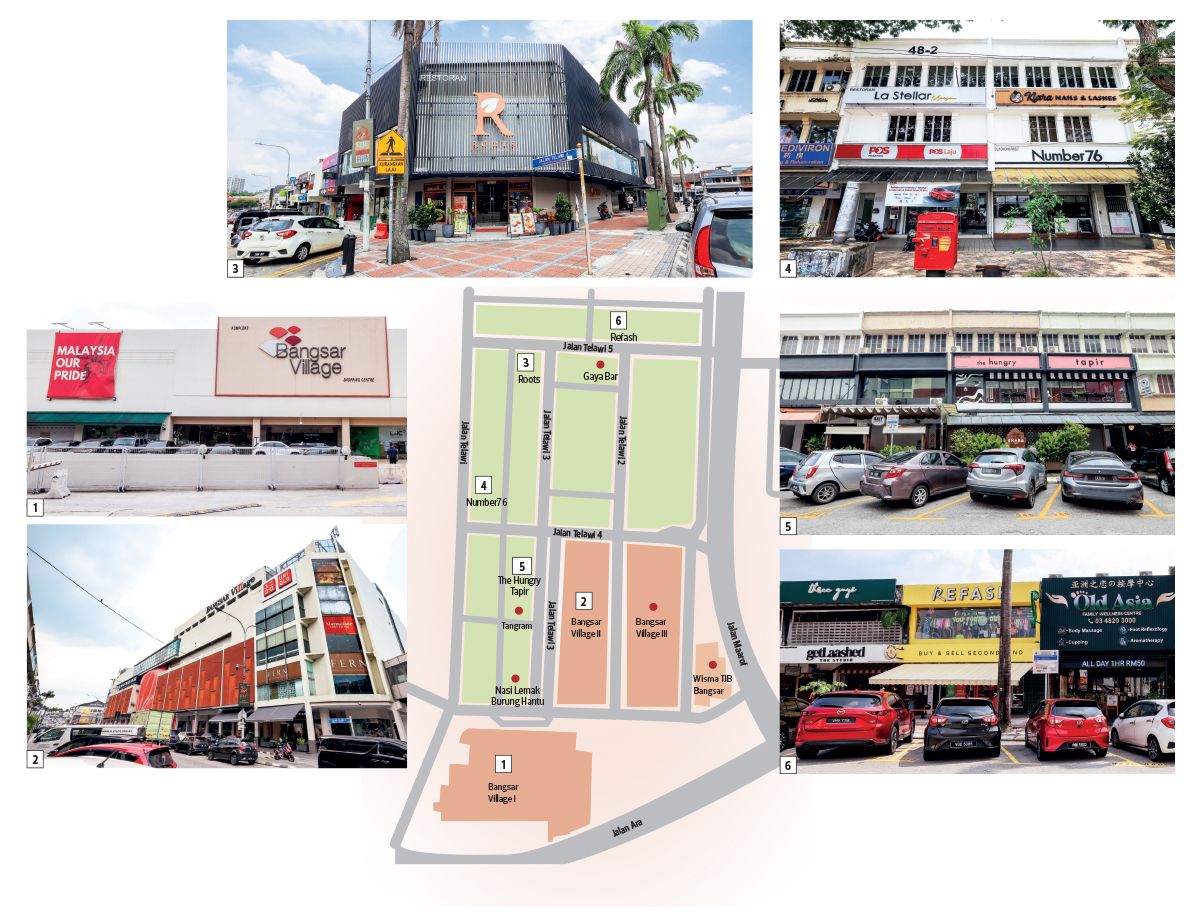
The commercial hub comprises 164 shoplots (74 two-storey and 90 three-storey), with a standard lot size of 24ft by 75ft and built-up of about 3,400 sq ft for the two-storey units and 4,500 sq ft for the three-storey units.
Often referred to simply as “Telawi” or “The Strip” by locals, the area’s enduring appeal makes it the most bustling zone within the wider Bangsar enclave. Today, the five streets of the Telawi grid hum with activity all day long.
Looking back at its history, the broader Telawi area in Bangsar Baru was originally built on plantation land in 1962, with houses constructed throughout the 1960s by BRDB Development Sdn Bhd and Bangsar Hill Developments Sdn Bhd. “That laid the foundation for Bangsar’s later emergence as an affluent, city-fringe residential and commercial precinct,” says Henry Butcher Malaysia director of corporate real estate Long Shi Chuen.
Subsequently, the Telawi shoplots were built in 1974 by Eng Lian Enterprise Sdn Bhd — a low-profile developer that played a significant role in shaping the commercial hub.

Through the late 1970s and 1980s, these shoplots served the daily needs of the local community, housing traditional sundry shops, bakeries, tailors, pharmacies and F&B outlets.
As the surrounding neighbourhood grew wealthier through the early 1990s and attracted a growing expatriate community, the enclave’s character shifted to become one of Kuala Lumpur’s premier lifestyle destinations, with trendy cafés, acclaimed restaurants, pubs, designer boutiques and speciality retail outlets gradually replacing traditional businesses there, according to Metro Rec head of agency Terence Yap.
In the 2000s, as other entertainment districts in Kuala Lumpur emerged, the opening of Bangsar Village I and II — both owned by Eng Lian Enterprise — helped restore footfall and retail relevance, successfully pulling the enclave firmly back upmarket and recapturing crowd, Long says.
“The main shift [of Telawi’s shoplots] was from a stronger nightlife and F&B-led identity in the 1990s to a more diversified lifestyle-retail mix after increased competition from other entertainment and commercial nodes in Kuala Lumpur,” says Long.
“As some earlier F&B operators fell away, retail and more curated lifestyle offerings gained ground, particularly with the influence of Bangsar Village I and II. This made the tenant mix more balanced and somewhat more upscale there,”
He adds that the malls anchor footfall and help sustain the street’s upmarket positioning. “They make the area more resilient by turning it into a fuller ecosystem rather than a standalone row of shoplots. At the same time, they do raise the competitive bar, as independent shoplots need the right frontage, concept and customer experience to compete effectively.”
Meanwhile, Bangsar Village III — located next to Bangsar Village II — opened in 2020 with anchor tenants Sports Direct and Haidilao .
“Its presence suggests continued retail deepening in the precinct, which should help traffic overall but also intensify tenant competition in the area,” he says.
Today, Telawi has shifted from being a largely neighbourhood commercial hub to becoming a mature lifestyle address, with the street’s staying power coming from its dual role as a local convenience cluster and destination strip.
“Tenant profile has not evolved much in recent years. Most tenants here have remained very much the same, with few changing hands. Health and wellness, beauty, medical, professional services and F&B will go on dominating the street,” Yap says.
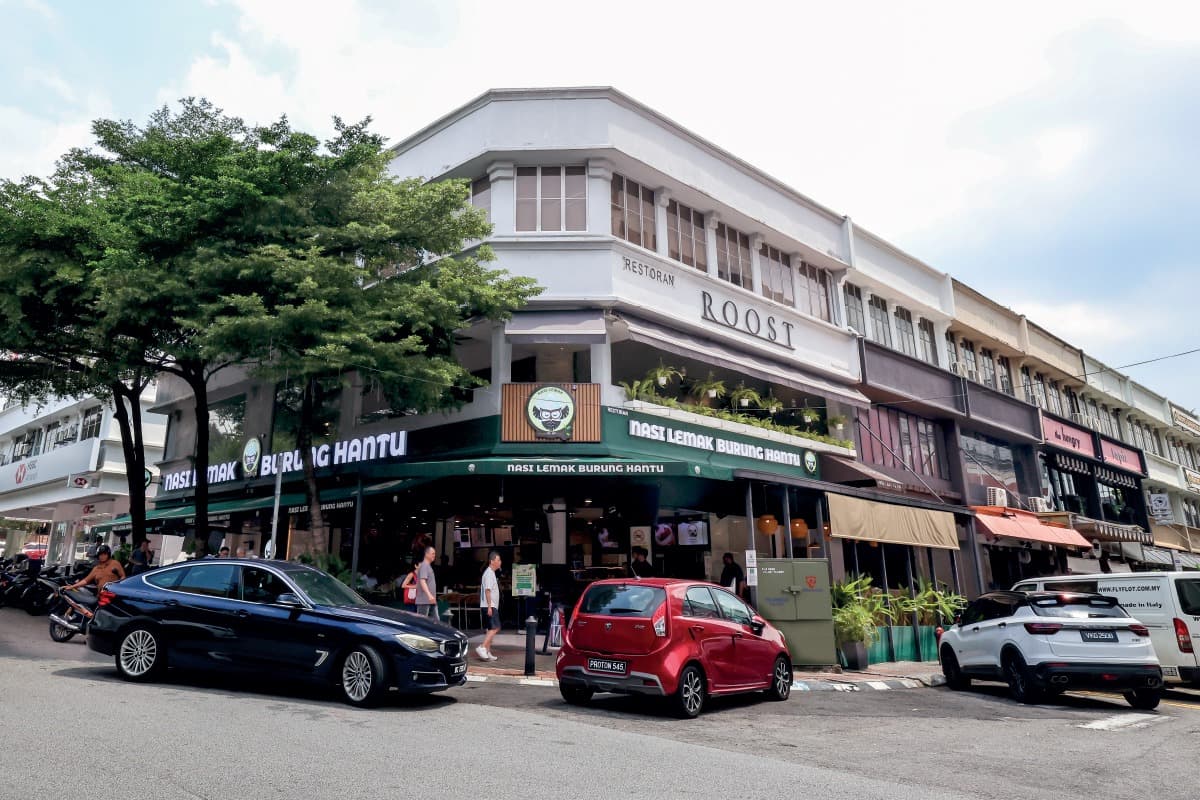
A street that works all day
According to the Valuation and Property Services Department (JPPH), Telawi shoplots recorded only a handful of transactions in most years.
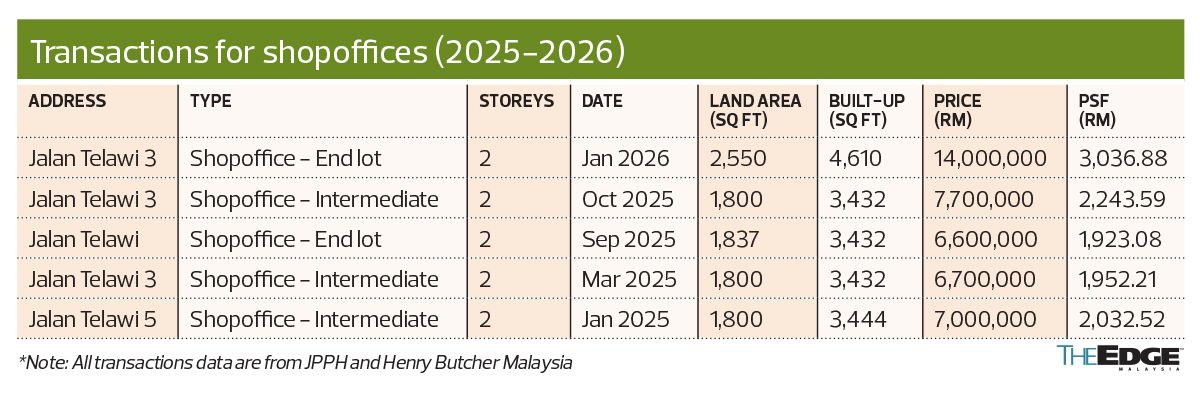
Yet, when they do trade, prices are high, with transactions from late 2025 to early 2026 ranging from RM6.6 million to RM14 million.
For example, in January 2026, a two-storey end lot on Jalan Telawi 3 was transacted for RM14 million (about RM3,037 psf on built-up area). In late 2025, two other two-storey units on Jalan Telawi and Jalan Telawi 3 changed hands at RM6.6 million and RM7.7 million respectively.
Comparably, back in 2020, units in Jalan Telawi 5 were transacted between RM6.3 million and RM6.5 million. Yap points that the trend shows a clear uptick in prices in the Telawi area.
He adds that the upward trajectory is driven partly by ongoing commercial evolution and a shift towards a modern tenant mix of curated retail and contemporary F&B concepts. Recent entrants anchoring the grid include Tangram, Bar Gaya, The Hungry Tapir and Refash.
Furthermore, the opening of Wisma TJB Bangsar — with tenants such as Kenny Hills Bakers, Decathlon, My Humble Bowl, Petit Bubs and The Smile Bar — continues to diversify the streets’ broader submarket profile into a more urban lifestyle hub, Yap says.
“[The evolution of tenant mix is also due to the customer base, which] comprises predominantly middle-to-upper-income residents from Bangsar and the surrounding neighbourhoods, complemented by professionals, expatriates and visitors from across the Klang Valley,” he notes.
Long concurs, saying that what keeps the shops popular in the market is a customer base that does not have to travel far to reach them. The catchment drivers are the affluent Bangsar residential base, destination dining, lifestyle retail and spillover from the two malls, and the footfall is local rather than tourists.

“It is one of the few precincts that can support daytime errands, meal-driven traffic and evening social activity within the same strip,” Long says.
He says the average occupancy rate of the shoplots is 90%, with most available space having already been taken up. “Demand is now more selective — stronger for well-positioned, highly visible lots than generic secondary space.”
Yap adds that vacant lots are mostly on the second floors, though they rarely remain unoccupied for long.
Generally, the commercial strip has fetched a healthy and stable rental yield over the years, with ground-floor units commanding monthly rents of RM18,000 to RM22,000, first-floor units fetching RM6,500 to RM8,000 and second-floor units fetching RM3,000 to RM3,500.
Looking ahead
While the demand for Telawi’s shoplots remains healthy, the area faces the common challenge of popular commercial enclaves — traffic congestion and insufficient parking bays.
“The main challenge here is street parking. It has been a nightmare finding a parking spot,” says Yap. “A good alternative is to park in Bangsar Village I and II and walk over, which most people do.”
A multi-storey car park of the kind built in Sri Petaling would help, he adds, but there is no lot available for one, and land cost would be the deterrent in any case.
For Long, pressure for the Telawi shoplots continues to come from outside the precinct, particularly newer master-planned lifestyle destinations, which have sufficient parking bays, walkways and a good tenant mix from the start.
“[The Telawi shoplots] cannot rely on their established location alone, as [the area] needs to remain curated, walkable and operationally convenient,” he says.
To him, this means a better parking experience, stronger pedestrian comfort, tighter tenant curation, more consistent streetscape quality and programmes that will help keep the area busy throughout the day rather than only after dark.
The only new supply is Wisma TJB Bangsar on Jalan Telawi 1. He expects it to attract tenants that have been unable to secure a slot in the Telawi shoplots because of the low vacancy rates.
Both consultants expect Telawi to hold its place as Bangsar’s landmark commercial address.
“The Telawi enclave will continue to maintain its strong appeal, with demand for its shops remaining resilient,” says Yap. “This is evidenced by the limited number of sale transactions in the area, as property owners are generally reluctant to dispose of their assets.”
“Telawi will still be Bangsar’s landmark, but it will continue to evolve from a legacy high street into a more curated, service- and experience-led precinct,” Long says. “Over the next five to 10 years, it should remain relevant by leaning into premium neighbourhood retail, food, wellness, services and destination concepts,” says Long.
Save by subscribing to us for your print and/or digital copy.
P/S: The Edge is also available on Apple's App Store and Android's Google Play.