

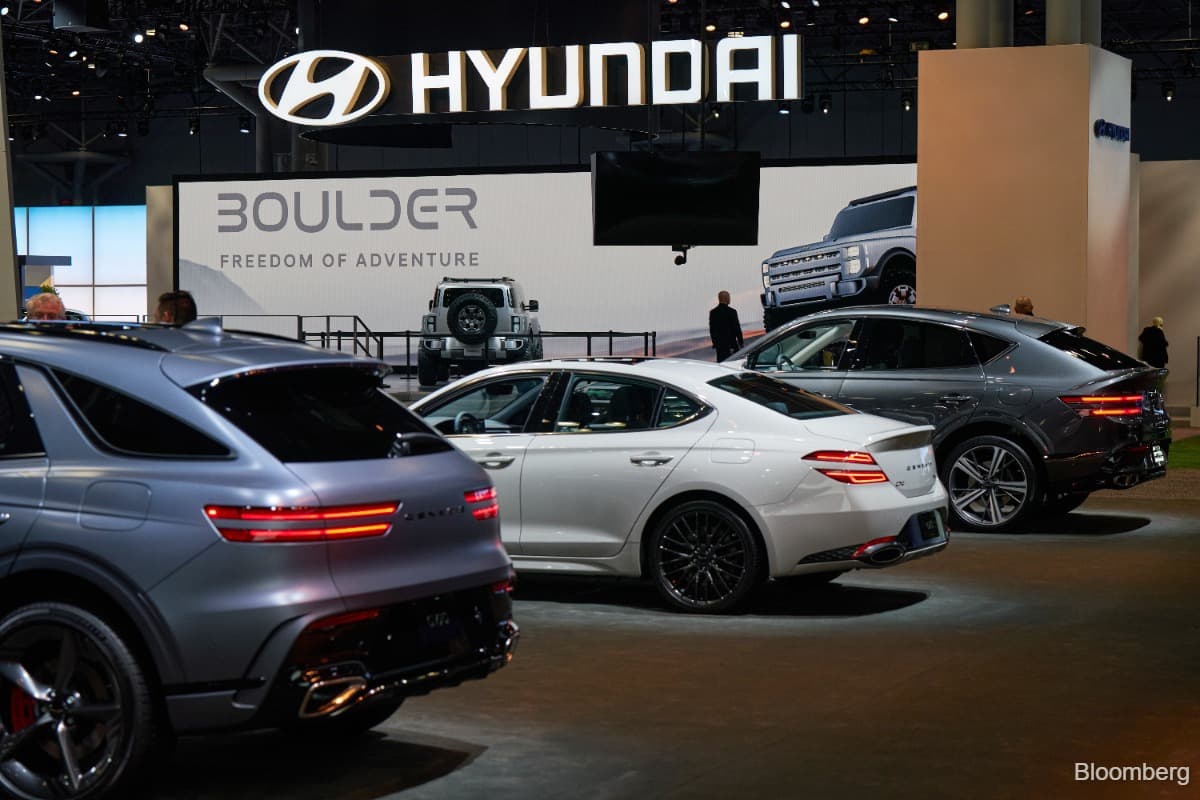
(July 23): Hyundai Motor Co’s second-quarter (2Q) profit missed analyst estimates as global sales dropped, with US policy uncertainty and intensifying competition from Chinese rivals hurting demand.
Operating profit was 2.85 trillion won (RM7.87 billion) for the three months ended June 30, down nearly 21% from a year earlier, the Seoul-based company said on Thursday. That fell short of analyst estimates for 3.1 trillion won. Revenue rose about 2% to 49.2 trillion won, a record for 2Q.
The results highlight the challenges facing Hyundai and other automakers in an increasingly uncertain business environment. Even as North American sales strengthen, the rollback of US support measures for electric vehicles (EVs) have clouded the longer-term outlook for the carmaker and its affiliate Kia Corp.
Hyundai is also losing ground to Chinese EV brands in places like Europe and Asia, while US tariffs are still a major headwind. The carmaker said the levies cost about 900 billion won in 2Q, on top of the first quarter’s 860 billion won.
“Prolonged geopolitical instability, including the Iran conflict, has heightened external uncertainty,” Chief financial officer Lee Seung Jo said in an earnings call. “China’s aggressive EV offensive is exerting a major impact on the growth of overall demand.”
Wholesale deliveries during 2Q were about 991,000, down 6.9% from a year ago, driven by lacklustre demand in the Middle East. Global retail sales fell 4.2% in the quarter, including a roughly 7% decline in Europe and a 33% slump in China. Sales rose 7.4% in India and about 4% in North America.
Back at home, domestic demand has also weakened and wage talks with unionised workers remain deadlocked, with a partial strike causing millions of dollars in losses for each hour of stoppage.
The earnings were also impacted by conflict-driven spikes in raw material prices. Meanwhile, the positive effect of a weaker Korean won was whittled down to 23.8 billion won after factoring in lower global wholesale sales and increased incentives due to intensifying market competition, according to Lee.
A fire at a parts supplier in March and component shortages from India also briefly caused supply disruptions, including the luxury Genesis models, but the situation has been normalised and the company plans to ramp up production in the second half, he said.
Even as total vehicle sales declined, hybrids remain a bright spot and electrified vehicles now account for about 27% of total global sales.
Despite the earnings miss, Hyundai shares traded about 2% higher following the results. The stock is up more than 40% this year primarily on optimism around the company’s robotics business following the unveiling of its latest Atlas humanoid model.
Uploaded by Felyx Teoh