

This article first appeared in The Edge Malaysia Weekly on July 20, 2026 - July 26, 2026
FOR an ambitious programme talked about in the market since late last year and officially launched in April this year, the My Value Up programme — Malaysia’s national capital market initiative under the Capital Market Masterplan (2026-2030) meant to catalyse strategic value creation among public-listed companies (PLCs) — has seen rather underwhelming progress three months on, for those eager to measure impact and progress.
That perhaps has to do with the Securities Commission Malaysia (SC) and Bursa Malaysia choosing to start with an easier path, allowing voluntary participation and merely encouraging disclosures without being prescriptive about what needs to be said.
Even though My Value Up currently targets participation from PLCs with at least RM4 billion market capitalisation — which stands at 88 companies at current market values — the capital market regulator and frontline regulator are giving participating PLCs until the year’s end to submit a “first disclosure” to them “to build familiarity with forward guidance disclosure”.
The voluntary public release of value-up plans is only expected sometime next year (2027).
Although there are discussions on incentives for participating PLCs, regulators seem to have chosen to neither wield a stick nor offer a carrot just yet — there are no immediate plans to name and shame or give a “badge” to acknowledge star performers. Regulators have only said they could provide a public list of participating PLCs to “spotlight [the PLCs’] commitment to the programme”.
Unlike Japan’s initial focus on companies that trade below book value and improve return on equity (ROE), Malaysia’s My Value Up wants PLCs to explain how management intends to create value over the medium and long term. In essence, My Value Up is challenging Bursa-listed companies to rethink how they present themselves and their growth narrative to investors and other stakeholders.
“As part of their Value Up Plans, PLCs should consider using metrics and reference points they consider most relevant for assessing value enhancement, including, where appropriate, selected financial and efficiency targets. Where such metrics are used, PLCs should explain the rationale for selecting them, together with relevant historical trends or contextual information, where this would aid understanding,” reads the My Value Up Guidebook, that was launched by the SC and Bursa on June 9 “to help PLCs create their medium- to long-term value and transform them into globally attractive investment propositions”.
The guidebook has examples of financial and efficiency metrics as well as sector-specific metrics which, by its own admission, “are generally available through existing PLC disclosures”.
This, thus, begs the question: If most companies already publicly disclose these metrics either through their required quarterly financial releases or annual reports, where is the expected value add from My Value Up? Surely the success of My Value Up is not to be judged purely based on how many companies have chosen to publish their value-up plan?
Will there be a scoreboard where not just investors, but also regulators and policymakers themselves, can regularly check to see tangible evidence of improved market valuation as well as financial and efficiency metrics among participating companies versus those who choose to continue their own way?
If not, how will success be measured? How will smaller companies, with fewer resources and greater needs, know it is worth their while?
“Beginning in early 2027, the list of targeted PLCs that disclose their Value Up Plans will be published by Bursa to favourably spotlight them and give stakeholders clearer visibility into their commitment and progress, enabling meaningful assessment,” the SC tells The Edge in a written reply. (See also “Five questions for the Securities Commission on My Value Up” on Page 67.)
There are nudges for regulators to be more prescriptive.
“Whilst we see the Guidebook as providing the right direction for companies to focus more on shareholder value, it would benefit from greater prescriptiveness to drive improvements in financial performance, along with meaningful incentives for companies to get on board,” Asian Corporate Governance Association (ACGA) secretary-general Amar Gill wrote in a June 18 article on its website.
He, for one, reckons that the My Value Up programme “will certainly evolve from here with indications it may become mandatory by 2028. As the programme develops, it may yet become a stronger impetus for shareholder returns in the Malaysian market”.
“From 2028 onwards, there are considerations to transition My Value Up into mandatory disclosure requirements (if the need arises). Having undergone familiarisation, trial disclosures, and market engagement, mandatory adoption represents a natural progression — supporting consistency, transparency, and accountability while reducing the risk of unexpected market reactions,” Bursa said in the Frequently Asked Questions (FAQ) page on the My Value Up programme on its website.
Ensuring accountability while allowing flexibility
As it is, the My Value Up programme largely leaves the PLCs to decide for themselves whether to participate and publish value-up plans as well as what metrics to disclose.
Voluntary participation is not necessarily flawed. Setting specific financial targets could well invite financial engineering and even boilerplate value-up plans written merely to tick the box as a programme participant.
But flexibility in disclosure should not mean nothing is measured.
Investors would benefit if, for example, participating companies not only periodically disclose key performance indicators (KPIs) and milestones but also explain the reasons for any revisions or missed targets. The disclosure of baseline and time-bound targets, consistent KPIs, and timely progress updates against previous promises, makes it easier for investors to follow a company’s progress.
To nudge participation, regulators can publish comparable aggregates showing whether My Value Up participants outperform non-participants.
Without specific measurable metrics, the value-up plans risk being just a nice story that may not necessarily lead to the desired improvements in ROE, cash generation or valuation.
“Some box-ticking is inevitable in any governance initiative. It works because it is visible — the reason companies are made to disclose or explain, for instance, 30% women board participation,” one market observer says.
The Tokyo Stock Exchange, for example, explicitly pushed boards to examine cost of capital, capital efficiency and persistently low market valuations. It also published which companies had responded, creating reputational pressure to comply.
Others beyond the 88 ‘expected’ to participate
Regulators may well be mulling ways to expand participation to smaller companies that may need the push to improve performance and visibility.
“The scope of mandatory participation may be reassessed and potentially expanded at the end of 2027,” Bursa said in the FAQ on its website, in reference to whether My Value Up is only for large PLCs.
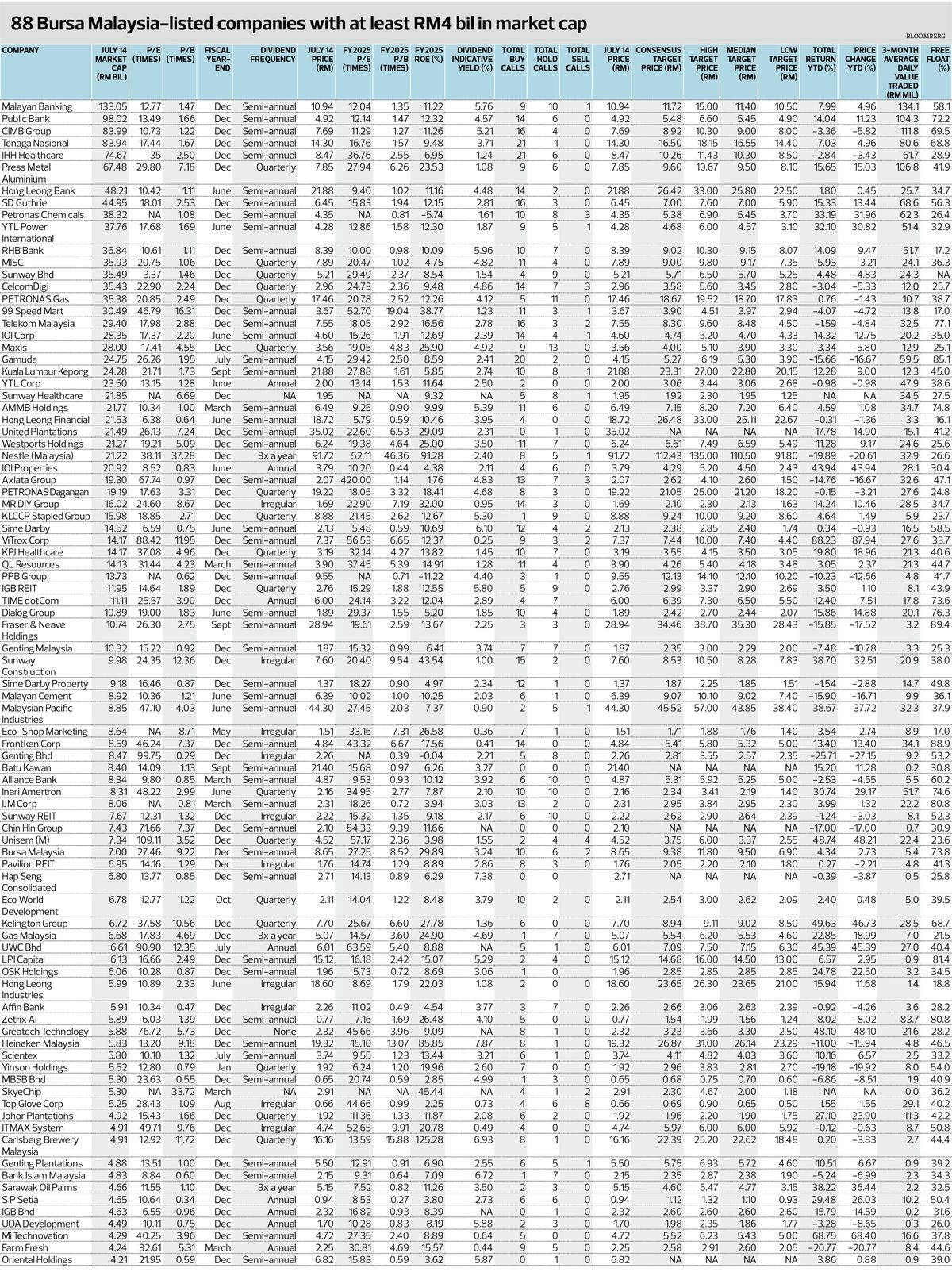
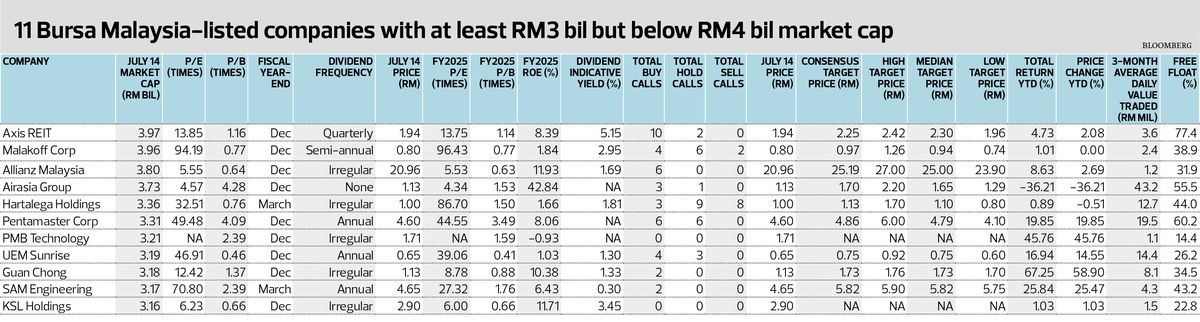
The immediate additions to the 88 are likely the 11 PLCs with market capitalisation of between RM3 billion and RM4 billion (see tables on pages 67 and 68). There are 32 companies with market capitalisation of between RM2 billion and RM3 billion and 60 companies with market value of between RM1 billion and RM2 billion, according to Bloomberg data on July 14.
The 191 companies with at least RM1 billion market capitalisation account for about 90% of total market capitalisation. The bar to participation may well be low for the 88 PLCs with market value exceeding RM4 billion, which collectively account for more than 80% of the total market capitalisation and “are expected to participate, reflecting their role as market leaders” even though participation is not compulsory.
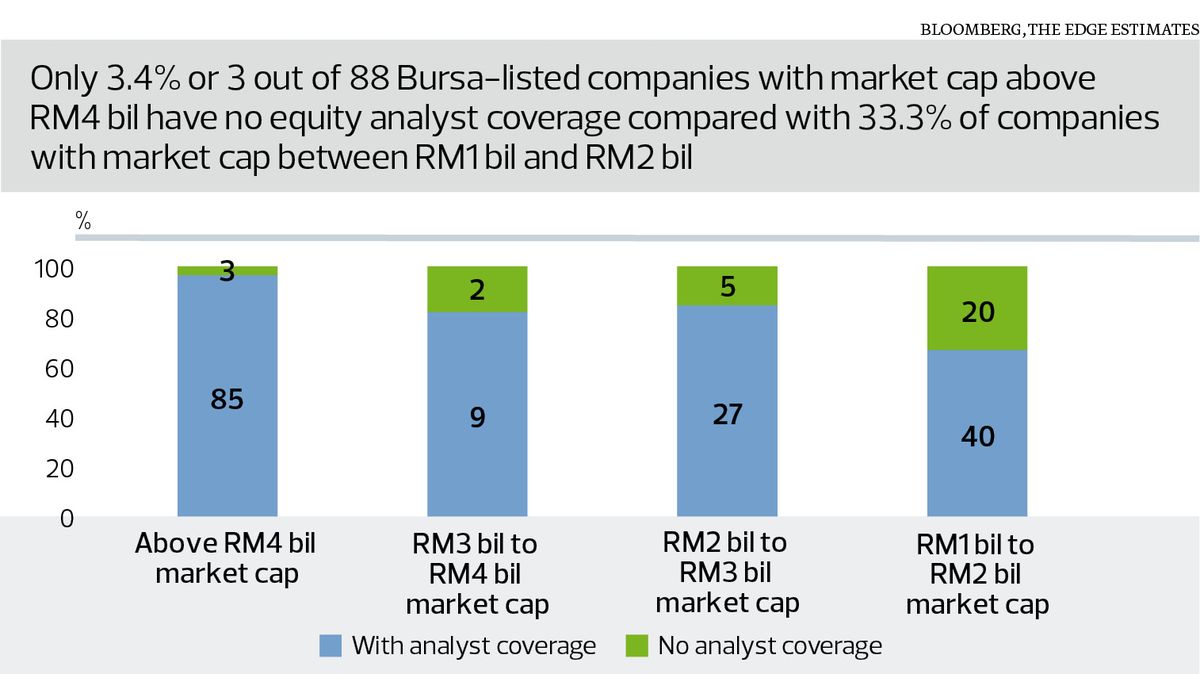
Only 3.4%, or three of the 88 do not have active coverage by equity analysts, according to Bloomberg data at the time of writing.
That compares to 33.3% or 20 without analyst coverage among 60 companies with market capitalisation of between RM1 billion and RM2 billion.
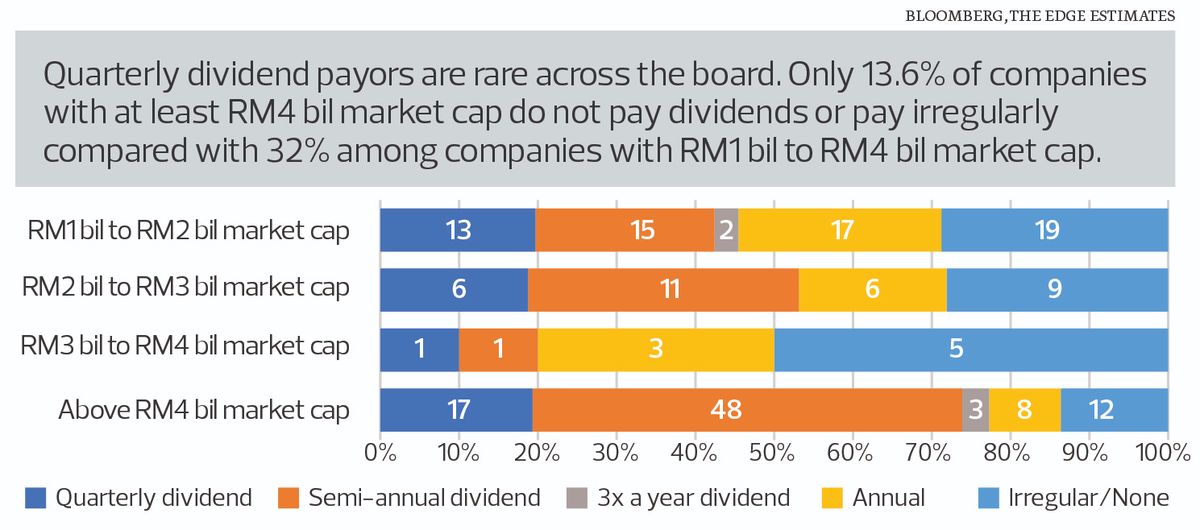
Only 13.6% of the 88 with at least RM4 billion market capitalisation do not already pay dividends regularly or at all compared to 32% of companies with market value of RM1 billion to RM4 billion, The Edge’s compilation of Bloomberg data shows.
It is worth noting that quarterly dividend payors are rare even among billion-ringgit PLCs.
Keeping score
Given that government-linked investment companies (GLICs) are expected to support the My Value Up programme, at least two enterprising research analysts have come up with a way to measure performance across the board.
“We develop the CGSI MY 30 Leaders list to put in place a practical methodology to measure the intended impact of the My Value Up Programme: enhancing shareholder value. The list picks the 30 companies from the 304-member FBM Emas Index (98% of the market cap of listed companies on Bursa Malaysia), based on published 2025 numbers, which scored the highest for generating ROE above cost of equity (COE), dividend payout and dividend frequency — factors which we believe are representative of companies focused on enhancing shareholder value,” CGS International Securities Malaysia analysts Prem Jearajasingam and William Wo Chen Weng told clients in a June 25 note, surmising its “attempt to create a practical methodology to measure the intended impact of the My Value Up Programme after examining similar programmes in Korea, Japan and Singapore, and gauging feedback from investors”.
Its 30 companies — not necessarily FBM KLCI components — outperformed the wider FBM100 index by 3.1% per annum over one year, 1.7% per annum over three years and 3.8% per annum over five years. In addition to the 30 “leaders” — which, the analysts calculate, trade on 18 times 2026 calendar year earnings, 4.2% dividend yield and generate 18.3% ROE — CGS also named 20 more “emerging leaders” which “could make inroads into the main list”.
The 30 companies are Malayan Banking Bhd (KL:MAYBANK), Public Bank Bhd (KL:PBBANK), Press Metal Aluminium Holdings Bhd (KL:PMETAL), CIMB Group Holdings Bhd (KL:CIMB), Maxis Bhd (KL:MAXIS), Tenaga Nasional Bhd (KL:TENAGA), PETRONAS Gas Bhd (KL:PETGAS), IHH Healthcare Bhd (KL:IHH), Nestlé (M) Bhd (KL:NESTLE), MISC Bhd (KL:MISC), CelcomDigi Bhd (KL:CDB), Telekom Malaysia Bhd (KL:TM), PETRONAS Chemicals Group Bhd (KL:PCHEM), MR DIY Group (M) Bhd (KL:MRDIY), Hong Leong Bank Bhd (KL:HLBANK), United Plantations Bhd (KL:UTDPLT), 99 Speed Mart Retail Holdings Bhd (KL:99SMART), RHB Bank Bhd (KL:RHBBANK), PETRONAS Dagangan Bhd (KL:PETDAG), SD Guthrie Bhd (KL:SDG), Sunway Bhd (KL:SUNWAY), YTL Power International Bhd (KL:YTLPOWR), Westports Holdings Bhd (KL:WPRTS), IOI Corp Bhd (KL:IOICORP), IGB REIT (KL:IGBREIT), Kuala Lumpur Kepong Bhd (KL:KLK), AMMB Holdings Bhd (KL:AMBANK), Sunway Construction Group Bhd (KL:SUNCON), Gamuda Bhd (KL:GAMUDA) and KPJ Healthcare Bhd (KL:KPJ).
Meanwhile its Emerging 20 companies are Axiata Group Bhd (KL:AXIATA), YTL Corp Bhd (KL:YTL), Bursa Malaysia Bhd (KL:BURSA), PPB Group Bhd (KL:PPB), Sunway Healthcare Holdings Bhd (KL:SUNMED), IOI Properties Group Bhd (KL:IOIPG), QL Resources Bhd (KL:QL), Gas Malaysia Bhd (KL:GASMSIA), Eco-Shop Marketing Bhd (KL:ECOSHOP), Heineken Malaysia Bhd (KL:HEIM), Sime Darby Bhd (KL:SIME), Inari Amertron Bhd (KL:INARI), Kelington Group Bhd (KL:KGB), Unisem (M) Bhd (KL:UNISEM), ViTrox Corp Bhd (KL:VITROX), TIME dotCom Bhd (KL:TIMECOM), Frontken Corp Bhd (KL:FRONTKN), Zetrix AI Bhd (KL:ZETRIX), Dialog Group Bhd (KL:DIALOG) and Genting Bhd (KL:GENTING).
“To drive ROEs, we believe as a first step companies should return excess cash to shareholders in the form of dividends,” they wrote.
“Observing the data for the Top 50 names (30 Leaders and 20 Emerging Leaders), 24% of the companies scored full marks for delivering ROEs 15% above the 10% COE we set as the expected market return, with 32% not achieving the 10% threshold,” they wrote. “All 50 of the companies in both lists delivered payout ratios of >25% with 70% of the Leaders scoring the top two bands for payout ratio (>50%) versus 60% in the Emerging group. Interestingly, 40% of the Leaders paid dividends more than twice a year with 11 paying quarterly dividends,” they added.
Their list is clear evidence that regulators can easily set up a scoreboard to nudge PLC participation in My Value Up to the betterment of the marketplace, once they decide keeping score is the better way forward.
Save by subscribing to us for your print and/or digital copy.
P/S: The Edge is also available on Apple's App Store and Android's Google Play.