

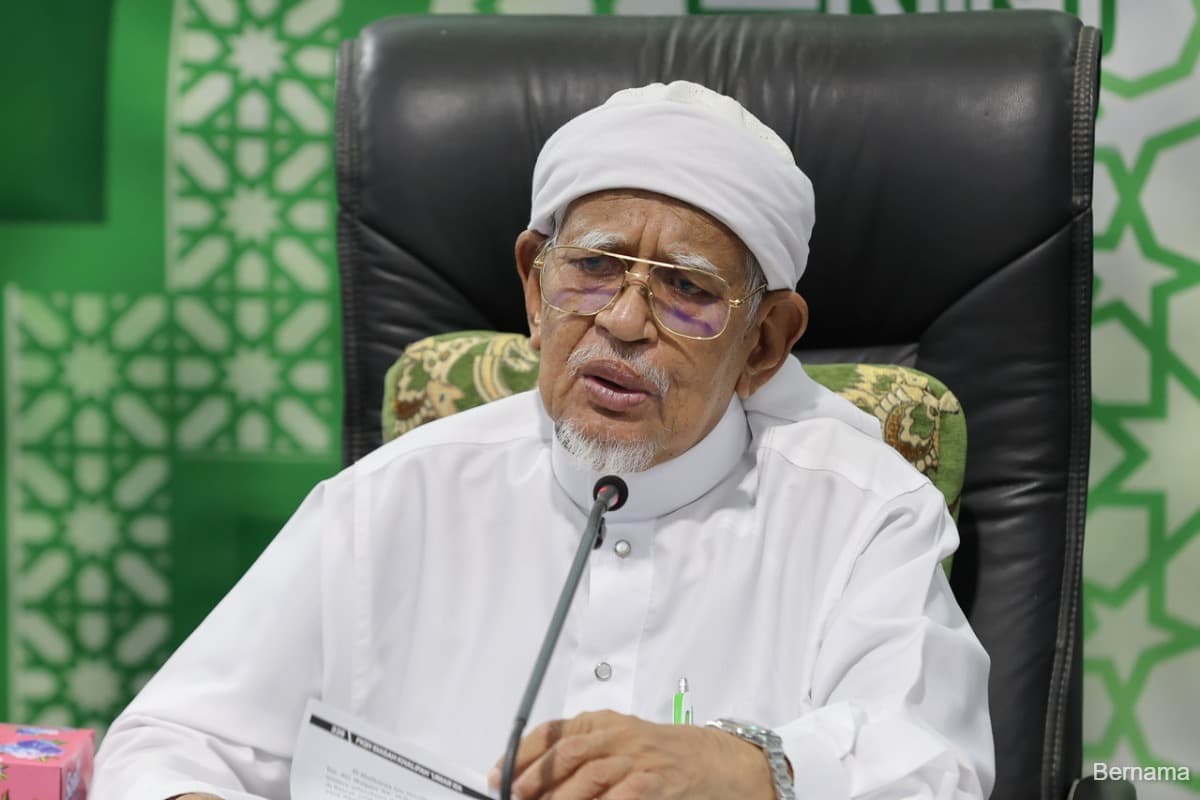
KUALA LUMPUR (July 21): PAS has defended its electoral cooperation with Barisan Nasional (BN) in the Negeri Sembilan state election, saying it is playing an "attacking" role to help wrest the state from Pakatan Harapan (PH).
PAS president Tan Sri Abdul Hadi Awang said the party has adopted a different strategy from the Johor state election, where the party "only contested symbolically" to reinforce BN's position as the incumbent state government against a PH coalition that is in power at the federal level.
He likened PAS' role in the July 11 Johor polls to that of a football team's defence, saying the party's objective was not to score goals but to prevent defeat by strengthening BN's position.
"In contrast, PAS is contesting in Negeri Sembilan as an attacking member that shares strategic positions to reclaim Malay-Muslim political power together with non-extreme non-Muslim parties," Hadi wrote in a social media post on Tuesday.
Critics have questioned the rationale for PAS' cooperation with BN that become apparent since the Johor polls on July 11. In Negeri Sembilan, both BN and the PAS-led Perikatan Nasional (PN) coalition have agreed to avoid direct contest against each other.
Under the arrangement, BN will contest 25 of the state's 36 seats, while PAS and other PN component parties — Gerakan, Parti Wawasan Negara and Malaysian Indian People's Party (MIPP) — will contest the remaining 11 seats.
Hadi criticised another PN component party, Bersatu, for distancing itself from the coalition, claiming that the move had complicated efforts to regain Negeri Sembilan from PH.
Malay-Muslim unity card
In defending the BN-PN cooperation, Hadi argued that divisions among Malay-Muslim political parties had historically weakened the community's political influence and made it easier for political opponents to gain power.
He cited historical events like the fall of Andalusia and the Ottoman Empire as examples of how internal divisions ultimately led to political decline, arguing that similar lessons should guide contemporary Malay-Muslim politics in this country.
PAS had previously worked with Umno both before and after Malaysia's independence, before joining opposition coalitions Barisan Alternatif and Pakatan Rakyat. The party later ended its cooperation with DAP, which was part of the Pakatan Rakyat coalition, over disagreements on the implementation of Islamic law. PAS subsequently teamed up with Bersatu to form PN.
PAS has been a long-standing critic of DAP, accusing the party of promoting a secular agenda and claiming it had encouraged attempts to challenge the constitutional position of Islam, the Malay Rulers and other provisions of the Federal Constitution.
Hadi also criticised PKR and Amanah, accusing the two PH component parties as representing liberal and progressive interpretations of Islam. He argued that greater political cooperation among Malay-Muslim parties is necessary to prevent PH from retaining power.
PH has consistently rejected PAS' characterisation of its component parties, maintaining that the coalition remains committed to the Federal Constitution, the constitutional monarchy and Malaysia's multiracial political system.
Find out all you need to know about the 2026 Negeri Sembilan election here.