

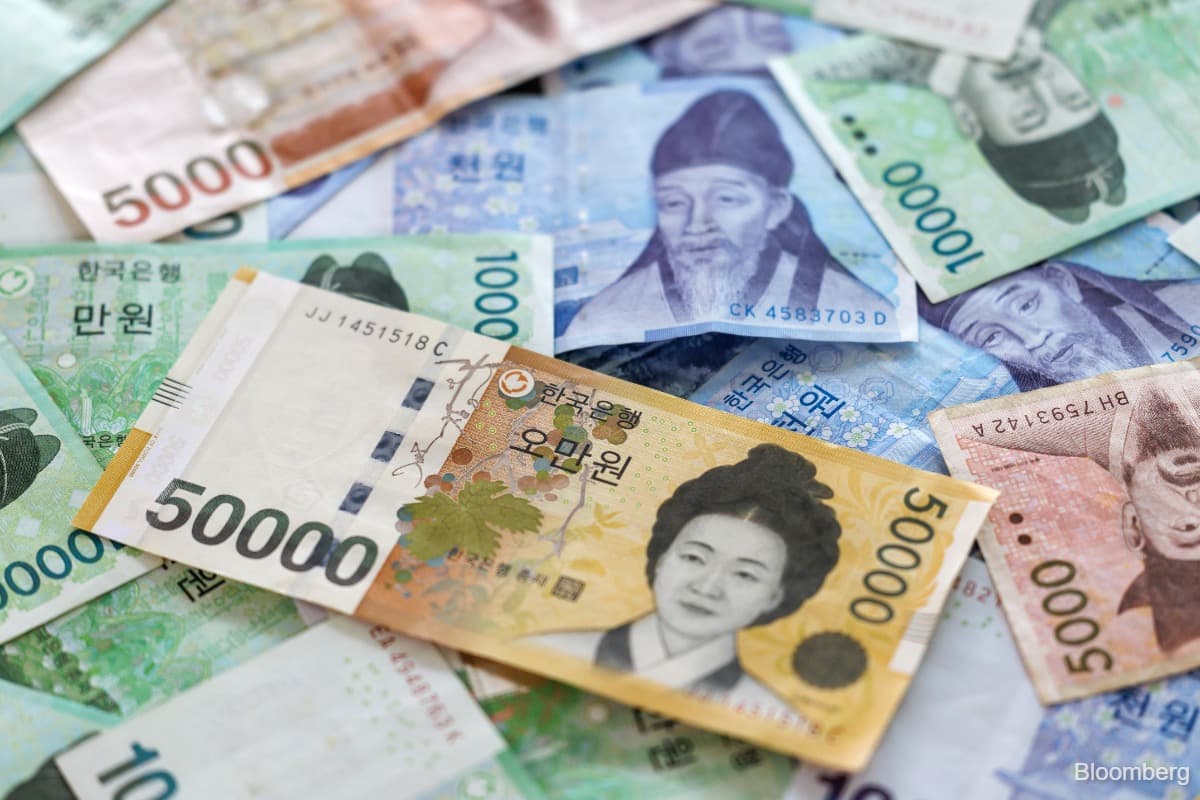
(July 21): Daily trading volume in the South Korean won has picked up since 24-hour trading began two weeks ago, a trend driven by foreigners offloading local chipmakers’ shares.
Roughly US$18.6 billion (RM76.06 billion) of dollar-won spot trading took place on average per day from July 6 to July 16, according to data from Seoul Money Brokerage Services Ltd and Korea Money Brokerage Corp. That is around 16% higher than the daily average of the 30 days prior to July 6, when full-day trading began. The data doesn’t separate day and night trading and also omits July 17, a holiday in Korea.
Clients’ enquiries about the won “have increased fourfold in the last four weeks and more calls are coming in during both day and night time”, said Neil Jones, managing director of FX sales & trading at TJM FX in London. "It's a major currency and will be more so going forward.”
The data confirms the official expectation that around-the-clock trading would boost won volume, a key step in Korea’s bid for MSCI Inc’s developed-market status. The new hours mark a break from decades of tight currency controls but have raised concerns that thinner overnight liquidity may worsen volatility, particularly as the won weakened in early July toward its lowest level since 2009.

The currency’s bid-ask spread, which is typically wider outside Seoul trading and reflects low liquidity, will continue to be tested as investors adjust to the new schedule. In the past six months, the spread has averaged about one won between 5pm and 8am local time (4pm and 7am in Malaysia), compared with roughly 0.3 won during the domestic business hours, according to Bloomberg-compiled data.
A key measure in gauging success for 24-hour trading will be “whether after-hours trading volumes pick up and then whether bid-offer spreads narrow", Wee Khoon Chong, senior Asia Pacific market strategist at BNY, said.
South Korea extended won trading to around the clock from 17 hours a day as part of its efforts to make the currency more accessible to overseas investors. Investors still must issue orders “onshore” with banks operating in the country, though they now can be processed at any hour.
The early weeks of extended hours have overlapped with global tech stock selloffs that were triggered by doubts over the durability of artificial intelligence spending and spilled into Korea, home to chip giants Samsung Electronics Co and SK Hynix Inc. Foreign investors sold about 4.22 trillion won (RM12 billion) of Korean equities on a net basis between July 6 and July 16, Bloomberg-compiled data show.
"Trading volume in the won during the past two weeks coincides with volatility in Kospi shares,” Chong said. He expects activity to rise further as Korea’s role in AI supply chains drives “natural interest in Kospi and therefore in the won".
South Korea has said it will strengthen monitoring of the night trading session and prepare measures to increase liquidity during those hours. Currently, four officials continue to take turns monitoring the won in a government office, known internally as “The Box", in the city of Sejong, according to a government official, asking not to be identified discussing internal operations. Government officials have begun procedures to expand staffing in New York for won-trade monitoring, the person said.
On Sunday, the government also unveiled a roadmap to make the won freely tradable among foreigners, including measures to support foreign banks’ local branches in night operations and incentives to shift trading from the won’s non-deliverable forwards market to deliverable forwards.
Since the extended hours began, activity is more concentrated in the won’s NDF market than in the spot market during non-Korean hours, according to traders, who asked not to be named due to internal policy.
After weakening at the start of the month, the won has risen about 4.8% so far in July to 1,477.45 per dollar on Tuesday, as exporters’ dollar sales offset foreign stock selling.
“Deeper offshore liquidity could also facilitate larger investment and repatriation flows without generating excessive FX volatility,” Commerzbank AG economist Henry Hao and analyst Moses Lim wrote in a note. “However, greater internationalisation may increase the won’s sensitivity to shifts in global risk sentiment over time.”
Uploaded by Arion Yeow