


This article first appeared in The Edge Malaysia Weekly on July 13, 2026 - July 19, 2026
Unwinding its risky put and call options without losses is not entirely within its control
A derivative trade is only as strong as the counterparties’ ability to fulfil their commitments. Only then is it considered a high-quality trade by the investment community.
The cash-rich Human Resources Development Corp (HRDC), which is under the purview of the Ministry of Human Resources, has an investment portfolio of RM1.9 billion, comprising unit trusts, quoted shares, redeemable convertible cumulative preference shares (RCCPS) and bonds.
The largest portion of its investment portfolio comprises quoted shares valued at RM757.3 million, followed by bonds worth RM458.2 million, unit trusts at RM434.9 million, and RCCPS amounting to RM272.4 million.
Of the RM757.3 million invested in quoted shares, RM593.2 million, or 78%, are covered by put and call options, which are derivative instruments.
The options are generally entered into between HRDC and counterparties using the shares as collateral. On paper, an option is extinguished when it expires at the end of 12 months. In reality, however, that does not seem to be the case.
This is particularly telling in HRDC’s latest financial report.
The entity continues to hold shares covered by put and call options despite the Public Accounts Committee (PAC) describing such trades as “risky investments” in 2024. Although the amount declined from RM620.6 million in 2024 to RM593.2 million at end-2025, it remains a substantial portion of its investments in quoted shares.
The PAC’s rebuke stemmed from HRDC being left holding 94.5 million shares in Widad Group Bhd (KL:WIDAD), which are now practically worthless.
The actual cost of HRDC’s investment in Widad is unknown, although reports put it at 62 sen per share. Widad is now trading around 1.5 sen per share.
In its annual report for the financial year ended Dec 31, 2025, HRDC reported an operating deficit of RM49.7 million, due to derivative losses of RM85.8 million and a decline in fair value gains on investments to RM29.8 million from RM139.8 million in 2024.
The provisions for the derivatives losses and drop in fair value gains on its investments ultimately led to the corporation’s registering a deficit of RM49.7 million.
Since January this year, HRDC has seen a series of changes: a new minister in charge, a new CEO and a complete revamp of the board.
According to Human Resources Minister Datuk Seri R Ramanan, HRDC has reduced its exposure to risky investments beginning this year. In a reply to a parliamentary question, he said risky assets had been reduced to 13.5% of total assets under management, from 21.6% previously. He also said the corporation had recovered RM270.7 million.
It is uncommon for HRDC to record a deficit, as most of its operating income comes from returns on its RM1.9 billion investment portfolio and RM2.4 billion in fixed deposits. In the past, HRDC recorded deficits only in 2008 and 2018.
The deficit in 2018 was a result of a decline in the value of its equities, following turmoil in global equity markets triggered by the financial meltdown of the US banking system.
That year, Malaysia saw a change in government. The new HRDC management provided for non-allowable Goods and Services Tax input tax as well as fair value losses on its equity investments, resulting in a deficit of RM42.9 million.
In 2018 and 2019, HRDC reduced its exposure to equities and increased its fixed deposits for safer returns. Equities accounted for less than 10% of its total portfolio. More importantly, it had no put and call options on its books.
In 2019, HRDC invested RM24.8 million in quoted shares, accounting for 8% of its total investment portfolio of RM311.9 million, with most investments in bonds.
Since 2020, however, HRDC’s investments in quoted shares have spiked significantly. Its CEO at the time was Datuk Shahul Dawood and the human resources minister was Datuk Seri M Saravanan. At end-2022, Saravanan was replaced by V Sivakumar and, later, Steven Sim.
Shahul stepped down as CEO in April 2025 and was replaced by Dr Syed Alwi Mohamed Sultan three months later. Syed Alwi served for only six months until January this year, after which he was replaced by Datuk Mohamed Shamir Abdul Aziz.
The year 2020 marked the start of HRDC’s entry into derivatives to mitigate risk. The redemption rate by vendors that entered into agreements with HRDC was between 7.5% and 8%.
By end-2020, quoted shares accounted for 34% of HRDC’s RM542.7 million investment portfolio. By December 2024, its exposure to quoted securities had risen to RM725.8 million, or more than 38% of its total investment portfolio of RM1.86 billion.
Some 85% of its quoted securities, worth RM620.6 million, were covered by put and call options.
The Perak Transit case
The downside of having quoted shares covered by put and call options is significant, especially when the equities involved are not blue-chip stocks and are illiquid. In the event of a selldown, HRDC could be left in a precarious position, with limited avenues to recover its investments.
Last year, HRDC’s exposure to Perak Transit Bhd (KL:PTRANS), in which it is the second-largest shareholder, also left it in a difficult position.
At the start of 2025, HRDC’s 54.4 million Perak Transit shares were valued at RM38.9 million, with the stock trading above 71 sen.
In October, heavy selling triggered a limit-down in the share price. Perak Transit now trades at 17 sen, just 24% of its January 2025 value.
With thin trading and no new investors entering the company, HRDC remains the second-largest shareholder with 54.4 million shares, but has no control over Perak Transit, which owns and operates bus terminals mainly in Perak.
Assuming HRDC’s interest in Perak Transit is covered under the put and call options, the agency is left in a position of disadvantage and potentially faces difficulty in recovering its investments. It would have been unable to sell the shares during the selldown because of the options arrangement, and there may now be no buyers even if it seeks to dispose of the shares.
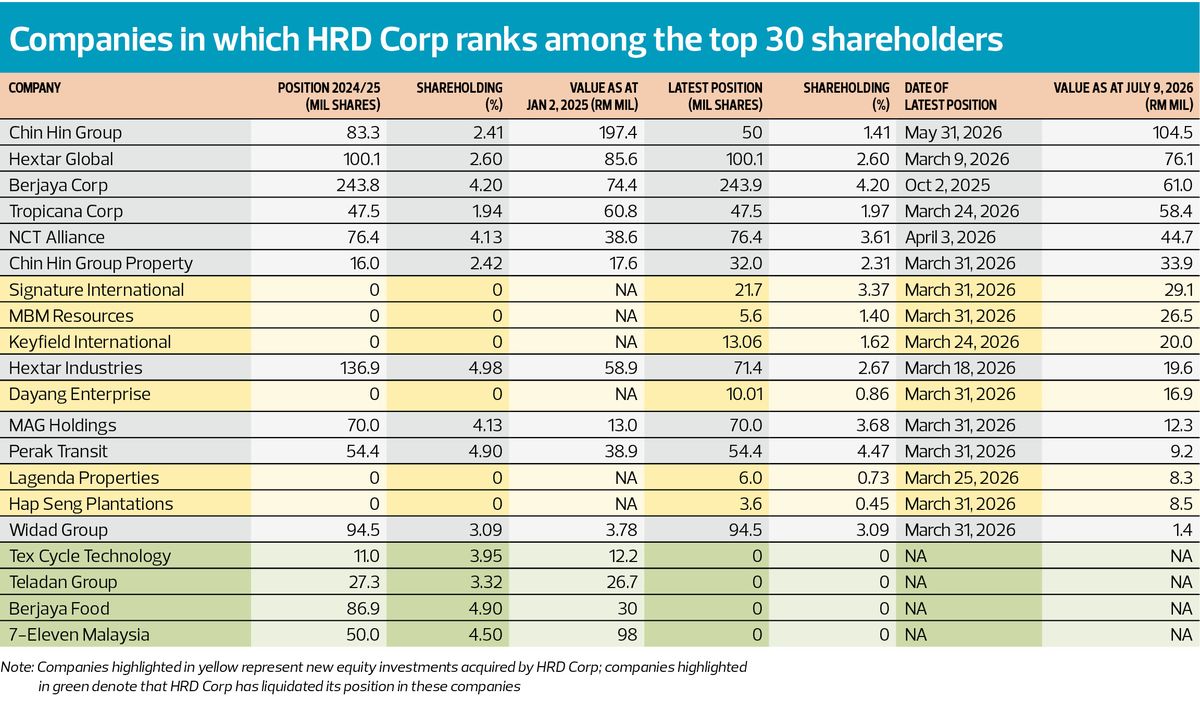
A review of HRDC’s shareholdings disclosed in the annual reports of listed companies suggests that most of its investments are in second- and third-tier companies on Bursa Malaysia. HRDC does not rank among the top 30 shareholders of any blue-chip companies on the local bourse.
The credible companies in which HRDC ranks among the top 30 shareholders include MBM Resources Bhd (KL:MBMR), Dayang Enterprise Holdings Bhd (KL:DAYANG), Keyfield International Bhd (KL:KEYFIELD) and Hap Seng Plantations Holdings Bhd (KL:HSPLANT), all of which were added to its portfolio last year.
These holdings account for only a small portion of HRDC’s overall portfolio, with the bulk of its investments in stocks that institutional funds would typically avoid.
In addition, it has shares in companies that are ultimately linked to a common shareholder. For instance, HRDC has 50 million shares in Chin Hin Group Bhd (KL:CHINHIN), 32 million shares in Chin Hin Group Property Bhd (KL:CHGP) and 21.7 million shares in Signature International Bhd (KL:SIGN). Both Chin Hin Property and Signature are part of the Chin Hin group.
HRDC also has investments in two companies under the Hextar group: Hextar Global Bhd (KL:HEXTAR), in which it holds 100.1 million shares, or a 2.6% stake; and Hextar Industries Bhd (KL:HEXIND), in which it holds 58.9 million shares.
HRDC used to have exposure to three companies under the Berjaya group and still has 243.9 million shares in Berjaya Corp Bhd (KL:BCORP) valued at RM61 million.
Based on the latest annual reports, HRDC is no longer among the top 30 shareholders in Berjaya Food Bhd (KL:BJFOOD) and 7-Eleven Malaysia Holdings Bhd (KL:SEM).
Unanswered questions
To be fair, the current management of HRDC, led by Mohamed Shamir, inherited the current investment portfolio, particularly the put and call options.
Prior to 2020, HRDC’s investments in quoted shares were made through direct purchases of equities, with no put and call options involved.
Why the change in strategy? Why not simply undertake direct share purchases if HRDC believes it is a worthy investment?
Since 2023, HRDC has also invested RM272.4 million in RCCPS, although the issuer or issuers have not been disclosed.
RCCPS are instruments typically used by sophisticated investors and give holders the option to convert their holdings into equity. But the rationale for investing in RCCPS remains unclear. Why not simply purchase shares from the market?
According to sources, HRDC no longer enters into put and call options for its equity investments and is not considering investments in instruments meant for sophisticated investors.
When existing put and call options expire, HRDC generally does not renew them. “The challenge is how it will unwind the older investments tied to put and call options. It will depend on the counterparty’s ability to fulfil its obligations under the put and call options,” says a fund manager.
Read also:
Cover Story: Inside HRD Corp’s accounts
Save by subscribing to us for your print and/or digital copy.
P/S: The Edge is also available on Apple's App Store and Android's Google Play.