


This article first appeared in The Edge Malaysia Weekly on July 13, 2026 - July 19, 2026
AFTER lagging stocks in sectors such as technology in the second quarter amid concerns over the Middle East conflict, Malaysia’s banking stocks are emerging as an attractive defensive play again, analysts say.
Despite fresh unrest in the Middle East last week, with the US and Iran trading strikes amid a supposed ceasefire, AmInvestment Bank Research’s Chan Jit Hoong believes the investment case for banking stocks remains intact as valuations are compelling and yields are attractive. Moreover, asset quality risks are likely to be manageable if the situation is not prolonged.
“We are doubling down on our ‘overweight’ stance on banks,” the banking analyst tells The Edge.
A quick check with other research houses shows that at least six of them also have a positive recommendation on the sector, with Public Bank Bhd (KL:PBBANK), RHB Bank Bhd (KL:RHBBANK) and Hong Leong Bank Bhd (KL:HLBANK) the most frequently cited as the top picks.
Chan’s bullishness is partly driven by investor positioning. Local funds’ exposure to the banking sector has slipped to 17.7% from a year-to-date peak of 21.6% in March, he says, citing the research house’s internal data. The lighter positioning suggests much of the recent caution is already reflected in the share prices and leaves room for investors to rotate back into the sector as uncertainty eventually subsides. ‘Positioning-wise, banks have underperformed some of the sectors out there, like tech,” he says. “Why not spread some love back to banks?”
Banking stocks — except for Public Bank — fell in the second quarter, dragging the Bursa Malaysia Financial Services Index down 2.1%. Public Bank gained 2.6% while Bank Islam Malaysia Bhd (KL:BIMB), the biggest decliner, shed 12.1%. The Technology Index, meanwhile, shot up 47.6%.
While oil prices surged again last week following the fresh attacks, Chan notes that crude prices remain below US$85 a barrel, which eases asset quality stress. “As long as we’re nowhere close to US$120 or above [that] for a prolonged period, we should be okay. Many banks quoted this as their pain threshold,” he states.
Brent crude has remained largely below US$80 since June 19, retreating towards its pre-conflict levels as supply disruptions eased not long after the ceasefire agreement. It briefly touched US$80 last Wednesday (July 8) before falling back to around US$76 the next day as investors weighed whether the latest hostilities were a temporary escalation or evidence that the ceasefire was breaking down.
While consensus expectations are that the banking industry’s gross impaired loan (GIL) ratio will edge higher this year, Chan says recent conversations with at least four banks suggest that stress among borrowers remains contained. Notably, the take-up for rescheduled and restructured (R&R) loans has been “rather muted” while applications under the SME Stabilisation Relief Facility (SRF) have also been limited.
“These are all good signs,” he says. “It signals that asset quality is still okay and likely won’t deteriorate to concerning levels.” The banking system’s GIL ratio rose to 1.43% in May from 1.40% the previous month.
Chan notes that some banks have high provision buffers in place, with a few — including Malayan Banking Bhd (KL:MAYBANK) and Alliance Bank Malaysia Bhd (KL:ABMB) — having already strengthened their provision buffers for the Middle East war, leaving them well-placed to absorb any deterioration in asset quality should macro conditions worsen.
Last Thursday, the Ministry of Finance said that about RM1 billion of the RM5 billion SME Special Relief Fund introduced by Bank Negara Malaysia in April had been approved as at June 25, benefiting 1,500 small and medium enterprises (SMEs), while banks had processed over RM4.7 billion in R&R loans for more than 1,000 borrowers since late April.
Chan notes that bank share prices have yet to recover meaningfully from the sell-off triggered by the geopolitical tensions, suggesting much of the concern over asset quality has already been reflected in prices. “I do not expect stocks to come off significantly from this level,” he opines. Although the outlook depends heavily on how the Middle East conflict evolves, Chan believes the market may already have discounted much of the downside.
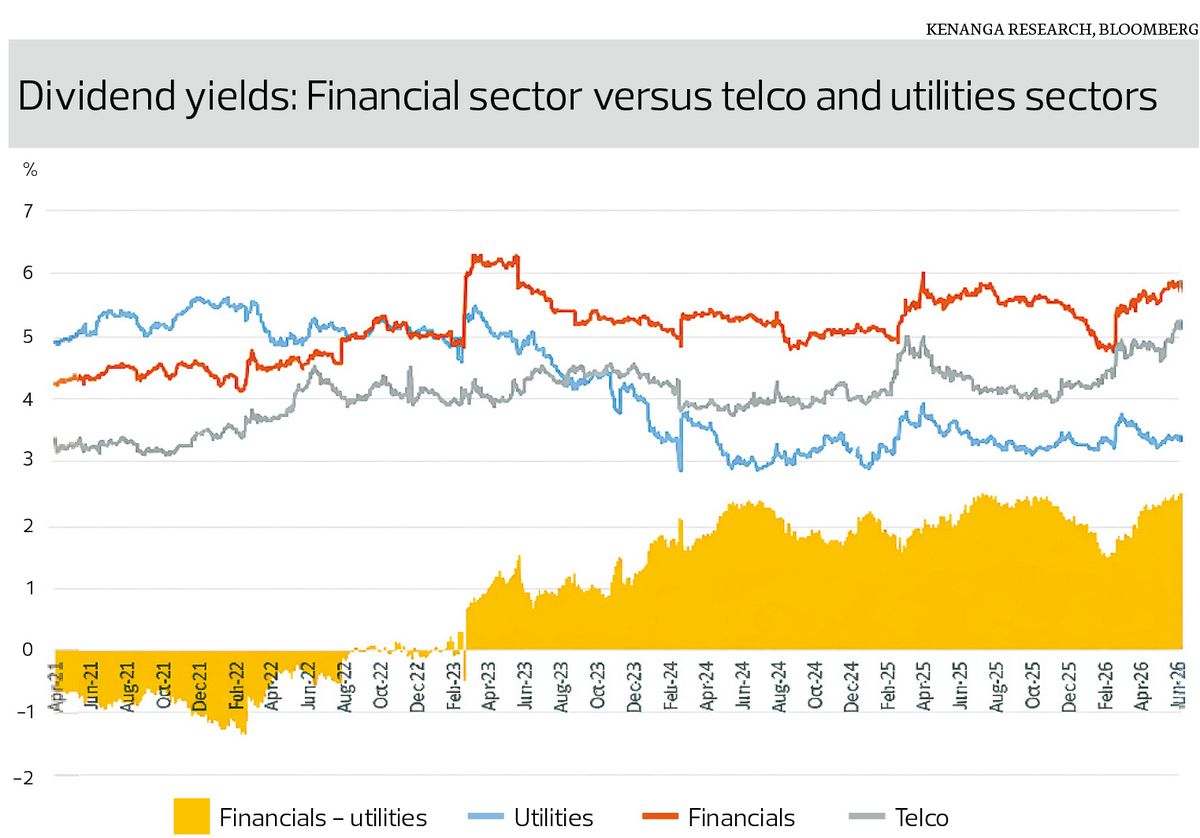
Dividend income is another attraction, with the sector currently offering yields of around 6%, which Chan describes as “attractive and compelling”.
Beyond regular dividends, he continues to see capital management as an underappreciated catalyst for parts of the sector. Public Bank has already demonstrated its willingness to return excess capital while CIMB Group Holdings Bhd (KL:CIMB) remains committed to its capital management plans. Its restructuring in Thailand also frees up additional capital for special dividends, he says.
Chan believes both Hong Leong Bank and Hong Leong Financial Group Bhd (KL:HLFG) maintain such capital-return optionality but he is of the view that the banks will do it in a progressive manner to sustain an upward payout trajectory. The two banks are his top picks for the sector.
Meanwhile, taking a contrarian view, Hong Leong Investment Bank Research (HLIB Research) last week downgraded the sector to a “neutral” from “overweight”, citing an absence of immediate near-term catalysts.
It anticipates two potential headwinds for the banking sector in the second half, namely asset quality deterioration and index-related overhang.
“Statistical analysis suggests global supply chain disruptions lead deterioration in industry GIL ratios by around 12 months while domestic inflation provides an earlier indication of credit stress. Although banks maintain a healthy RM4.1 billion management overlay (2.6 times cover on 2025 aggregate provisions), sustained cost pressures could still test these buffers if macro conditions deteriorate,” HLIB Research points out.
“Separately, the proposed expansion of the FBM KLCI to 50 constituents [from 30] introduces an additional short-term headwind, with lower sector index weightings potentially creating a transitory overhang for banking stocks that are currently represented in the bellwether index. We downgrade the sector … considering [that] the current valuations already largely reflect the optimism surrounding capital management,” it adds.
HLIB Research’s top pick for 2H2026 is Alliance Bank, citing its “resilient” earnings outlook and possible inclusion into the expanded FBM KLCI.
Kenanga Research, which has an “overweight” rating on the sector, believes that the market will likely look at rotational plays in the near term, against a backdrop of potentially slower economic growth. It expects growth to moderate in 2H2026, albeit staying above 4%, compared to possibly 5% or higher in the first half (2025: 5.2%).
“In [our] 2Q2026 outlook, we have recommended investors to be cautious as to the timing of accumulating banks, which in hindsight was validated — the KLFIN index slid 2% in [that quarter]. We have renewed conviction now that banks offer very good risk-reward, given that their dividend yields as a sector have continued to see widening gaps versus other sectors,” its head of research Peter Kong says in its July 6 strategy report for 3Q2026.
“The tone across several anchor banks on dividends — despite still being at the time when the Strait of Hormuz situation was still on gridlock — remain relatively constructive over the 1Q2026 results season. This belief is reinforced now that provisions for [the] SME and retail segment is likely averted, which could help shield against some slippage from the revenue front amid some potential net interest margin pressure. We believe also that banks would be in an ideal space to attract foreign interest amid the MY Value Up scheme,” he adds.
MY Value Up is a programme by the Securities Commission of Malaysia and Bursa Malaysia aimed at helping listed companies unlock shareholder value through better strategy disclosure, capital allocation and investor engagement.
Save by subscribing to us for your print and/or digital copy.
P/S: The Edge is also available on Apple's App Store and Android's Google Play.