

This article first appeared in The Edge Malaysia Weekly on July 13, 2026 - July 19, 2026
ESTABLISHED out of long-standing frustration over high airfares, AirBorneo Airways represents more than just a new airline for Sarawak. The state-owned carrier is part of a broader strategy to strengthen the state’s position within Asean, improve connectivity and give businesses easier access to regional markets.
It is an ambitious undertaking in an industry where success is far from guaranteed. Malaysia has seen several airlines collapse in recent years, including Rayani Air Sdn Bhd, MYAirline Sdn Bhd and SKS Airways Sdn Bhd, as mounting financial pressures exposed the unforgiving economics of an industry defined by thin margins and intense price competition.
AirBorneo believes, however, that it starts from a position of relative strength. Backed by the Sarawak government, the airline has access to longer-term financial support, allowing it to pursue a strategy that extends beyond short-term commercial returns.
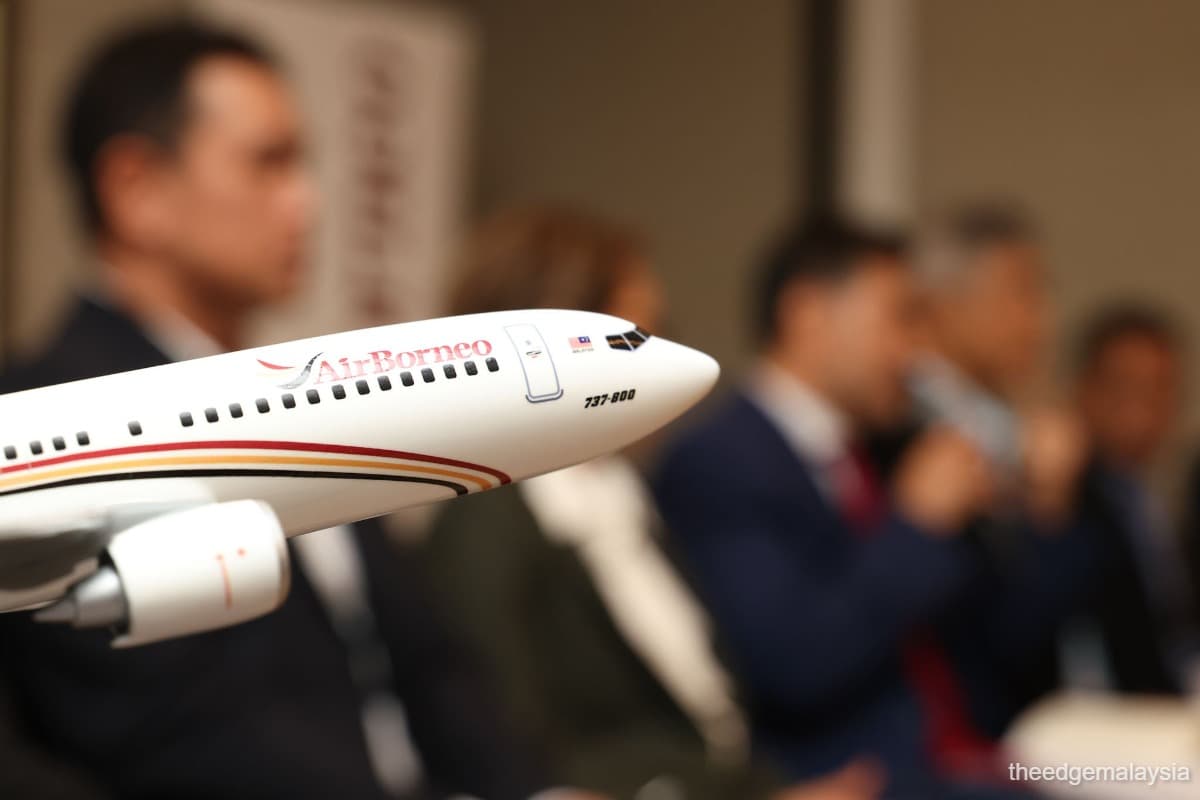
Positioning itself as a premium regional full-service airline, AirBorneo has woven Sarawak’s identity into its brand, from maroon cabin crew uniforms to a logo inspired by the hornbill.
“It’s still early days for AirBorneo. We’re still trying to find our footing. The past six months have been like running a marathon in 100m sprints,” CEO Megat Ardian Wira Mohd Aminuddin tells The Edge in an interview.

The former chief aviation and strategy officer of Malaysia Airports Holdings Bhd (MAHB), who also held senior roles at AirAsia, Malaysia Airlines and Saudi low-cost carrier Flynas, says the airline’s branding is closely tied to Sarawak. “The livery reflects the state’s colours. Even the logo incorporates the feathers of the hornbill.”
Megat Ardian says the airline’s strategy rests on two pillars: its network and the customer experience.
Unlike most commercial airlines, AirBorneo’s network is shaped by Sarawak’s priorities as much as market demand.
“First, our network is designed around Sarawak’s needs. Like any commercial airline, we study market demand, analyse data and benchmark ourselves against competitors,” he explains.
“But there are routes that are important to Sarawak that no other airline wants to operate because of limited commercial viability. That’s where AirBorneo comes in. We will provide that connectivity.”
The carrier also hopes to reduce travellers’ reliance on Kuala Lumpur and Singapore as transit hubs by introducing direct flights from Kuching to selected destinations across Southeast Asia. It is targeting a broad mix of passengers, including leisure and business travellers, students and medical tourists.
The second differentiator is the customer experience.
“AirBorneo will carry a Sarawak identity throughout the journey. The taste of Sarawak will be reflected in our products, including the inflight meals,” he says, adding that the airline is working with external catering partners. “We want people flying to and from Sarawak to experience the state’s culture and hospitality.”
AirBorneo inherited a fleet of 14 turboprop aircraft — eight ATR 72-500s and six DHC-6 Twin Otters — after the Sarawak government completed its acquisition of MASwings Sdn Bhd from Malaysia Aviation Group Bhd in January.
Six months on, the airline will begin jet operations on July 20 with two wet-leased Boeing 737-800s, offering twice-daily services between Kuching and Terminal 1 of the Kuala Lumpur International Airport, followed by a daily service from Kuching to Singapore. Under the arrangement, the aircraft come with crew, maintenance and insurance.
Configured with 12 business-class seats and 150 economy seats, the aircraft will initially offer an all-inclusive one-way economy fare of RM375 between Kuching and Kuala Lumpur, covering meals, baggage allowance, seat selection and airport taxes.
“With the RM375 fare, we want to help stabilise domestic airfares. Before launching the service, we studied market sentiment just like any other airline. We also sought incentives from airports and tourism bodies to support route development,” says Megat Ardian.
“We’ve factored everything into our planning — working capital, operating expenses and capital expenditure. Some routes will make money, others won’t. Ultimately, we’ll assess the network as a whole and see how it performs.”
Megat Ardian declines to disclose how much capital the Sarawak government has committed to the airline, saying only that funding has been allocated over the next five years.
Scale will ultimately determine the airline’s success, he says. “The larger our fleet, the more destinations we can serve and the more passengers we can carry. Higher revenue helps offset our fixed costs.”
Still, rather than expand aggressively, AirBorneo is taking a measured approach.
“We are starting with just two jets and will ramp up progressively. We have to make sure we’re operationally ready while maintaining service reliability,” Megat Ardian says.
AirBorneo’s five-year plan, released last week, envisages the fleet growing by one aircraft every quarter, reaching five jets by end-2027, nine by end-2028 and 17 by 2030.
One challenge facing airlines globally is securing aircraft on time, but Megat Ardian says AirBorneo is spreading its risk by negotiating with multiple lessors rather than relying on a single provider.
“We are talking to several lessors. The two narrow-body aircraft we’re starting with are just the beginning. As we grow towards a fleet of 17 jets, we will determine which type best suits our network. So, the 737s may not necessarily become our long-term core fleet.”
The acquisition of MASwings also brought across 293 employees, mainly pilots, cabin crew, engineers and other operational staff, who continue to operate the Rural Air Services (RAS) network using the existing turboprop fleet.
Jet operations required an entirely new workforce, which was built from scratch since Jan 1 this year and has 150 recruited so far.
Seamless between RAS and jets
For AirBorneo, the challenge is not simply to build a jet network but to integrate it with the RAS it inherited from MASwings. The airline’s hub-and-spoke strategy hinges on passengers experiencing the two operations as a single network, regardless of the aircraft they board.
“Passengers shouldn’t notice any difference between our jet operations and the RAS,” says Megat Ardian.
A visitor arriving in Kuching from overseas and connecting to Mulu, for example, should experience the journey as one continuous trip rather than a series of disconnected flights, he notes.
“You shouldn’t have to think about whether one sector is operated by a jet and another by a turboprop. That is where service reliability, customer experience and operational efficiency become critical.”
AirBorneo has designated Kuching as its jet operations hub, while Kota Kinabalu will remain the base for its ATR fleet and Miri for its Twin Otter operations.
As the fleet expands over the next five years, the airline is studying new domestic jet routes in Sabah and Sarawak, including services linking Kuching with Kota Kinabalu, Sibu, Bintulu and Tawau.
Beyond the domestic market, AirBorneo is targeting both Asean capitals and secondary cities before broadening its regional footprint.
“As we grow, we would also like to expand farther afield to destinations within a six-hour flying radius. Southern China and parts of the Philippines are among the markets we’re looking at,” says Megat Ardian.
Rationalising the rural network
Expanding its jet operations is only part of AirBorneo’s task. The airline is also reviewing the RAS network, where some routes remain underutilised, making it difficult to deploy aircraft efficiently.
“We have quite a number of flights with low load factors. On some ATR services, only half of the 68 seats are occupied. On certain Twin Otter flights, we may have only two passengers on a nine-seater aircraft.
“Our plan is to consolidate some services and reduce frequencies where demand is weaker, while protecting routes and flight timings that continue to attract strong demand,” says Megat Ardian.
The aim is not simply to cut the number of flights, but to improve reliability across the network.
“Reducing some frequencies gives us more time for aircraft maintenance and serviceability. Ultimately, that improves reliability and punctuality,” he adds.
This follows a recent surge in unannounced flight delays and cancellations that stranded passengers and disrupted travel plans.
The rural network remains underpinned by public funding. As part of the MASwings acquisition, AirBorneo receives a fixed annual subsidy of RM209 million from the federal government to operate RAS services across Sabah and Sarawak.
Megat Ardian says the funding will remain unchanged even if the airline adjusts its network.
“The RM209 million subsidy is fixed. Any changes we make to the schedule will first require approval from the Ministry of Transport under the public service obligation (PSO) agreement. We can’t make those changes unilaterally.”
AirBorneo’s expansion comes at a time when airlines across Asia-Pacific are grappling with higher fuel costs and growing geopolitical uncertainty, squeezing profitability just as the industry was recovering from the Covid-19 pandemic.
The recent rise in oil prices, following tensions in the Middle East, has added fresh pressure to carriers already operating on razor-thin margins. According to International Air Transport Association (IATA) data, global airlines were generating net profit margins of 4.2% in 2025 before the recent spike in fuel costs. That figure has since fallen to 2%.
For now, AirBorneo has opted not to hedge its fuel purchases.
“We have seen fuel costs increase, but the impact has been manageable because we’ve budgeted for it,” he says. According to S&P Global Platts spot assessments, jet fuel averaged US$119.13 per barrel as at July 3, 2026, up 32.2% from a year earlier.
With jet operations only just beginning, the airline is deliberately limiting its exposure.
“That is one reason we’re starting with just two narrow-body aircraft. We know what our exposure is and we have already factored it into our budget. We’re also managing costs through operational efficiencies, careful resource allocation and negotiations with suppliers and vendors.”
Whether AirBorneo eventually adopts a fuel hedging programme remains under review. “Hedging isn’t just about saving money; it’s about providing stability and predictability. That’s the thinking behind it,” says Megat Ardian.
Fleet renewal, meanwhile, is already under way.
AirBorneo has placed a firm order for eight new ATR aircraft — five ATR 72-600s and three ATR 42-600s — to replace its ageing ATR fleet. Deliveries are scheduled between 2027 and 2029.
The existing ATR aircraft will eventually be disposed of through a request for proposal (RFP) process. “We’ll evaluate who offers the best value and what options are available in the market,” says Megat Ardian.
The airline has no immediate plans to replace its DHC-6 Twin Otters, which are between 10 and 12 years old. “We expect to continue operating them for another three to four years before issuing an RFP. There are several manufacturers offering 18- and 19-seater aircraft in this category. When the time comes, we will assess which aircraft is best suited to our network,” he says.

A cautious outlook for airlines
Wong Hong, director-general of the Association of Asia Pacific Airlines (AAPA), believes the industry is unlikely to return to a more stable operating environment before 2027.
Even then, airlines may have to adapt to structurally higher operating costs if oil prices remain elevated.
“If oil settles at US$100 per barrel instead of US$90, airlines will have to decide whether to absorb part of the increase or pass some of it on to passengers,” he tells The Edge in a separate interview.
Higher fares could eventually dampen demand, particularly if households become more price-sensitive.
“People may choose closer destinations or travel less often. Instead of taking three holidays a year, they might take two,” says Wong.
So far, however, demand has remained relatively resilient.
“Bookings are still holding up, although we saw some softening in May,” he says. Preliminary traffic figures from AAPA showed that the region’s carriers carried 31.7 million international passengers in May 2026, down 1.1% from a year earlier.
“Travel in June, July and August should remain relatively resilient because those trips were booked earlier and coincide with the northern hemisphere summer holiday season. But it’s much harder to predict what happens from September onwards.”
Asked whether the industry believes the worst is over, Wong is cautious. “No one is in a position to say that. Everyone hopes the situation improves, but events in the Middle East remain highly unpredictable. Nobody knows what might happen tomorrow.”
Save by subscribing to us for your print and/or digital copy.
P/S: The Edge is also available on Apple's App Store and Android's Google Play.