

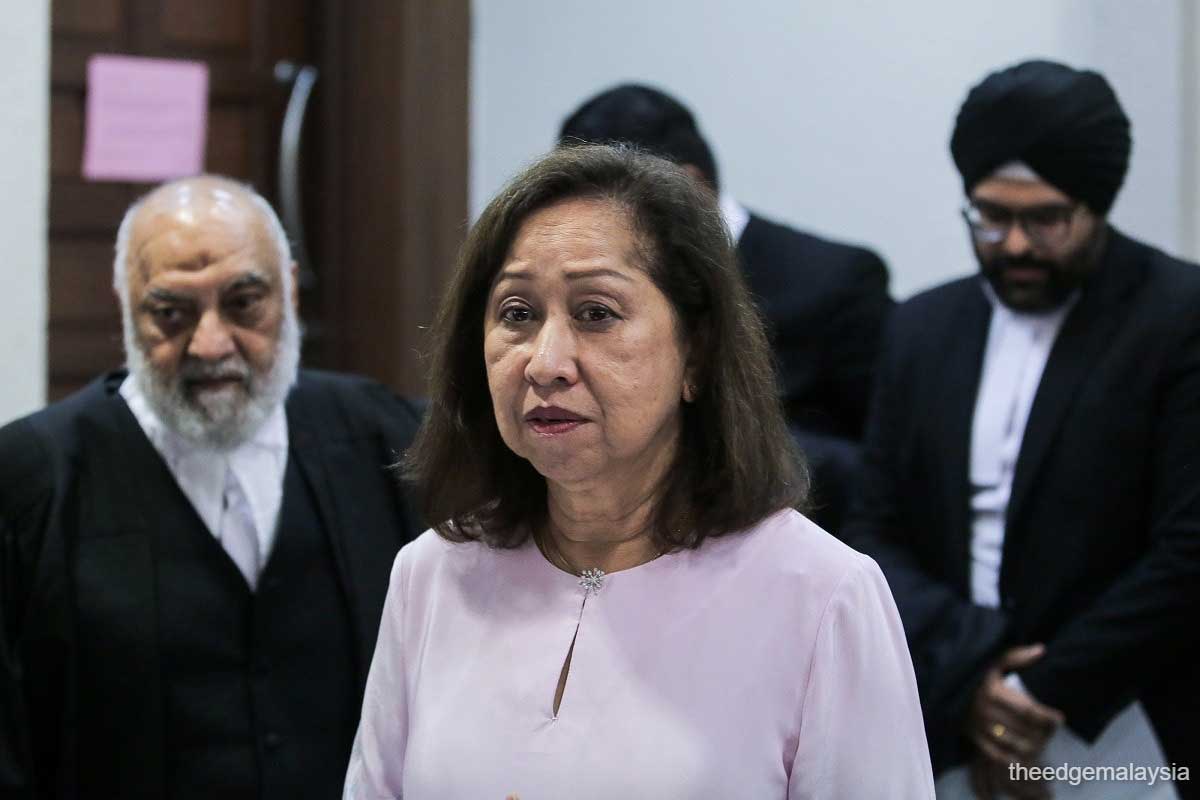
SHAH ALAM (July 14): The High Court heard that Tun Daim Zainuddin and his wife Toh Puan Na’imah Abdul Khalid faced a new tax investigation in January 2024, despite having settled a previous tax probe in November 2023 by paying RM31.498 million in additional taxes for the 2017, 2018 and 2019 assessment years.
Despite the earlier settlement, Na’imah is facing an additional RM313.8 million tax claim from the Inland Revenue Board, which alleged that she had failed to declare income used to acquire and generated from three overseas properties worth US$178 million (RM700.57 million) — Nantasket Beach Resort, Chauncy Place, and Hotel Buckminster and Annex in the United States.
Datuk S Saravana Kumar, Na’imah’s lawyer, said Daim and Na’imah had filed joint tax assessments, meaning no separate taxable income was assigned to Na’imah. However, the IRB began investigating them and their family members in June 2023.
Although they later settled the tax issue by paying RM31.498 million in November 2023, Saravana Kumar said the IRB reopened the investigation in January 2024 and imposed an additional RM313.8 million tax claim on Na’imah.
The IRB alleged that Na’imah had used assets linked to Ilham Baru Sdn Bhd, Ilham Tower Sdn Bhd and Wellberton Private Equity Corp as loan collateral, claiming these assets were acquired using unreported income.
Saravana Kumar argued that the assets were overseas properties acquired more than 20 years ago, and no income from them was received in Malaysia. He also maintained that Daim’s wealth was legally earned.
“Na’imah’s husband (Daim) had earned his money properly and legitimately and as affirmed by former prime minister Tun Dr Mahathir Mohamad that Daim was already a millionaire when he joined the Cabinet, and as Cabinet minister he had been cleared by the anti-corruption agency and IRB.”
“The three assets in question (used as collateral) are assets that were foreign situated, no income from those assets had ever been received in Malaysia and that they were acquired more than 20 years ago,” the lawyer said.
Saravana Kumar, who appeared with lawyers Nur Amira Azhar and Dharshini Sharma, said that by requiring Na’imah to pay additional tax for the same year of assessment (2018), the IRB appeared to have acted beyond its statutory jurisdiction, misconstrued and misapplied the Income Tax Act, and used its investigatory powers for an improper collateral purpose.
He added that the IRB had also allegedly breached established principles of administrative fairness, natural justice and legitimate expectation, and had engaged in conduct that, when viewed holistically, was oppressive, irrational and legally unsustainable.
“Furthermore, Na’imah’s accounts had been frozen, yet IRB raised additional tax for her to pay — RM313.8 million. That is why we come to court before my lady as this is a fit and appropriate case for judicial intervention. We are not coming to court seeking favours but she has no chargeable income for her.
“The IRB’s decision to investigate the same subject matter and impose the tax, when it is already fully settled, is illegal and this judicial review should be allowed,” he added.
Furthermore, he said that companies and individuals are only required to keep records for a seven-year period, and that requiring her to now produce documents or recall events from 20 years ago regarding the acquisition was unreasonable, especially as the matter involved her late husband.
Daim passed away in November 2024.
IRB counsel: Additional tax relates to previously unreported income
Senior revenue counsel (SRC) Ahmad Isyak Hassan, who appeared with SRC Marina Ibrahim and revenue counsel Nur Farzana Muhammad Puat, said the additional tax was imposed following findings from the couple’s declarations relating to the Ilham Baru and Ilham Tower loans. He said the IRB sought evidence on how the couple had funded the acquisition of the foreign assets, alleging that they had lived beyond their means.
“The issue is how he managed to accrue the assets in foreign countries. That is the whole issue. What is the purpose of obtaining and owning those assets? What is the revenue that is not reported and the capital statement?” Ahmad Isyak asked.
He added that Na’imah had been given ample time to respond and had sought an extension, which was granted by the IRB. However, she had yet to provide the required details.
This led judge Evawani Farisyta Mohammad to ask how the IRB could make a claim based on the 2018 year of assessment when the alleged events occurred years earlier, and whether it was appropriate to impose additional tax for that year after a settlement had already been recorded.
Ahmad Isyak said this was due to the disposal of foreign assets, which the IRB only discovered in 2018. He said the IRB wanted to determine how the assets were acquired and where the funds came from.
He claimed that Daim had declared annual income of RM4 million, but questioned how he could have acquired overseas assets worth hundreds of millions of ringgit.
Ahmad Isyak added that there was a discrepancy between the reported income and the value of the assets.
“There is unreported revenue and also discrepancy on the reporting of income,” he said, adding that this required explanation.
Furthermore, Ahmad Isyak said that Na’imah had also filed an application to refer the matter to the Special Commissioners of Income Tax (SCIT), and therefore the appropriate forum should be the SCIT rather than through a judicial review.
He reiterated that the IRB had conducted a review in 2023 following concerns over unexplained wealth linked to the acquisition of the US properties, as the income used to acquire the assets had allegedly not been fully declared.
Evawani Farisyta asked whether the applicant, Na’imah, had provided the necessary documents. Saravana Kumar replied that the documents were with the Malaysian Anti-Corruption Commission. The judge then asked Ahmad Isyak whether the IRB had requested the documents from the MACC, to which he replied no.
“Although there are no documents, there is no explanation as to how those assets are acquired and there has been ample opportunity and time given to explain,” the senior revenue counsel added.
“The purpose now is to ensure that the reported income tax is correct,” Ahmad Isyak said, adding the judicial review application should be dismissed.
Na’imah obtained leave (permission) to proceed with the judicial review, which was granted by High Court judge Dr Shahnaz Sulaiman, now a Court of Appeal judge, on April 22 last year. The court ruled that it was satisfied that there were legal issues to be considered. The matter is now being heard on its full merits before Evawani Farisyta.
The judge has fixed Aug 6 afternoon to deliver her decision.