

This article first appeared in The Edge Malaysia Weekly on July 13, 2026 - July 19, 2026
FOR more than two decades, Mi Technovation Bhd (KL:MI) has been quietly building its capacity to become one of the niche champions in the global semiconductor industry.
The company’s die sorting and inspection machines command a market share of more than 70% among Taiwan’s leading outsourced semiconductor assembly and test (OSAT) service providers while its high-performance solder ball materials have become an integral component in advanced semiconductor packaging, used by some of the world’s largest foundries and OSAT companies.
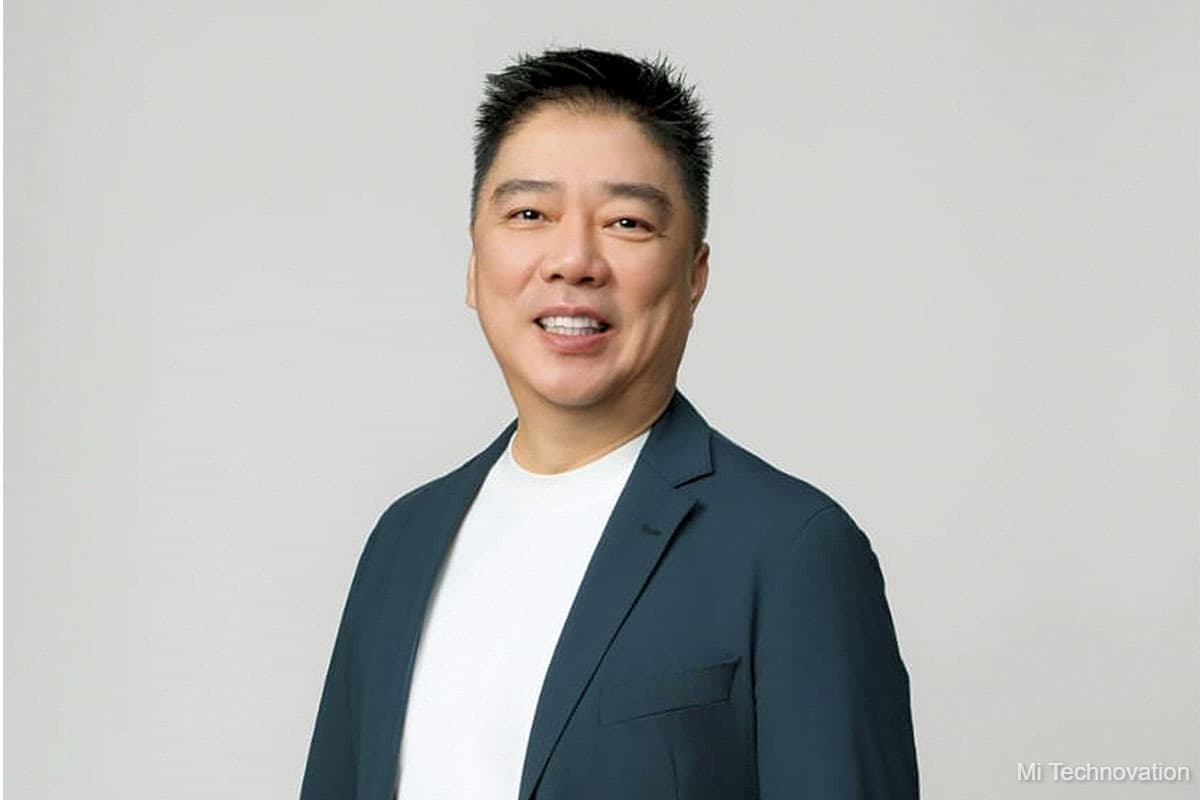
These two businesses have transformed the Penang-based group into one of Malaysia’s most successful semiconductor equipment companies. Yet its founder and group CEO Oh Kuang Eng believes that the company’s biggest achievements are yet to come.
Rather than merely defending its leadership position in semiconductor equipment, he is embarking on an ambitious reinvention — transforming Mi from an equipment manufacturer into a diversified semiconductor technology group involved in advanced materials, silicon carbide (SiC) power semiconductors and electric powertrain systems.
It is a strategy that Oh, a mechanical engineer with 28 years of experience in the semiconductor industry, has spent years planning. “The equipment and materials businesses are already able to run independently. My focus now is on building the next businesses that will define Mi over the next decade,” he tells The Edge.
The group’s earnings have been closely tied to the semiconductor capital expenditure (capex) cycle through its equipment division. But Oh wants its proprietary technologies and products to gradually become key contributors to its earnings, reducing its reliance on the inherently cyclical wafer fabrication investment cycle.
To achieve that, Mi has reorganised itself around four strategic pillars — the semiconductor equipment business unit (SEBU), semiconductor materials business unit (SMBU), semiconductor technology business unit (STBU) and vehicle technology business unit (VTBU). The latter two were recently carved out of its semiconductor solutions business unit (SSBU), underscoring management’s intention to develop them into standalone growth engines.
Together, the four pillars make up what Oh describes as Mi’s blueprint to evolve from an equipment supplier to a globally recognised semiconductor technology player.
Moving up the value chain into silicon carbide wafers
The centrepiece of Mi’s transformation is STBU. Unlike its traditional equipment business, which supplies manufacturing tools to chipmakers, the business unit aims to develop and commercialise semiconductor devices of its own under a fabless model.
The first two generations of 6in silicon carbide MOSFETs (metal-oxide-semiconductor field-effect transistor) — dubbed Vanda 1 and Vanda 2, and marketed under Mi’s MiSE brand — are being developed in Taiwan. Meanwhile, its engineers are already working on a third-generation platform based on 8in wafers, which is expected to be developed in collaboration with Singapore’s Agency for Science, Technology and Research.
A MOSFET is a semiconductor device primarily used as an electronic switch to amplify or control the flow of electrical power.
Silicon carbide MOSFETs are increasingly used in applications requiring higher power efficiency, including electric vehicles, renewable energy systems, artificial intelligence (AI) data centres and industrial power infrastructure. They can operate at higher voltages and temperatures than conventional silicon chips while reducing energy loss.
Mi’s first-generation device has entered pilot production and is undergoing an extensive qualification programme. Commercialisation is expected in the first quarter of next year if everything goes according to plan.
Instead of directly taking on industry leaders such as Wolfspeed, Infineon Technologies and STMicroelectronics, which continue to push the performance frontier, Oh has deliberately chosen a more measured market entry. Mi is targeting performance comparable with established fourth-generation silicon carbide devices, allowing it to compete on a combination of performance, cost and supply chain diversification.
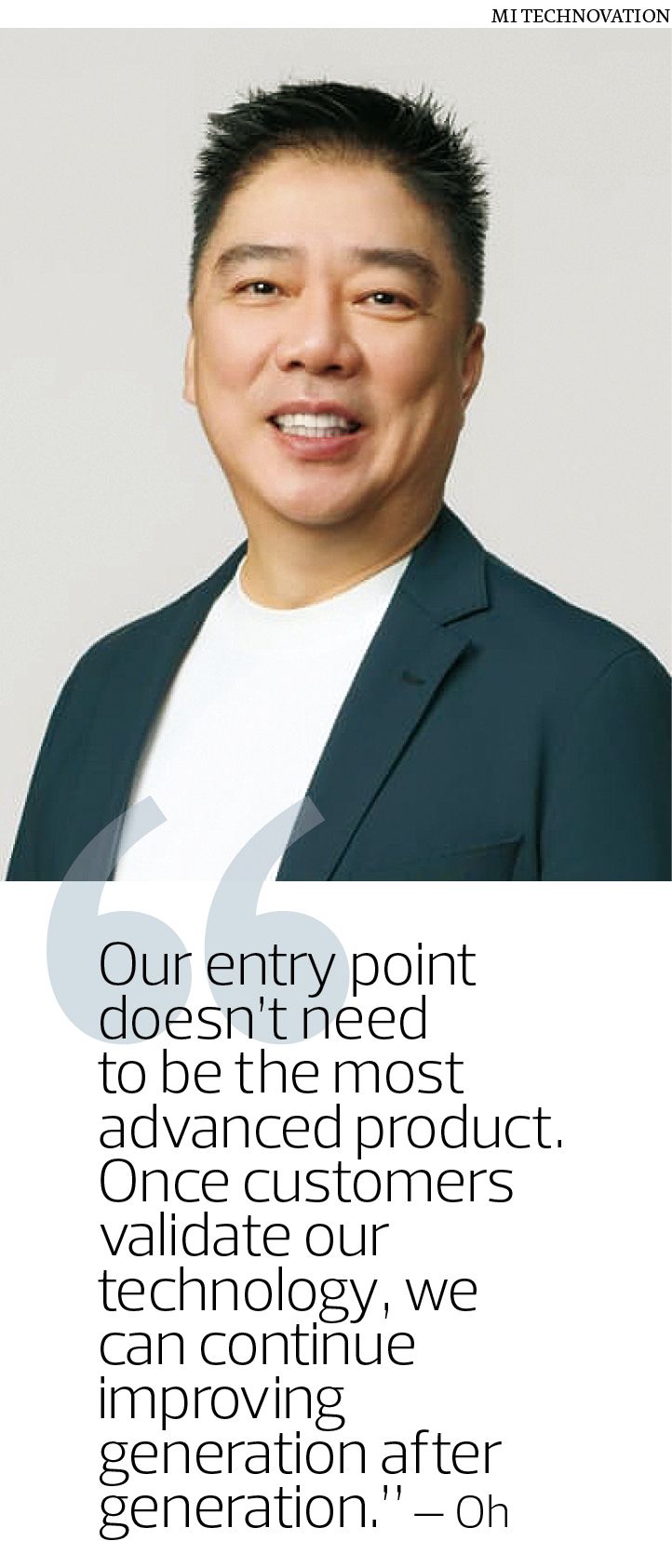
“Our entry point doesn’t need to be the most advanced product. Once customers validate our technology, we can continue improving generation after generation,” he says.
Several customers in Taiwan and China are already evaluating the devices while Mi’s VTBU is expected to become one of its earliest internal customers.
Even then, management intends to keep commercialisation deliberately selective. Rather than chasing rapid sales growth, the company plans to work with only three to five strategic customers in 2027 and 2028 to establish a track record before expanding to the wider market. For Oh, proving reliability is more important than maximising early revenue.
Electric powertrains become the proving ground
The group’s VTBU, housed under Singapore-based Ohima International Pte Ltd, is the second pillar of its long-term strategy. The business develops integrated electric powertrain systems for heavy-duty mining trucks, combining proprietary electronics, software and, eventually, Mi’s own silicon carbide power devices.
Commercial momentum is beginning to build with the VTBU securing 26 orders in the first half of this year and targeting deliveries of between 45 and 55 systems for the full year. Each electric powertrain system sells for roughly US$40,000.
But Mi’s immediate objective is not profitability.
That is because every deployed vehicle serves as a real-world testing platform, generating valuable operating data on software stability, thermal management and component durability. The information will be used to support broader commercial adoption while validating the company’s silicon carbide technology under demanding operating conditions.
Oh believes the market opportunity is considerably larger than the current sales suggest. He cites a mining customer that operates about 7,000 trucks as an example, pointing out that roughly half of those vehicles will eventually need to be electrified under China’s decarbonisation policy.
“No customer converts everything overnight. They do it in phases. But when you multiply that across many mining operators, the opportunity becomes very large,” says Oh.
Mi is targeting annual revenue of US$20 million by 2028 for VTBU, which is equivalent to about 500 powertrain systems annually, a relatively modest volume compared with the addressable market that management believes is available.
Following the ecosystem
Mi’s operations are increasingly regional as it expands beyond equipment manufacturing. Its research and development now take place in Taiwan, Singapore, China and Malaysia, reflecting management’s belief that semiconductor innovation is ultimately driven by access to specialised talent and mature supply chains rather than geography.
“If we don’t have the people or supply chain, we go where they already exist. We learn, we build our own design and we bring the knowledge back,” says Oh.
China, in particular, often attracts attention because of the scale of its manufacturing.
“People always think we’re going to China because the labour is cheaper. That’s not the reason. We go there because they already have the ecosystem, the engineers and the supply chain,” says Oh.
Developing sophisticated semiconductor products requires close collaboration between chip designers, materials suppliers, packaging specialists and manufacturing partners. Without the ecosystem, product development can slow dramatically.
“In China, a prototype may take three months. In Malaysia, it could take a year because you don’t have the ecosystem,” he explains.
Rather than viewing China as a permanent manufacturing base, Mi sees it as a place to accelerate learning. Once product architecture, patents and intellectual property have been established, production can ultimately be located wherever it makes the most commercial sense.
“The important thing is not where you make it, but that you own the technology,” says Oh.
That philosophy underpins Mi’s broader ambition of becoming a regional technology company rather than one anchored to a single country. The strategy may also prove advantageous amid an increasingly fragmented semiconductor industry.
As a Malaysian-listed company with operations in several Asian markets, Mi believes it occupies a relatively neutral position that allows it to work with customers from different regions without being viewed as aligned with any particular geopolitical bloc.
The group’s growing technology portfolio reflects that ambition. Mi now holds 134 patents while another 110 are awaiting approval.
Investing before the payoff
The aggressive push into semiconductor devices and electric powertrains comes at a cost. Annual investment in STBU and VTBU rose sharply to about RM27 million in 2025 from roughly RM5 million in 2024, and is projected to increase further to between RM50 million and RM55 million in 2026 as the group ramps up prototype development, wafer fabrication and customer qualification programmes.
The increased spending is already weighing on earnings. For the first quarter ended March 31, 2026 (1QFY2026), the two divisions posted a combined segmental loss of RM7.65 million as Mi accelerated product development. Management expects losses to widen to RM56.3 million for the full year before easing to RM46.6 million in FY2027 and RM14.5 million in FY2028 as commercialisation gains traction.
For some investors, the widening losses may be difficult to overlook. Oh, however, views these as an inevitable investment in building a semiconductor business from the ground up.
Unlike semiconductor equipment, where products can be commercialised relatively quickly, semiconductor devices must go through multiple design iterations, wafer fabrication runs and lengthy qualification programmes before customers are willing to incorporate them into mission-critical applications.
“At the beginning, you test, fail, redesign and test again. That cycle costs a lot of money. But once you have a successful product, future improvements become much cheaper,” he says.
The long-term economics of the business justifies the upfront investment, he argues.
Once production reaches commercial scale, silicon carbide devices are expected to deliver gross margins of at least 40%, broadly in line with those of established fabless semiconductor companies. As development spending tapers off and production ramps up, the business is expected to move from investment mode to earnings generation.
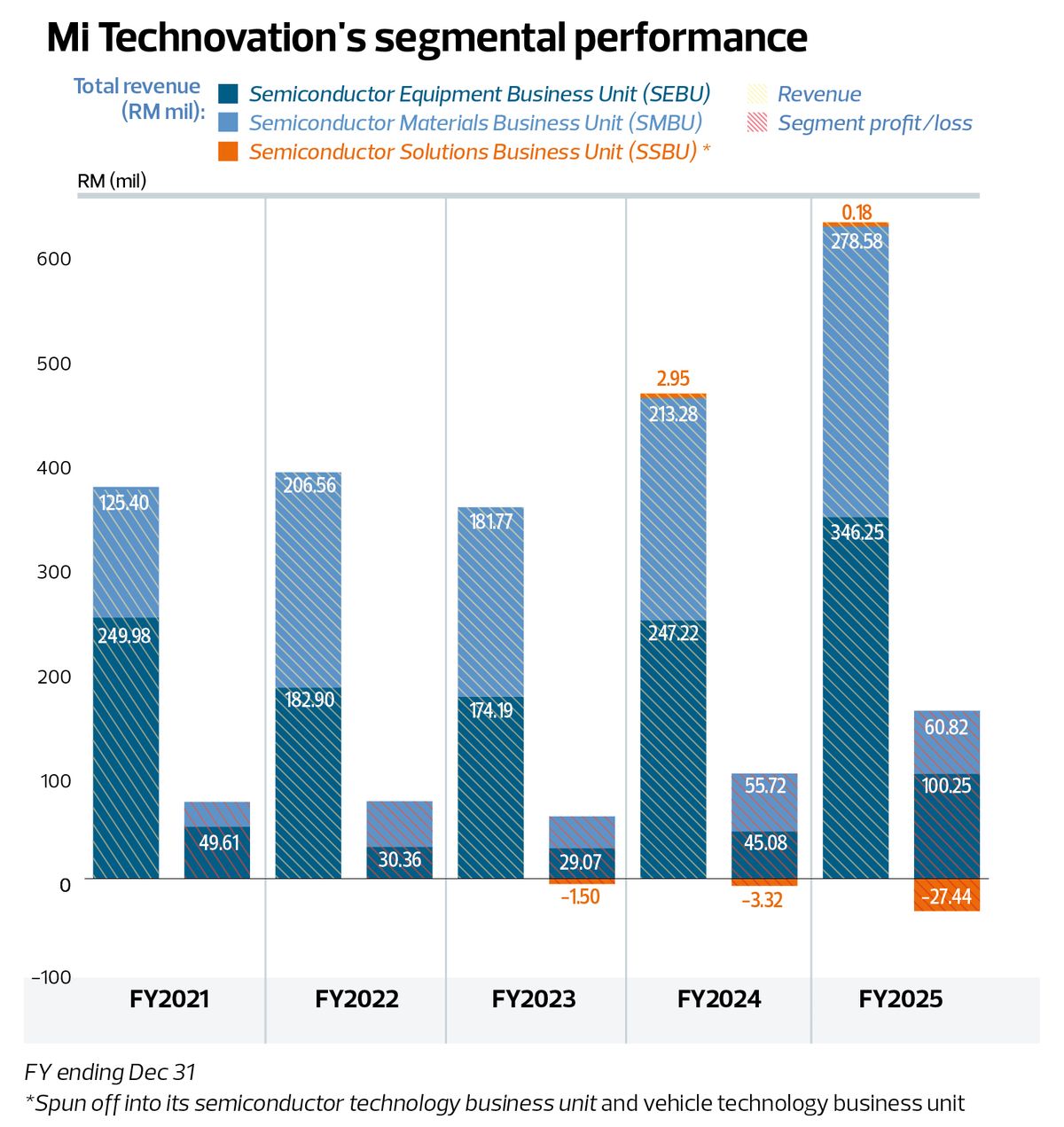
Looking further ahead, Oh sees STBU becoming Mi’s next major earnings pillar. His target is ambitious: annual revenue of about US$500 million (RM2 billion) between 2029 and 2038 from the semiconductor division alone. For perspective, the target is more than three times the group’s revenue of RM625 million in FY2025, when it posted a net profit of RM93.8 million.
A transformative acquisition
While investors have been paying close attention to Mi’s ambitions, one of the group’s biggest success stories has come from a business it acquired just five years ago. The April 2021 acquisition of Taiwan-based solder materials manufacturer Accurus Scientific Co Ltd for RM271 million was done via the issuance of new shares at RM3.65 apiece, a dilution of about 9.9% for the existing shareholders.
At the time, some questioned the rationale for the venture into semiconductor materials when Mi was better known for manufacturing die sorting equipment. Five years on, the investment appears to have paid off handsomely. Accurus’ revenue more than doubled to RM278.58 million in 2025 from RM125.40 million in 2021 while net profit surged to RM60.82 million from RM24.06 million.
The performance has transformed the materials division into one of Mi’s fastest-growing and most profitable businesses, providing both recurring earnings and a strategic foothold in one of the semiconductor industry’s fastest-growing niches.
Unlike the equipment division, whose earnings are tied more closely to customers’ capex cycles, solder materials are consumables. Every chip package requires solder balls to connect semiconductor dies to substrates, which creates recurring demand as semiconductor production volumes increase.
The recurring revenue stream also complements Mi’s equipment business. The company’s die sorting, inspection and bonding equipment are used in many of the same advanced packaging processes that consume Accurus’ solder materials, allowing it to engage customers across multiple stages of semiconductor manufacturing.
“The material business and equipment business complement each other. Our equipment is designed to process the chip with our materials, while our materials are developed with a deep understanding of how the equipment works,” says Oh.
The combination has become increasingly valuable as semiconductor packaging grows more sophisticated. Advanced packaging technologies such as wafer-level packaging, fan-out packaging and 2.5D integration require demanding material specifications, an area where Mi believes its expertise in both equipment and materials provides a competitive advantage over companies specialising in only one segment.
Unlocking value in Singapore
As the materials business or SMBU matures, Mi is preparing to unlock its value through a separate listing on the Singapore Exchange (SGX), with a targeted valuation of no less than RM1.5 billion for the unit, which will dilute its ownership to about 72.6% post-listing.
The dilution means the materials business will need to continue expanding to offset Mi’s reduced equity interest. The math shows that its earnings will need to grow by about 38% for the company’s share of the profits to remain unchanged after its stake falls to 72.6% from 100%.
For Oh, the listing is not just about capital raising. Singapore offers closer proximity to major customers and access to international investors, government research grants and a deeper semiconductor talent pool. It also allows the business to position itself alongside many of its multinational customers and research partners.
Meanwhile, the division is preparing for its next phase of growth with a new manufacturing facility in Senai, Johor. The first phase of the plant will add a monthly capacity of about 90 billion solder balls — equivalent to roughly 30% of the output of its existing flagship facility in Tainan, Taiwan. Commercial production is targeted for the first quarter of 2027 after customer qualification.
Rather than competing with the Taiwan operation, the Johor plant will complement it. Its initial production has effectively been earmarked for multinational front-end semiconductor customers based in Singapore, allowing Mi to shorten lead times while freeing capacity in Taiwan to serve new customers.
For Oh, the expansion reflects a broader strategy of building manufacturing closer to customers without disrupting the group’s established Taiwan operation — another step to transforming Mi from a Malaysian equipment maker into a regional semiconductor technology player.
AI remains a powerful tailwind
Oh believes the semiconductor industry’s current investment cycle still has several years to run, noting that in his discussions with major chipmakers and customers, global semiconductor manufacturing capacity is unlikely to catch up with demand until around 2030.
Working backwards, front-end wafer fabrication investments could begin moderating around 2028, with back-end packaging equipment demand remaining healthy until 2029 as new fabs gradually come on stream. That suggests capex supporting advanced packaging — Mi’s core business — should remain robust over the next few years, even if growth eventually normalises.
“The AI cycle will slow one day. Every technology cycle does. But before supply and demand reach balance, the industry still needs to build capacity,” he says.
Oh estimates that AI-related applications currently account for about 20% of equipment revenue and almost 30% of materials sales, with memory manufacturers such as Micron among the key customers benefiting from the surging AI demand.
Against that backdrop, management is targeting a compound annual growth rate (CAGR) of between 20% and 30% for its equipment business over the next three years, supported by continued investment in advanced packaging technologies.
The materials division, while expected to grow at a more measured pace of between 15% and 25% annually, offers a steadier earnings profile given its consumable nature. Unlike equipment sales, which are largely driven by customers’ capex cycles, solder materials generate recurring demand as semiconductor production volumes increase.
Oh describes the period from 2024 to 2028 as the company’s “planting” years, when the group invests aggressively. The following decade, from 2029 to 2038, will be the time to harvest the returns.
It is an ambitious vision that mirrors the transformation he has already overseen.
Since listing on Bursa Malaysia in 2018, Mi’s revenue has nearly quadrupled to RM625 million in FY2025 from RM160 million while net profit more than doubled to RM93.78 million from RM44.35 million. The group has maintained a consistent dividend policy over the years, with its payout ratio typically between 40% and 70%, even though its FY2025 dividend payout eased to 28% as management prioritised investing in its next phase of growth.
Oh remains Mi’s largest shareholder with 45.37% equity interest while his wife and group chief financial officer Yong Shiao Voon has an 11.3% stake. The group’s top 30 shareholders include a number of institutional investors, such as Hong Leong Asset Management, KAF Investment Funds, the Employees Provident Fund and Amanah Saham funds, as well as insurance funds run by the likes of AIA, Manulife and Great Eastern.
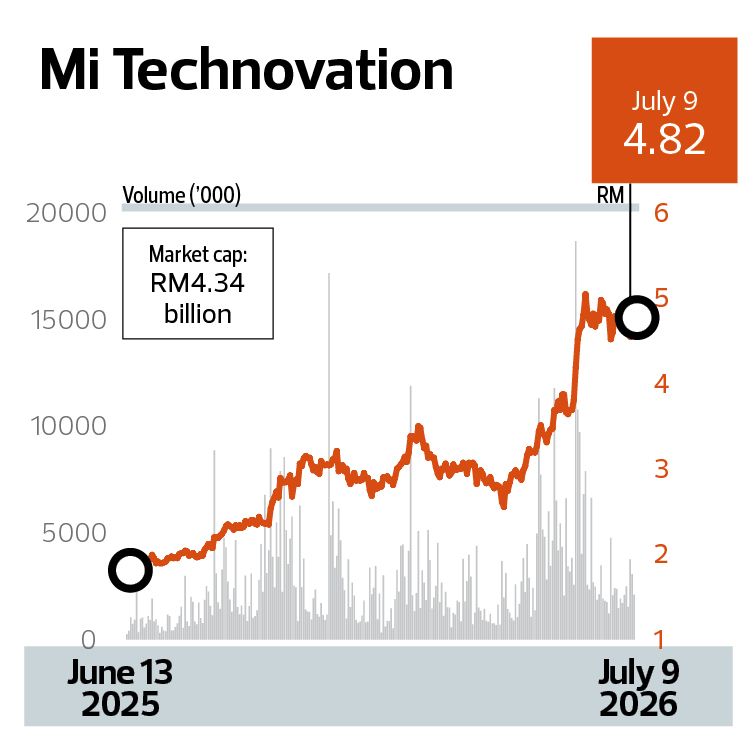
Mi’s share price touched an all-time high of RM5.05 on June 3 before easing to RM4.82 last Thursday, giving the group a market capitalisation of RM4.34 billion. The shares are trading at a trailing price-earnings ratio (PER) of 40.5 times and a forward PER of 34.4 times. Over the past 12 months, the stock has surged 151%, fuelled by investor optimism surrounding the AI-driven semiconductor up cycle.
Analysts remain optimistic about Mi’s prospects, with all five research houses covering the stock maintaining their “buy” calls, with their target prices ranging from as low as RM4.15 (CGS International) to as high as RM6.23 (Apex Securities). The consensus target price stands at RM5.52, implying an upside of about 14.5% from its last traded price.
Save by subscribing to us for your print and/or digital copy.
P/S: The Edge is also available on Apple's App Store and Android's Google Play.