


This article first appeared in The Edge Malaysia Weekly on July 13, 2026 - July 19, 2026
MALAYSIA’s chief statistician Datuk Seri Mohd Uzir Mahidin, who reached mandatory retirement age of 60 last Tuesday (July 7) after 36 years of public service and nine years at the post, is probably one prime example of public sector talents that countries with a higher retirement age might choose to keep on for a couple more years.
Singapore, which passed the “aged-society” (14% older people) threshold in 2021 and is on track to hit “super-aged” status this year once 21% of its population hits age 65 and above, for example, has raised its minimum retirement age to 64 effective July 1 this year and will further raise that to 65 by 2030. Those eligible are allowed re-employment up to 69 years old currently and 70 by year 2030.
Malaysia — which last raised its retirement age from 58 to 60 in 2012 and became an “ageing society” (7% older people) in 2021 — currently has no plans to further raise the retirement age, Communications Minister and government spokesperson Datuk Fahmi Fadzil told reporters last Wednesday (July 8). Last August, Putrajaya was reportedly studying the need to raise the retirement age to 65 under the 13th Malaysia Plan (2026 to 2030) to prepare the path towards an aged society.
The more pressing need is for Putrajaya to determine how it will implement public sector pension reforms while also ensuring that new civil servants — signed on three-year contracts since Feb 1, 2024 without a public pension promise, pending the formalisation of a new contributory permanent appointment scheme — can save enough for retirement.
No longer promising a pension to new civil servants is a bold political decision but that alone does not solve Putrajaya’s burgeoning public pension burden that was projected to reach RM120 billion a year by 2040.
Because of the long delay in arriving at the decision, there are already over 810,000 public pension recipients as at end-2024, up 100,000 from 710,000 in 2019 — a figure that includes both pensioners and derivative pension recipients, who are eligible because their spouse or legal guardian was a pensionable civil servant. The number will continue to grow for some years, given that most of the 1.3 million civil servants in active service are still eligible for public pension.
AAA-rated Singapore, for example, had incentivised most civil servants to convert from a defined-benefit (DB) pension scheme to a defined-contribution (DC) scheme under its Central Provident Fund (CPF) by the 1990s, having begun reforms in the 1970s and 1980s, before many people saw pension cheques.
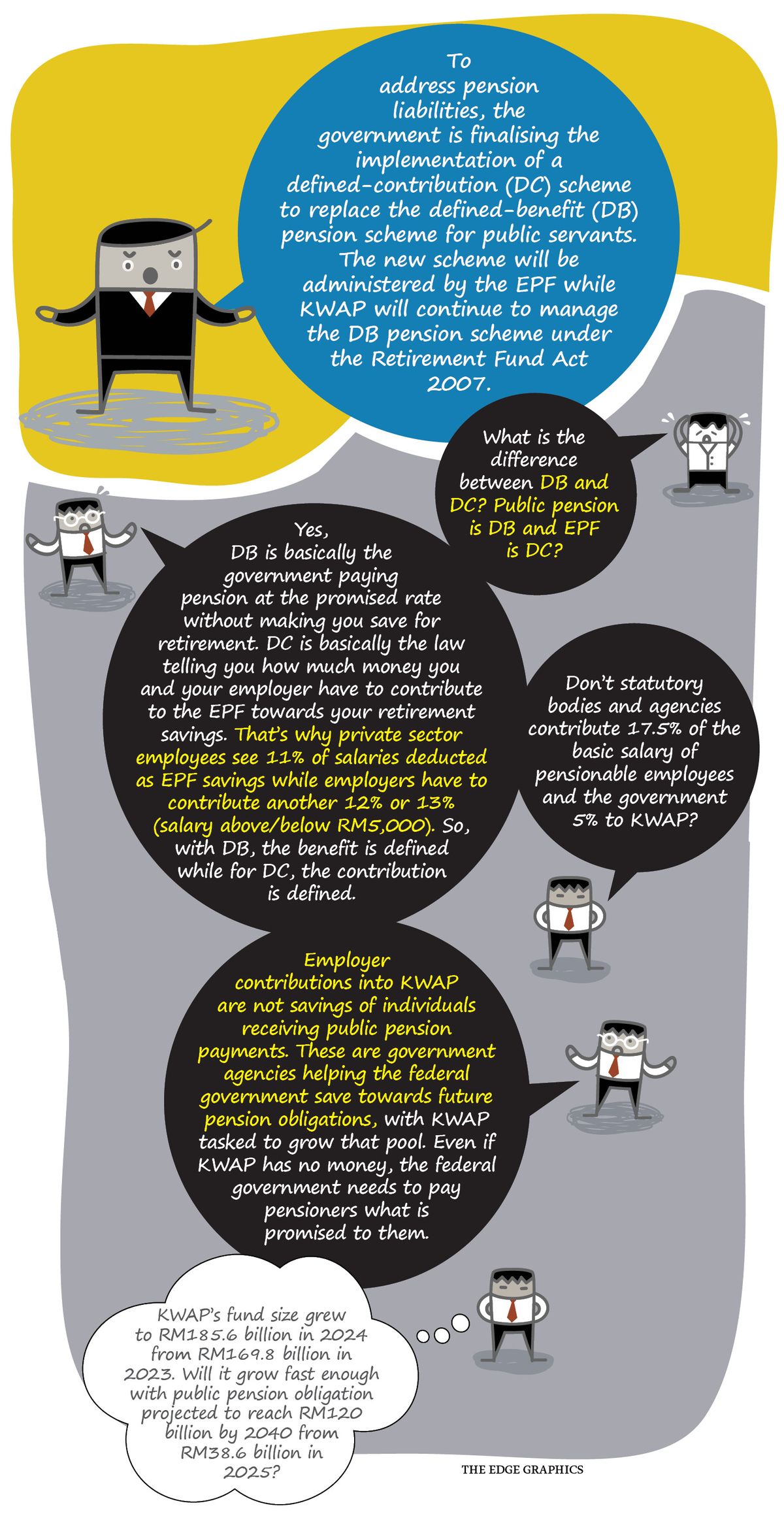
Being able to pull off a public pension reform at the current stage of demographics is no small feat for Putrajaya, which will need to fork out employers’ contributions for new civil servants who will automatically fall under the Employees Provident Fund’s (EPF) DC scheme.
That means new civil servants will likely have to contribute 11% of their salaries as statutory retirement savings with the EPF. It is understood that there may be a phased implementation towards the 11% to allow new civil servants some planning room. The recent civil service upward salary adjustment also provides room for implementation.
The federal government itself, or via statutory bodies and agencies, will need to contribute at least 12% or 13% of salaries of new civil servants under the DC scheme towards the latter’s retirement savings with the EPF. This is similar to what is currently required by law of private sector wage earners and their employers.
Retirement Fund Inc (KWAP) will continue to manage the DB pension scheme for civil servants who have been promised a pension under the Retirement Fund Act 2007.
While 489 statutory bodies, local authorities and agencies already contribute 17.5% of pensionable emoluments for 177,713 employees to KWAP as at end-2023, the money does not belong to those public sector employees who are eligible for public pension. Civil servants under the DB scheme with pension promise do not have salary deductions to save money with KWAP nor do they have the option to do so.
According to KWAP’s website, the federal government is supposed to contribute 5% of pensionable emoluments towards growing and pre-funding the pool to cover its future public pension obligation.
Actual contribution data to KWAP, however, indicates that the government has been contributing only RM500 million a year to KWAP between 2017 and 2023 while contributions from statutory bodies, local authorities and agencies to KWAP ranged between RM2.13 billion and RM3 billion during the period.
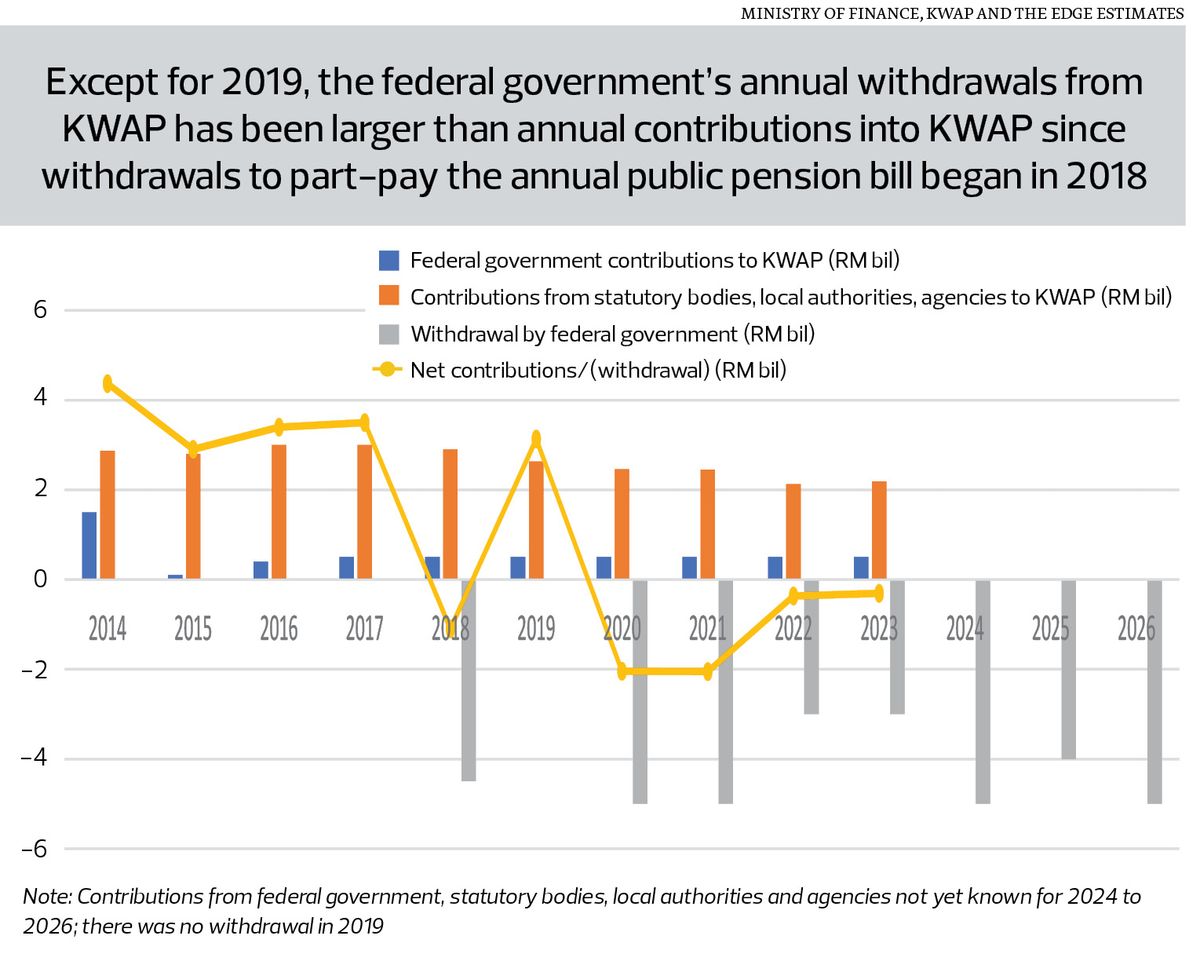
Except for 2019, Putrajaya has been withdrawing money from KWAP every year since 2018 to part-fund its annual public pension bill, official data shows. These withdrawals exceed the contributions received, resulting in a net withdrawal of as much as RM2.05 billion in 2022 (see chart). The lack of pre-funding in prior years means more work needs to be done going forward.
The fact that Malaysians are living much longer highlights the need to make haste on preparing for an aged society. Incidentally, former prime minister Tun Dr Mahathir Mohamad — who was just two months shy of 93 when he returned to head Putrajaya for a second term in May 2018 — turned 101 last Friday (July 10). He is one of more than 1,000 Malaysians living past 100.
Alongside public pension reform, Malaysia needs to also ensure more people are saving enough for retirement and successfully widen its social safety net to improve old-age income security. Otherwise, new civil servants without a pension — like many EPF members — may find themselves not having enough for retirement.
Save by subscribing to us for your print and/or digital copy.
P/S: The Edge is also available on Apple's App Store and Android's Google Play.