

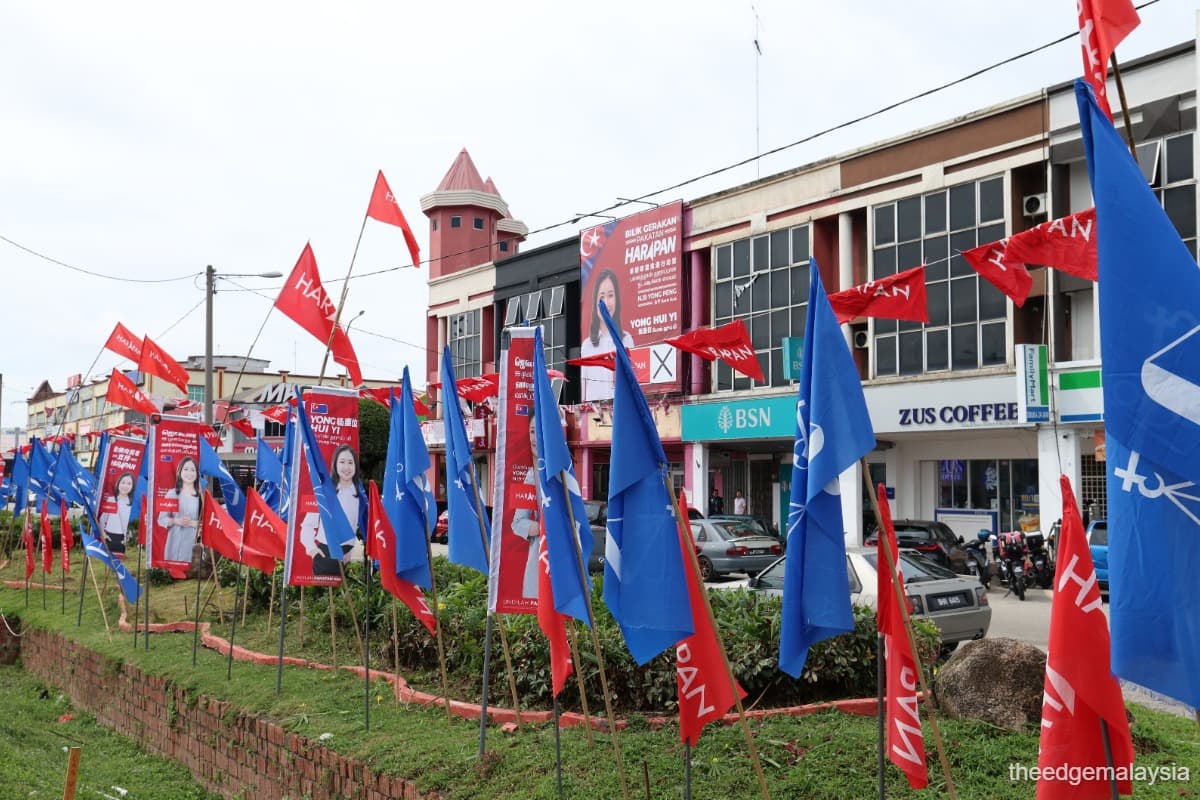
JOHOR BAHRU (July 10): Pakatan Harapan (PH) coalition is betting towards the end of the Johor election campaign that the deployment of its large grand campaigns could lift turnout among Chinese voters, younger voters and fence-sitters.
Unlike its head-to-head rival, Barisan Nasional (BN), which largely doubled down on smaller grassroots programmes and community engagements, as the party was confident that the popularity of incumbent Menteri Besar Datuk Onn Hafiz Ghazi would be enough to deliver victory.
"It's time that we make these changes now, before it's too late. Please help save Johor and save Malaysia," Prime Minister Datuk Seri Anwar Ibrahim remarked during a campaign rally over the weekend. PH's success arguably hinges on the voter turnout, and the Chinese community will still throw support to the party.
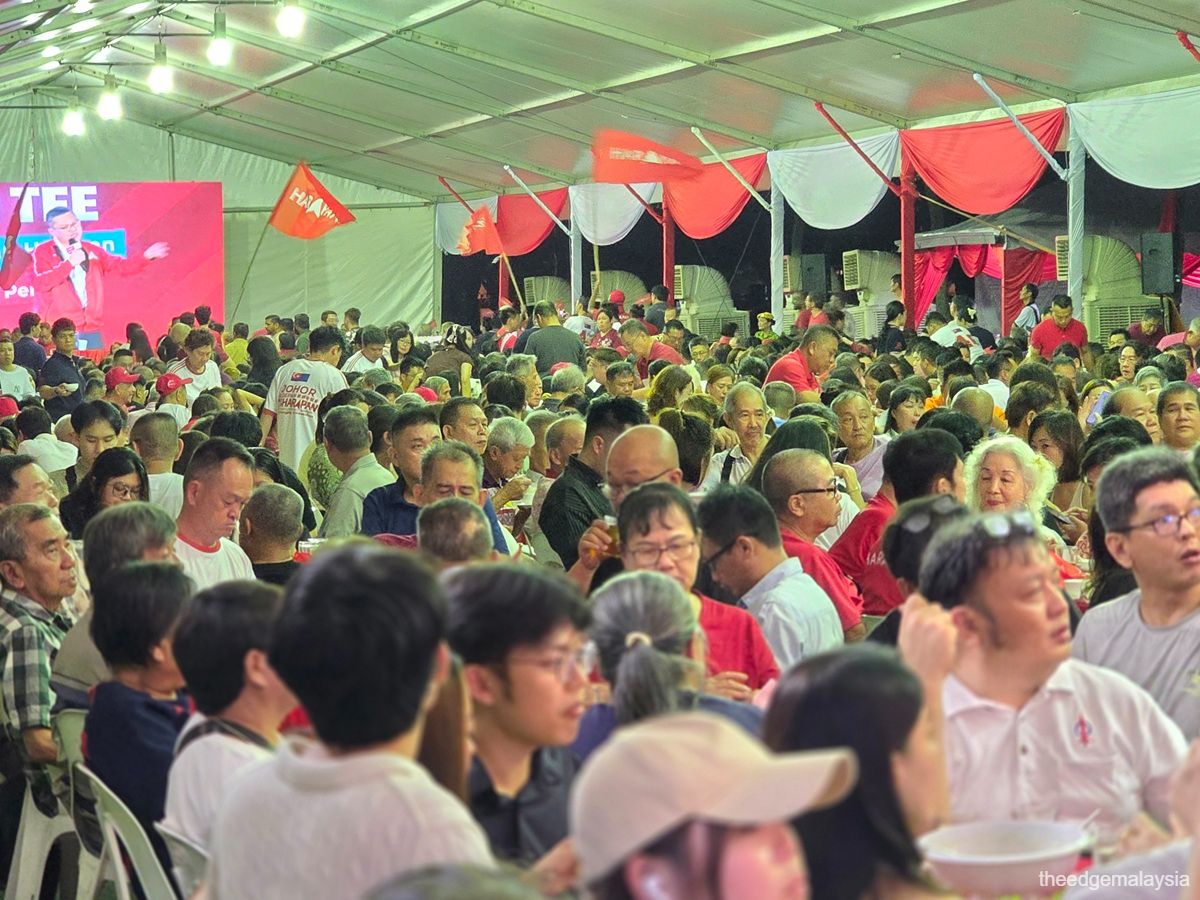
On Thursday alone, PH organised a few large-scale campaigns, one of it being at the Johor Jaya area, with around 20 large fancy tents erected across an entire street. Based on observations by The Edge, the audience was made up largely of older residents and local community members, with noticeably fewer younger voters.
Earlier in the first week of the campaign, The Edge's conversations with residents in a Chinese neighbourhood often ended with uncertainty, with some saying they had yet to decide whom to support, particularly following the emergence of Parti Bersama Malaysia (Bersama) as a new political alternative. But the narrative has somehow partly shifted.
"I don't know what people say in other areas because we are different. People may say this or that about DAP, but our community here still supports DAP," said a woman in her 60s who attended a Democratic Action Party (DAP) ceramah in a Chinese-majority constituency in Skudai. DAP is part of the party components in PH.
Even throughout the entire campaign, PH largely avoided attacking Deputy Prime Minister Datuk Seri Dr Ahmad Zahid Hamidi in his capacity as BN chairman and Umno president, choosing instead to focus its criticism on the Johor administration under Onn Hafiz.
PH leaders repeatedly challenged Onn Hafiz to debate former education minister Dr Maszlee Malik, the coalition's candidate for Puteri Wangsa.

The proposed debate went ahead without Onn Hafiz's participation and was instead held as a dialogue session with Maszlee, as BN leaders argued that there was little basis for a debate because the two politicians were contesting different seats.
Maszlee, meanwhile, consistently argued that turnout of between 80% and 90% would better reflect the people's mandate, saying higher participation would favour candidates who had genuinely served the public, rather than any particular political party.
BN trusts its machinery
Rather than compete with PH's nightly mega ceramah, BN instead just kept Onn Hafiz firmly at the centre of its messaging, with senior BN leaders repeatedly portraying him as the face of Johor's next generation of leadership.
BN spent much of its campaign on smaller programmes with party members, volunteers and local communities instead.
"Our reading is that turnout may not be as high as what Pakatan is hoping for," a BN official told The Edge during a Program Apa Khabar Siswa di Politeknik Ibrahim Sultan attended by Ahmad Zahid and Higher Education Minister Datuk Seri Dr Zambry Abdul Kadir. "We believe many young voters will still support BN."
At the same event, Ahmad Zahid also urged young voters to "jangan salah pilih, pilih yang muda", referring to Onn Hafiz, while arguing that another BN victory would preserve political stability in Johor and maintain close cooperation with the federal unity government.
Even when PH is campaigning against BN in Johor, at the same time governing in coalition with BN at the federal level. PH has consistently framed the election as an opportunity to align the Johor government more closely with Putrajaya, arguing that this would accelerate policy implementation and economic development.
Its leaders repeatedly pointed to major projects such as the Johor-Singapore Special Economic Zone (JS-SEZ), the Rapid Transit System (RTS) Link and the planned Autonomous Rapid Transit (ART) network as examples of the benefits of closer federal-state cooperation.
Beyond the campaign trail
Away from the competing narratives of stability, federal-state cooperation and political strategy, conversations with ordinary voters often returned to more immediate concerns.
Whether they supported BN, PH or remained undecided, many discussions centred on rising living costs, ageing infrastructure, worsening traffic congestion and whether Johor's rapid economic growth was translating into improvements in daily life.
In Tiram, where Malays account for about 56.4% of voters, followed by Chinese (24.4%), Indians (11.8%) and others (7.5%), several traders told The Edge that they were generally satisfied with BN's performance but questioned the coalition's decision to field a candidate who was not from the constituency and flagged the cost of living concerns.
"Raw material costs have increased and that has made things more difficult," one cendol seller said. "But the biggest issue here has always been the roads. There are too many potholes. Maybe the roads aren't built well enough, or maybe it's because so many heavy lorries use the industrial area every day."
Notably, large stretches of the Pasir Gudang Highway remain under construction in that area, while rows of BN, PH, Perikatan Nasional and Bersama flags compete for visibility along roads leading into industrial areas.
Tiram is among Johor's more closely watched contests due to Bersama presence. The seat is featuring a four-cornered fight involving BN's Abdul Halim Suleiman, PH's Nor Zulaila Abd Ghani, Bersama's Harith Fakhrudin Abdul Malek and Perikatan Nasional's Khirul Muntanazar Ismail.
Find out all you need to know about the 2026 Johor election here.