

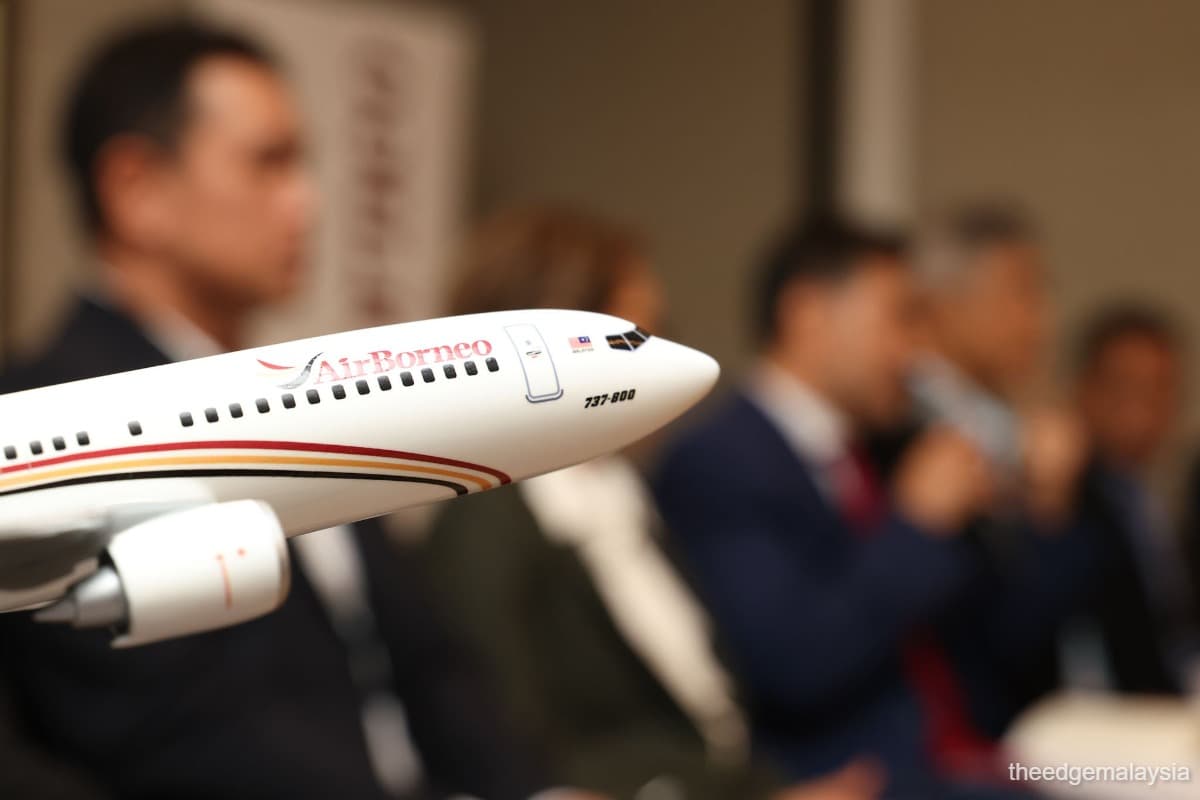
KUCHING (July 8): Sarawak-owned AirBorneo Airways will begin commercial jet operations on July 20, marking its expansion beyond rural air services (RAS) with flights connecting Kuching to Terminal 1 of the Kuala Lumpur International Airport (KLIA T1) and Singapore.
The carrier will initially operate two wet-leased Boeing 737-800 aircraft, offering twice-daily services between Kuching and KLIA T1, followed by a daily service to Singapore.
Introductory all-inclusive one-way economy fares between Kuching and Kuala Lumpur will start from RM375 for travel between July 21, 2026 and March 27, 2027.
Chief executive officer Megat Ardian Wira Mohd Aminuddin said the airline's jet operations will be conducted under an 18-month aircraft, crew, maintenance and insurance agreement running from July 2026 to December 2027.
"We are introducing two wet-leased 737-800 aircraft at the start. Progressively, we will add three more jets next year, bringing the fleet to five aircraft by the end of 2027," he told a media roundtable here on Wednesday.
From 2028, the airline plans to transition the five aircraft to dry leases, lowering leasing costs as it assumes responsibility for the crew and maintenance.
The fleet will continue expanding with one aircraft added every quarter, reaching nine jets by the end of 2028 and 17 aircraft by the end of 2030, he said.
Airport slots for the initial Kuala Lumpur and Singapore services have been secured from the aviation authorities in both countries.
"Two jets are essential for us to stabilise our operations. We enter the market, stabilise operations, gather customer feedback and assess market response," Megat Ardian said.
The airline's medium-term network strategy is to develop routes within a three- to five-hour flying radius from Sarawak, targeting regional destinations.
Megat Ardian said the RM375 introductory fare was determined after analysing ticket prices over the past six months, taking into account fuel price fluctuations and competitors' pricing.
"We also took last year's average low fares and benchmarked against all other local carriers on the route. RM375 sits within that range," he said. The fare includes airport taxes, checked baggage, meals and other standard services, reflecting AirBorneo's full-service carrier model.
_(1)_20260708130813_theedgemalaysia_1wlt13.jpg)
"We have already secured the air traffic rights from Singapore. The remaining step is to complete operational testing with Changi Airport, which is expected to be finalised soon. Once that process is complete, we will be in a position to announce a firm launch date for the Kuching and Singapore service and its fare."
The launch comes as AirBorneo works to improve operational reliability following delays and cancellations caused by maintenance issues affecting its ageing turboprop fleet. The airline currently operates 14 turboprop aircraft comprising eight ATR 72-500s and six DHC-6 Twin Otters serving rural air services across Sabah and Sarawak.
Megat Ardian attributed the disruptions partly to a global shortage of aircraft spare parts, saying the airline is working with suppliers and maintenance providers to accelerate the transfer of components and reduce aircraft downtime.
"We have to fix the aircraft quickly and return them to service. That's where reliability and faster turnaround during maintenance become critical," he said.
AirBorneo has placed a firm order for eight ATR 72-600 aircraft, with deliveries scheduled between 2027 and 2029. The new aircraft will replace the existing ATR 72-500 fleet on a one-for-one basis.
The airline is also reviewing its rural network by consolidating lightly patronised services while maintaining frequencies on high-demand routes. The changes are intended to free up aircraft for maintenance and improve schedule reliability.
"We have to fix it quickly for us to put it back on into the schedule. So that's where the service reliability comes in and fast turnaround when it undergoes checks," he said, noting that there is a global spares shortage out there.
"We are also starting off as an economic driver as well. So this is where we bring in passenger volumes. We create jobs with our multiplier effects and also we enable the trade. All of this in support of Sarawak's post-Covid-19 development strategy 2030," said Megat Ardian.
He added that the airline aims to become a commercially sustainable full-service carrier while supporting Sarawak's broader economic development agenda.
Besides improving connectivity within Borneo, the introduction of jet services is expected to strengthen international links, boost tourism and facilitate trade.
"We are an economic driver. We bring passenger volumes, create jobs through multiplier effects and enable trade," Megat Ardian said.
"Our role is to support Sarawak's post-Covid-19 development strategy 2030 by expanding connectivity and opening new international routes that strengthen tourism, business events and the state's digital and physical connectivity."
The Sarawak government completed its acquisition of MASwings Sdn Bhd from Malaysia Aviation Group Bhd in January and subsequently rebranded the carrier as AirBorneo.