

This article first appeared in The Edge Malaysia Weekly on July 6, 2026 - July 12, 2026
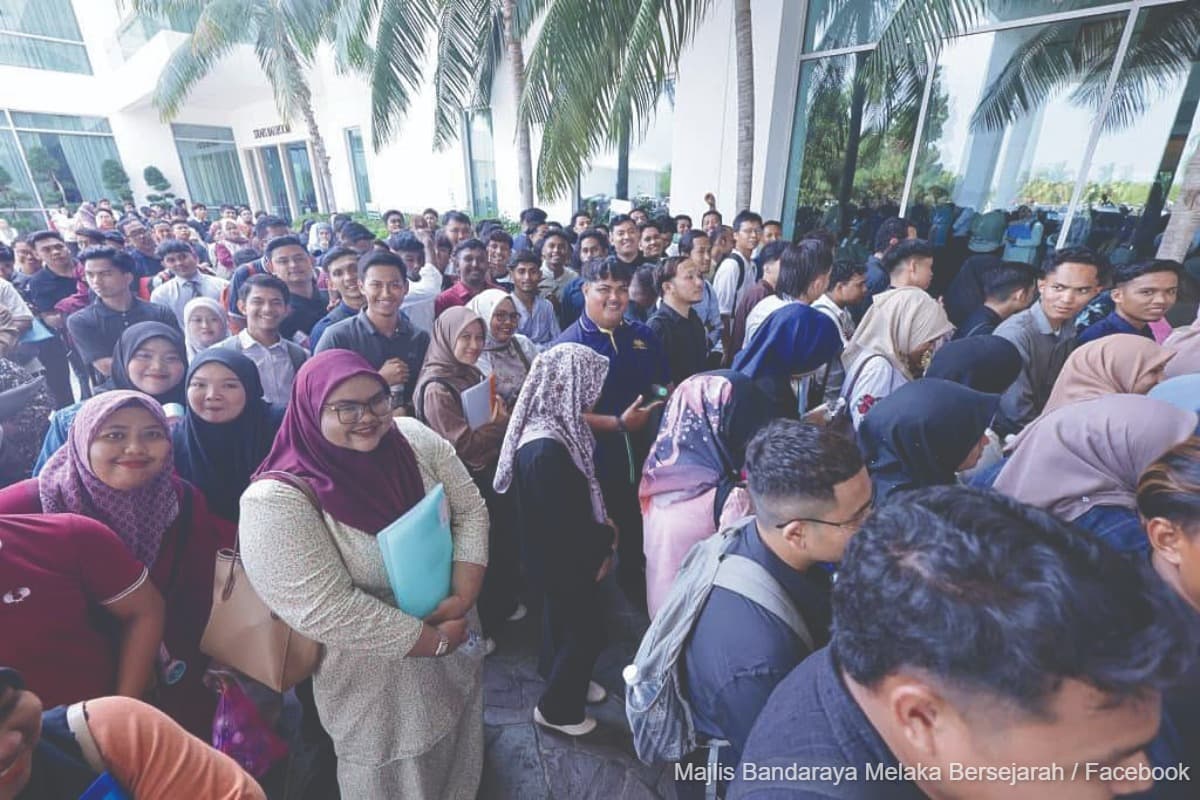
THE queue started forming before dawn that Sunday morning. By 5am on June 14, job seekers had begun gathering outside Holiday Inn Melaka — a waterfront hotel near Mahkota Parade in the city centre — hoping to secure one of the 500 new jobs at German semiconductor giant Infineon Technologies AG.
The roles of production operator and technician positions reportedly offered a starting salary of RM3,500 — double the minimum wage of RM1,700 per month.
Within a few hours, more than 1,000 people had turned up, with the line stretching nearly 2km along the road, under the hot sun. Pictures of the queue making its round on social media reached Melaka Chief Minister Datuk Seri Ab Rauf Yusoh and Mayor Datuk Shadan Othman, who both visited and distributed food and drinks to those waiting in line.
At a time when electrical and electronics (E&E) industry players still lament the persistent talent shortage, what does a 2km queue for semiconductor jobs really say about Malaysia’s labour market?
Industry executives say the picture may be more nuanced than it appears. While E&E firms continue to struggle to recruit experienced engineers and specialists in areas such as chip design, advanced packaging and wafer fabrication, there is still a strong supply of workers seeking better-paying opportunities at the operator and technician levels.
Rather than contradict the prevailing narrative on talent shortage, the long queue points to a mismatch in the labour market — where demand for highly skilled talent far exceeds supply, with the reverse true for lower-skilled workers.
A former business executive of a local outsourced semiconductor assembly and test (OSAT) firm says the strong turnout was not a surprise to him, given the attractive remuneration package on offer. At the operator level, salaries in the industry typically range from the high-RM1,000s to the mid-RM2,000s, although employees can earn up to around RM4,000 a month with overtime, he notes.
“From what I understand, Infineon is offering a starting salary of at least RM3,500 while complying with Responsible Business Alliance (RBA) standards on working hours and conditions, in addition to providing good Employees Provident Fund (EPF) benefits. This is a very compelling proposition in Melaka, which does not offer as many E&E employment opportunities as some other states such as Penang,” he tells The Edge.
He points out that many multinational corporations (MNCs) already have structured training programmes to equip technicians with machine repair and maintenance skills while technical and vocational education and training (TVET) programmes such as those offered by Penang Skills Development Centre (PSDC) also help develop such talent.
However, talent shortages are more acute at the skilled and critical levels.
He observes that areas such as automated test equipment (ATE), vision system design, machine-level programming, advanced packaging technologies, integrated circuit (IC) architecture design, wafer fabrication processes and thermal simulation, as well as graphics processing unit (GPU) and artificial intelligence (AI) accelerator testing, still have a limited talent pool. “As a result, companies often end up poaching talent from one another. Malaysian engineers are also highly sought after by companies in Singapore because they are already ‘industry-ready’.”
A business executive at a local chip design firm shares a similar view, saying the long queue was likely made up largely of technicians and operators, many of whom perform repetitive tasks.
“The more pressing shortage is in skilled talent. In our experience, this reflects a talent mismatch. We do receive a fair number of job applicants but many do not possess the required qualifications or expertise,” he says.
While recruitment drives at universities provide access to fresh graduates and junior talent, the bigger challenge lies in hiring intermediate and senior-level professionals, where shortages remain significant, he adds.
Meanwhile, a semiconductor industry veteran believes Infineon has effectively set a new benchmark for monthly salaries in Melaka. “By raising the salary ceiling for operators and technicians, the company has been able to attract the large number of workers it needs. In effect, Infineon is drawing talent from the existing labour pool.
“If employees can earn 50% more by moving to a company just down the road, many would naturally consider making the switch. Operators in the industry typically earn between RM1,700 and RM2,100 a month, so it is not surprising to see such strong interest,” he says.
Nevertheless, the industry veteran cautions against drawing overly broad conclusions from the episode. “Higher pay alone does not necessarily prove there is a talent mismatch, nor does it suggest that talent shortages do not exist. I do believe that Malaysia continues to face a talent mismatch issue, particularly at the higher-skilled end of the industry.”
A co-founder of a local semiconductor equipment firm says companies are constantly looking to build strong talent pipelines, particularly as many are ramping up production. “The large number of applicants queuing up is largely driven by Infineon’s immediate production ramp-up and demand for operators and technicians.
“For sustainable long-term growth, however, companies need quality talent that can contribute to innovation and business expansion, alongside technicians and engineers who are required to support production growth,” he says.
The executive agrees that there is a talent mismatch in the industry, adding that the RM3,500 starting salary is likely a new benchmark in Melaka for technicians and operators, rather than engineering graduates.
“Talent shortages persist across the entire hierarchy, especially for skilled engineers and experienced technicians. Many of those queuing for jobs are likely lower-skilled workers seeking better-paying opportunities. I would not be surprised if many of them are already employed and are simply looking for a more attractive offer,” he says.
Notably, global semiconductor company Texas Instruments operates two state-of-the-art assembly and test factories in Melaka, which churn out billions of chips every year. With a potential investment of up to RM5 billion over time, the new second factory is expected to support up to 500 local jobs when fully operational.
However, it should be noted that there is no indication that Infineon’s recent hiring exercise is linked to any movement of workers from Texas Instruments.
A tale of two queues, which one is more worrying?
The competition for human talent is further intensified by the continued outflow of Malaysians to Singapore. In January, it was reported that 61,116 Malaysians relinquished their citizenship over the past five years, averaging about 10,000 people annually.
“Singapore has been a major draw for Malaysian fresh graduates and young professionals because of the better pay and career opportunities available there. I think the long queue at the High Commission does reflect the strong pull that Singapore continues to have on Malaysian talent.
“From Malaysia’s perspective, this raises concerns about the continued outflow of human capital, especially at a time when the country is trying to move up the semiconductor value chain and develop more high-skilled talent,” says a contact who recently witnessed a queue of people renouncing their Malaysian citizenship at the High Commission of Malaysia in the island state.
In any case, the long queue at Infineon’s open recruitment exercise in Melaka has raised questions over whether such turnout levels are really unusual in a single hiring event.
Some corporate observers say the length of the queue has prompted scrutiny of whether the situation reflected strong interest in the employer or instead pointed to shortcomings in the management of the interview process. After all, on a purely numerical basis, the exercise implies roughly two applicants for every available position, raising questions on whether such attendance was anticipated in advance and how recruitment capacity was calibrated.
This has also led to wider queries on whether the scale of the turnout should have been better expected given the sizeable number of vacancies and whether the on-site arrangements were sufficient to handle such volumes without job-seekers queueing under the hot sun. The visible crowding has further prompted questions on whether the episode indicates an isolated case of recruitment congestion or something more systemic in the way large-scale hiring exercises are conducted in the sector.
“The turnout was significantly higher than expected, far exceeding previous sessions. While this reflects strong interest in opportunities with Infineon, it also created challenges in managing the large crowd,” Infineon told The Edge in a written reply.
“Despite the availability of QR code submissions for applications, a large number of candidates opted to remain in line for on-site interviews. We acted immediately, supported by hotel staff and local authorities, to distribute drinking water, arrange safer queuing areas and increase interview capacity to accelerate the interview process.
“Infineon remains committed to treating all candidates with professionalism, respect and care. We will implement improvements to ensure a better experience moving forward.”
Labour market realities occurring simultaneously
Samirul Ariff Othman, an adjunct lecturer at Universiti Teknologi PETRONAS and a senior consultant with Global Asia Consulting, says policymakers should not see the long queue as evidence of Malaysia suddenly having an oversupply of semiconductor talent.
“It is entirely possible for Malaysia to face shortages of experienced semiconductor professionals while simultaneously having large numbers of applicants competing for entry-level manufacturing positions.
“Economists describe this as a qualitative labour mismatch, where the number of available workers is not the primary issue. Rather, the skills, experience and qualifications of available workers do not perfectly match employers’ requirements,” he explains.
Samirul reckons that the queue probably says more about the higher salaries on offer than about a shortage of jobs. “When one employer offers a superior combination of wages, allowances, overtime opportunities, job security and career progression, applications become concentrated. The queue therefore reflects relative attractiveness rather than simply weak labour demand.”
He also acknowledges that many Malaysians increasingly perceive employment in established multinational semiconductor firms as offering stronger long-term career prospects than employment in many traditional manufacturing sectors.
“Media reports indicated starting salaries of around RM3,500 for certain positions, which is competitive for operator and technician roles in many parts of Malaysia. Combined with shift allowances, overtime and employee benefits, the total compensation package becomes even more attractive.
“Large MNCs seldom recruit 400 to 500 production employees in a single exercise. Such recruitment exercises create a perception of unusually high hiring probability,” he says.
According to him, job applicants often reason that “If hundreds of positions are available, my chances of success are better than applying for one or two vacancies online” and this naturally encourages a larger pool of applicants.
In short, says Samirul, the long queue should not be interpreted as disproving the semiconductor talent shortage. Instead, it demonstrates that labour supply exists but the composition of skills does not yet fully align with the evolving demands of Malaysia’s high-value semiconductor ecosystem.
“This distinction is crucial for policymakers seeking to move Malaysia further up the global semiconductor value chain,” he says.
60,000 talents under NSS
To recap, the Malaysian government had in 2024 set a target to train and upskill 60,000 high-skilled local engineers in the next five years under the National Semiconductor Strategy (NSS). About RM1.2 billion has been allocated for this initiative.
In Penang, initiatives such as Penang Silicon Design @5KM+ serve as localised accelerators to nurture IC design companies, supported by technology collaborators within a concentrated innovation ecosystem.
The initiative brings together start-ups, industry, academia and government to foster collaboration, accelerate innovation and strengthen Malaysia’s chip design capabilities while cultivating more local IC design champions. It also supports companies across the value chain — from front-end design to new product introduction — through mentorship and hybrid office infrastructure.
To complement this effort, the Penang Chip Design Academy delivers structured mastery training and advanced upskilling programmes to develop industry-ready IC design engineers and expand the talent pipeline critical to the sector’s long-term success.
Meanwhile, ViTrox Corp Bhd (KL:VITROX) has set up ViTrox Academy, ViTrox College and the V-Makerspace to bridge the gap between education and industry.
Since 2022, the Penang-based ATE firm has hosted at least 12,000 primary and secondary school students at its campus in Batu Kawan for hands-on science, technology, engineering and mathematics (STEM) activities and engineering workshops.
ViTrox has also trained hundreds of Sijil Pelajaran Malaysia school leavers who are now working in the semiconductor sector or pursuing Technical and Vocational Education and Training (TVET) or engineering diplomas.
Besides, ViTrox is also collaborating with Universiti Sains Malaysia (USM). Engineering and computer science degree students will study at its campus and walk a few steps into real research and development (R&D) labs and manufacturing floors to apply what they learn.
Still, the pool of wafer fabrication companies in Malaysia remains relatively small, making skilled and experienced wafer fabrication engineers highly sought after whenever new investments are announced, both locally and across the region.
Demand for wafer fabrication engineers is expected to track the expansion of domestic players as well as new wafer fabrication investments entering the country. Today, job demand in this segment is likely to remain closely tied to the pace of industry expansion.
Save by subscribing to us for your print and/or digital copy.
P/S: The Edge is also available on Apple's App Store and Android's Google Play.