


This article first appeared in Capital, The Edge Malaysia Weekly on July 6, 2026 - July 12, 2026
BANKS, utilities, construction and data centre-linked companies are expected to lead Bursa Malaysia into the second half of 2026, as investors pivot towards sectors with clearer earnings visibility, resilient domestic demand and tangible exposure to the country’s infrastructure and digital investment pipeline, market strategists say.
With global interest rate uncertainty, ringgit volatility and foreign-flow pressure likely to keep sentiment uneven, the market’s next leg is expected to favour financials with potential for stronger shareholder returns. Rather than a broad-based rally, defensive power and telco names, as well as selected beneficiaries of data centre, renewable energy and supply chain relocation spending, are also expected to see momentum.
AmInvestment Bank head of equity research Paul Yap tells The Edge he is positive on Malaysian banks.
“We remain constructive on Malaysian banks, supported by undemanding valuations and the potential for enhanced capital management initiatives, which align well with the government’s MY Value Up programme aimed at improving shareholder returns and market attractiveness.”
Banks are expected to benefit from stable funding costs, loan growth and dividend visibility if Bank Negara Malaysia keeps the Overnight Policy Rate unchanged at 2.75%. Real estate investment trusts (REITs), utilities and telcos could also remain in favour for their yield and recurring earnings.
MBSB Research head Imran Yassin Yusof says investors should have a defensive core of utilities, telcos, banks, consumer staples and selected REITs while maintaining selective growth/recovery exposure to construction, data centre beneficiaries, renewable energy (RE), technology and chemicals.
“Investors should avoid chasing momentum blindly. The environment is still uncertain, with US rate risk, ringgit volatility and foreign-flow pressure,” he says.
The local market has a reasonably constructive domestic backdrop, but investors should not expect a repeat of the broad-based recovery seen in late 2025 and early 2026, when easing inflation, expectations of a US Federal Reserve pivot and improving domestic growth sentiment lifted most sectors, the market strategists caution.
Tradeview Capital chief investment officer Nixon Wong says gains in the second half are likely to be more selective and driven by earnings rather than valuation expansion. “Malaysia’s relatively contained inflation, healthy labour market and ongoing investment flows into infrastructure and industrial projects remain supportive factors, although external volatility will continue to cap market upside.”
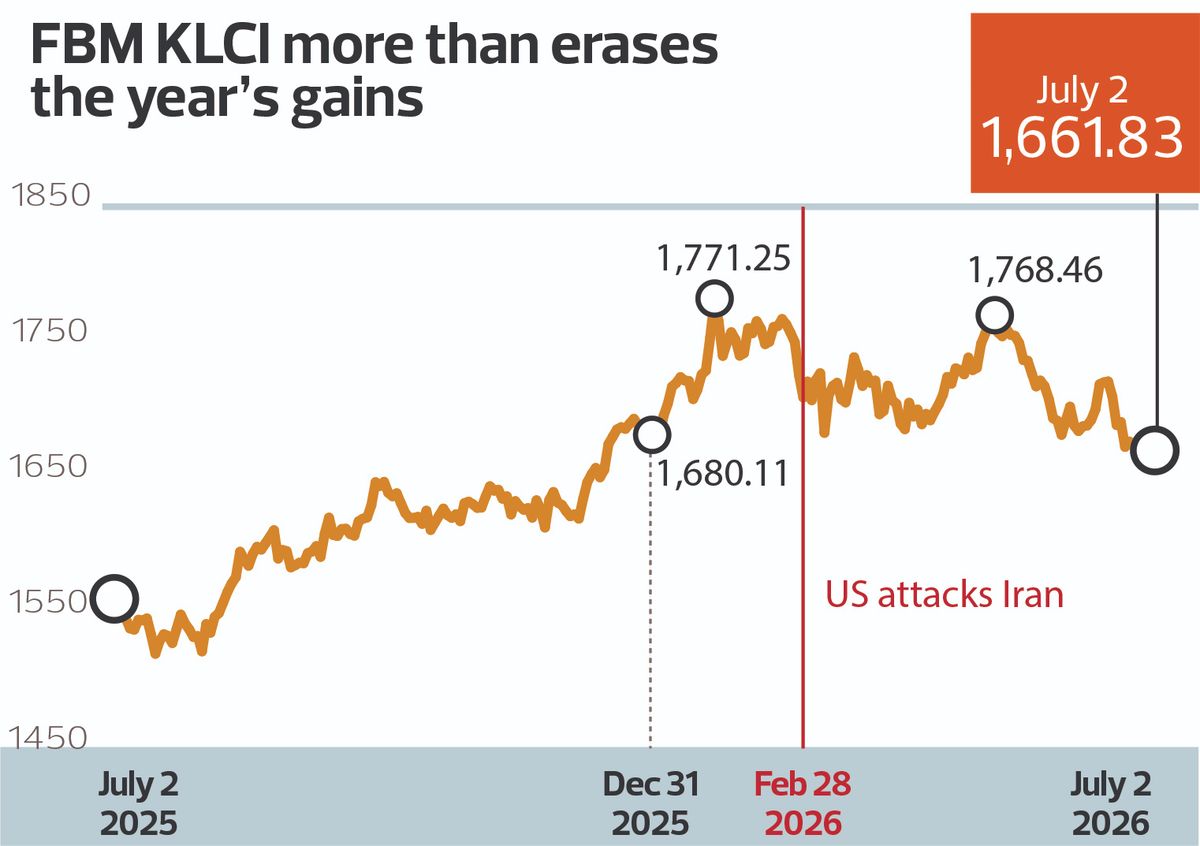
The FBM KLCI closed at 1,656.83 points last Thursday.
The market entered 2026 with support from easing tariff uncertainty, rate-cut expectations and an inflow of investments linked to renewable energy and artificial intelligence (AI). Geopolitical tensions in the Middle East later tested sentiment, but the benchmark index remained resilient, rebounding to as high as 1,768.46 points on May 7, a shade lower than the year’s peak of 1,771.25 points on Jan 21 before the war broke out. However, it is down 1.09% year to date.
Imran expects the market to begin the second half on a volatile note as investors weigh the risk of a more hawkish Fed, continued pressure on the ringgit and foreign fund outflows. Still, he expects it to recover later in the year if the US central bank’s policy stance does not turn into a prolonged tightening cycle.
MBSB’s revised 2026 targets are 1,770 points for the FBM KLCI, 12,900 points for the FBM Emas Shariah and 18,600 points for the FBM70.
Similarly, AmInvestment Bank and Maybank are constructive on the market. AmInvestment Bank maintains its year-end target for the FBM KLCI at 1,900 points and Maybank has a year-end target of 1,750.
Meanwhile, Rakuten Trade, having warned of a potential “perfect storm” in global financial markets as mounting US debt, rising Japanese bond yields and a weaker US dollar trend threaten to rattle investors, revised its KLCI target downwards to 1,770 from 1,800.
Winners and losers in first half
Technology, construction, banking and utilities broadly met expectations in the first half, according to the market strategists.
Technology was the strongest performer during the period, with the Bursa Malaysia Technology Index reaching a year-to-date peak of 75.33 points last Wednesday, its highest level since August 2024, on renewed interest in AI and semiconductor demand. Construction was supported by infrastructure and data centre projects, utilities by defensive earnings and rising power demand, and banks by stable asset quality and loan growth.
The weaker sectors were export-oriented manufacturers, which faced softer global demand conditions and currency-related uncertainty. Similarly, certain consumer discretionary players saw positive but uneven spending growth in a higher-cost environment.
Oil and gas, energy, petrochemicals, healthcare and some defensive yield plays also disappointed. Commodity-linked sectors initially helped cushion the market during the Middle East conflict, but energy and petrochemical stocks later came under pressure as investors became concerned about demand conditions, costs and volatility.
Look out for earnings visibility amid AI/tech play
The sharp reversal in global technology fund flows in late June has raised a familiar question — whether the pullback was merely a short-term de-risking move, or the start of a rotation away from expensive AI-related equities.
According to LSEG Lipper data, global technology sector funds recorded US$17.83 billion (RM72.75 billion) in net outflows in the week ended June 24, reversing the US$21.5 billion inflow in the previous week. The reversal came as investors reassessed stretched valuations and debt-funded spending by major technology companies, while concern over US interest rates also weighed on long-duration growth stocks.
The market strategists do not see this as a rejection of the AI investment theme. Instead, they view it as a reset in which investors are becoming more discerning about valuation, earnings visibility and the ability to monetise AI-related investments.
“The long-term AI structural story remains intact, but investors are becoming increasingly selective after years of strong performance among mega-cap technology companies,” Tradeview’s Wong says.
He says Malaysia could benefit because it offers exposure to semiconductor and industrial supply chains, as well as data centre, power infrastructure and manufacturing investment.
“Rather than pure AI plays, Malaysian beneficiaries are likely to be the ‘picks and shovels’ providers, in areas such as utilities, industrial parks, construction firms and selected semiconductor companies,” he adds.
Malaysia’s AI exposure lies in semiconductor names such as Inari Amertron Bhd (KL:INARI), and in the infrastructure supporting data centre expansion, including power, renewables, construction, industrial land and digital connectivity, says Wong.
Utilities, power infrastructure providers, construction companies, renewable energy players and telcos stand to benefit if capital expenditure in data centres and cloud infrastructure continues. MBSB’s Imran highlights Tenaga Nasional Bhd (KL:TENAGA), YTL Power International Bhd (KL:YTLPOWR), Gamuda Bhd (KL:GAMUDA), Sunway Construction Group Bhd (KL:SUNCON), Pekat Group Bhd (KL:PEKAT), Samaiden Group Bhd (KL:SAMAIDEN) and Telekom Malaysia Bhd (KL:TM) as among the beneficiaries.
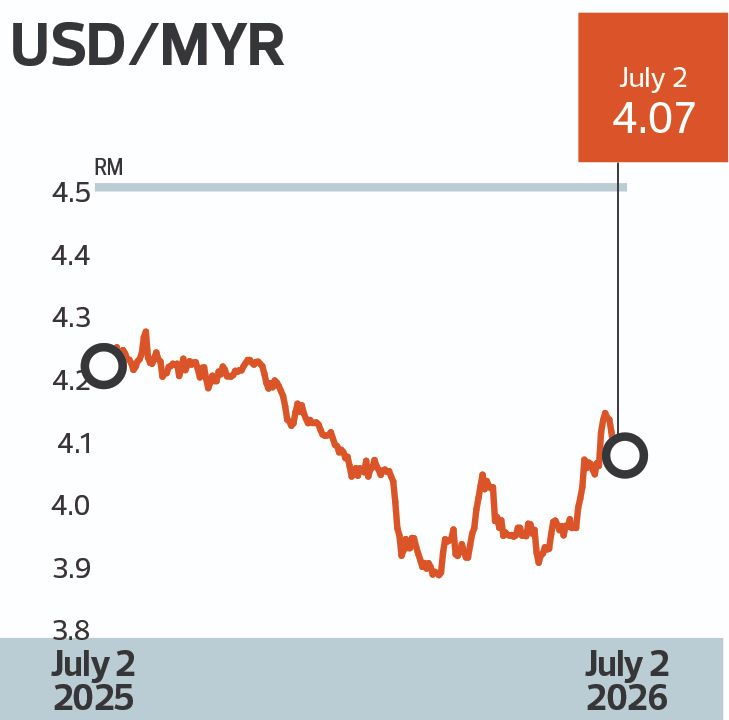
Weaker ringgit against greenback
The ringgit’s recent swings and the prospect of higher-for-longer US interest rates have placed foreign fund flows back at the centre of the market outlook.
The ringgit had strengthened to 3.8895 against the US dollar just before the US attacked Iran but had progressively weakened to 4.0805 by last Thursday.
On June 17, the US Federal Open Market Committee left the federal funds target range unchanged at 3.50%-3.75%, saying economic activity was still “expanding at a solid pace”, although uncertainty remained elevated.
For Bursa, higher US yields could continue to pull capital towards American fixed-income assets, while a stronger US dollar could pressure emerging-market currencies, including the ringgit.
Tradeview’s Wong says the capital flight to the US might cap Bursa’s valuations even if domestic fundamentals remain sound.
Companies with significant US dollar debt may face higher financing costs. Wong argues, however, that Malaysia remains relatively well-positioned because inflation — at 2% year on year in May — is manageable, the banking system remains stable and investment commitments in manufacturing, infrastructure and digital sectors are ongoing.
He also expects large domestic institutional investors to remain an important stabilising force for the local equity market.
A stronger ringgit would support consumer, aviation, transport, automotive, healthcare, manufacturing and media companies by lowering US dollar-linked costs such as imported inputs, fuel, aircraft leases, medical supplies and content.
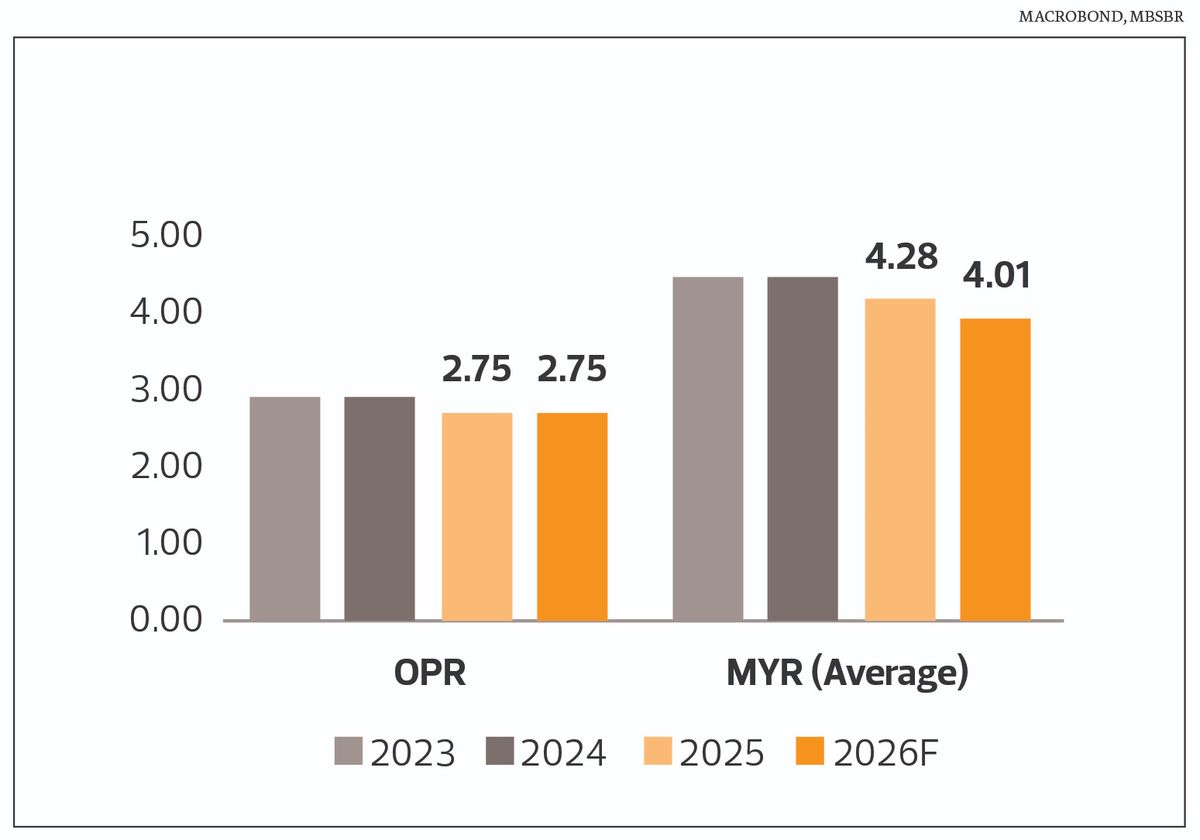
If ringgit volatility persists, Imran would prefer companies with domestic revenue, recurring demand and defensive earnings. Utilities, telcos, banks, consumer staples and value retailers fit that profile, while selected exporters and technology companies with US dollar revenue may offer a partial natural hedge.
State elections not expected to have major impact
Johor’s state elections on July 11 will be watched by investors not just due to the fact that the state has become a focal point for industrial, property, logistics and data centre investments of late but also because the outcome could set the tone for the Aug 1 state polls in Negeri Sembilan as well as the political climate at the national level.
Construction companies, Johor-based property developers, industrial park operators, utilities, water-related companies and data centre ecosystem players could see short-term sentiment shifts as the polls approach.
Tradeview’s Wong says, however, that the market is likely to be more focused on policy continuity and project execution than on the election itself.
“Short-term volatility around elections is not uncommon, especially for sectors directly linked to government spending and infrastructure. However, if investors perceive that major economic policies like NIMP 2030 (New Industrial Master Plan 2030), JS-SEZ (Johor-Singapore Special Economic Zone) and the AI infra rollout remain intact, the impact on the broader market is typically limited and temporary.”
The larger concern for investors is whether the investment pipeline in Johor remains intact, particularly for the JS-SEZ, industrial projects, infrastructure investment and AI-related development.
Market strategists point out that the Fed’s call, ringgit and foreign flows, oil prices and global risk appetite are likely to have a greater influence on Bursa than the election itself. Politics may affect sentiment in the short term, but policy certainty and execution will determine whether Johor’s investment story continues to attract capital.
For investors, the second half is likely to reward discipline over momentum. A defensive core in banks, utilities, telcos, consumer staples and selected REITs could provide earnings and dividend support, while selective exposure to construction, data centre infrastructure, renewable energy and technology offers participation in longer-term growth themes.
Save by subscribing to us for your print and/or digital copy.
P/S: The Edge is also available on Apple's App Store and Android's Google Play.